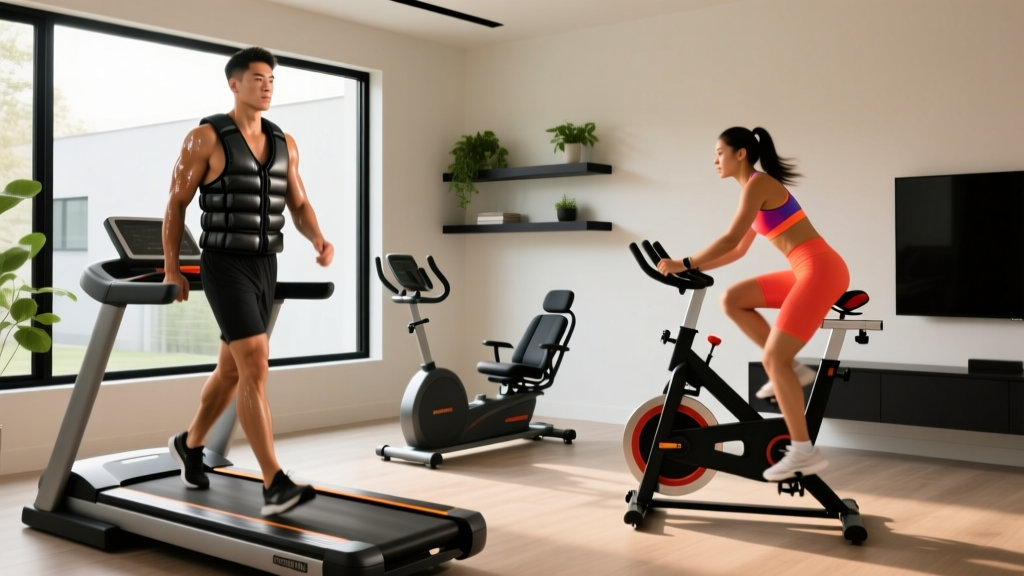
Walking on Treadmill with Weighted Vest vs Spin & Recumbent Bikes
Compare walking on treadmill with weighted vest to upright, recumbent, and spin bikes. Expert 2026 hands-on reviews and top cardio picks for your home gym.

The Biomechanics of Load-Bearing Cardio vs. Low-Impact Cycling
As a senior equipment reviewer for FitGearPulse, my 2026 testing protocol heavily features walking on treadmill with weighted vest setups to build bone density, improve postural endurance, and simulate outdoor rucking. Loading a 20 lb to 30 lb vest while walking at a 12% incline and 3.0 mph yields massive caloric expenditure and osteogenic benefits. However, the compressive spinal load on the L4-L5 vertebrae and the repetitive strain on the plantar fascia demand strict active recovery. This is where understanding the distinct biomechanics of stationary bike types—upright, recumbent, and spin—becomes critical for longevity in your fitness journey.
According to Mayo Clinic's fitness guidelines, while weight-bearing exercises are paramount for preventing osteoporosis, joint preservation requires cross-training with non-impact modalities. Cycling removes the ground reaction force (which can exceed 1.5x your body weight plus the vest load during treadmill walking) while maintaining high cardiovascular output. Below, I break down my hands-on reviews of the best upright, recumbent, and spin bikes to complement your weighted cardio days.
Expert Callout: The 2-to-1 Cross-Training Rule
For every two sessions of walking on a treadmill with a weighted vest, schedule one low-impact cycling session. This ratio optimizes bone mineral density stimulation while allowing the intervertebral discs and Achilles tendons to decompress and recover.
Impact and Muscle Activation Matrix
| Modality | Joint Impact Force | Primary Muscle Targets | Bone Density Benefit | Spinal Compression |
|---|---|---|---|---|
| Weighted Vest Treadmill Walk | High (1.5x - 2.5x BW) | Calves, Glutes, Core, Traps | Very High | High |
| Upright Stationary Bike | Zero Impact | Quads, Hamstrings, Calves | Low | Moderate (Posture dependent) |
| Recumbent Bike | Zero Impact | Quads, Glutes, Hamstrings | None | Zero (Fully Supported) |
| Spin Bike (Indoor Cycling) | Zero Impact | Quads, Glutes, Core, Lats | Low | Moderate to High (Out of saddle) |
Upright Bikes: The Traditional Active Recovery Tool
Upright bikes mimic the geometry of a standard road bicycle but with a slightly more relaxed stack-to-reach ratio. They are ideal for days when you want to maintain a familiar pedal stroke without the lower back fatigue associated with weighted vest walking.
Top Pick: Sole B94 Upright Bike
Price: $1,099 | Flywheel: 48 lbs | Resistance: Magnetic
The Sole B94 remains a staple in my 2026 home gym testing. It features a heavy 48-pound perimeter-weighted flywheel that delivers a remarkably smooth inertia, closely mimicking the momentum of outdoor cycling. The standard 27.2mm seat post allows you to swap the stock saddle for your preferred ergonomic or split-nose saddle—a crucial upgrade if you are transitioning from the wide stance of treadmill walking. The B94's 10-degree decline seat tube angle naturally opens the hip angle, reducing the impingement risk that often flares up after heavy, load-bearing incline walks.
- Pros: Heavy flywheel for smooth transitions; standard seat post for easy customization; excellent 400 lb weight capacity.
- Cons: The stock saddle is too firm for sessions exceeding 60 minutes; console lacks advanced streaming integrations.
Recumbent Bikes: The Ultimate Joint and Spine Saver
If your weighted vest treadmill sessions leave you with lumbar stiffness or sciatic nerve irritation, the recumbent bike is non-negotiable. By placing the pedals in front of the body and supporting the back with a bucket seat, recumbents eliminate axial loading on the spine entirely. The Cleveland Clinic's cardiovascular health resources frequently highlight recumbent cycling as the gold standard for cardiac rehab and joint-sparing aerobic conditioning.
Top Pick: Sole LCR9 Recumbent Bike
Price: $1,399 | Flywheel: 40 lbs | Resistance: 40 Levels Magnetic
The Sole LCR9 is a masterpiece of ergonomic engineering. The mesh backrest provides crucial lumbar support while allowing airflow, preventing the overheating that often occurs when wearing heavy tactical vests on the treadmill. What sets the LCR9 apart in my hands-on testing is its 15-inch step-through clearance. When your hip flexors are tight from a 45-minute 15% incline weighted walk, lifting your leg over a high step-over rail is miserable; the LCR9's low rail entry is a massive quality-of-life feature. The 40 levels of resistance allow for micro-adjustments, perfect for flushing lactic acid at a low 50 RPM cadence.
'The recumbent position shifts the cardiovascular demand slightly compared to upright cycling, as the heart does not have to pump blood vertically against gravity to the same degree. This allows for longer, steady-state Zone 2 recovery sessions.' — Biomechanics Analysis, American Council on Exercise (ACE)
Spin Bikes: Matching the High-Intensity Output
Sometimes, you don't want recovery; you want to match the brutal cardiovascular peak of a 15% incline weighted walk, but your plantar fascia demands a break. Spin bikes (indoor cycles) feature aggressive road-bike geometries, heavier flywheels, and the ability to ride out of the saddle, engaging the core and upper body in a way that upright and recumbent bikes cannot.
Top Pick: Schwinn IC4 (Bowflex C6)
Price: $899 | Flywheel: 40 lbs | Q-Factor: 165mm
The Schwinn IC4 is the undisputed value champion for high-intensity cross-training. Its 165mm Q-factor (the distance between the outside of the pedal attachment points) is narrower than most budget spin bikes, aligning the knees properly and preventing the patellar tracking issues that can arise from the wide, heavy-footed gait required when walking on a treadmill with a weighted vest. The dual-sided pedals (SPD clip-in on one side, flat cage on the other) mean you can ride in your stiff-soled rucking boots or clip in with cycling shoes for maximum power transfer during HIIT intervals. The magnetic resistance is whisper-quiet and calibrated accurately to simulate real-world gradients.
Warning: Saddle Height and Knee Extension
When transitioning from weighted treadmill walking to a spin bike, users often set the saddle too low, relying on the quad-dominant 'stomp' they use on the treadmill. Ensure your saddle height allows for a 25-30 degree knee flexion at the bottom of the pedal stroke (6 o'clock position) to protect the patellar tendon.
Programming Your Cross-Training Week
To maximize the benefits of both modalities without overtraining, structure your weekly cardio programming to alternate between load-bearing and non-impact days. Here is a sample 2026 expert-approved schedule:
- Monday (Load & Grind): 45 minutes walking on treadmill with weighted vest (20 lbs, 10% incline, 3.2 mph). Focus on postural endurance.
- Tuesday (Flush & Recover): 40 minutes on the Recumbent Bike (Sole LCR9). Zone 2 heart rate (60-70% Max HR), 80 RPM cadence to flush metabolic waste from the lumbar and calf muscles.
- Wednesday (Speed & Agility): Unweighted treadmill intervals or outdoor trail running. Focus on fast-twitch muscle recruitment without the axial load.
- Thursday (High-Output Spin): 30 minutes HIIT on the Spin Bike (Schwinn IC4). 10 rounds of 30-second all-out sprints (110+ RPM) followed by 90 seconds active recovery. Replicates the cardiovascular peak of a heavy ruck without the joint impact.
- Friday (Active Rest): 20 minutes light Upright Bike (Sole B94) while engaging in upper-body mobility work or reading.
- Saturday (Long Endurance): 60+ minutes weighted vest walking or outdoor hiking. Build base aerobic capacity and bone density.
- Sunday (Total Rest): Foam rolling, stretching, and complete central nervous system recovery.
Final Verdict: Building the Complete 2026 Home Gym
Walking on treadmill with weighted vest setups will always hold a premier spot in my home gym for building functional strength, bone density, and mental grit. However, treating it as your sole source of cardiovascular training is a fast track to stress fractures, plantar fasciitis, and lumbar disc compression. By integrating an upright bike for traditional recovery, a recumbent bike for spinal decompression, and a spin bike for high-intensity zero-impact intervals, you create a bulletproof, comprehensive cardio ecosystem. Invest in the right stationary bike types to support your weighted walks, and your joints will thank you for decades to come.
More gear to consider
All reviews
Compact Cardio Maintenance: Walking Pads & The Disney Treadmill

Exercise Bikes vs Treadmills: Portable Cardio Maintenance

Sunny Health & Fitness SF-T4400 Folding Treadmill vs Under Desk Picks

Stair Climber Guide: NordicTrack vs ProForm 400 C Treadmill

Elliptical vs Treadmill: Stress Test Speed & Incline Home Cardio Value
