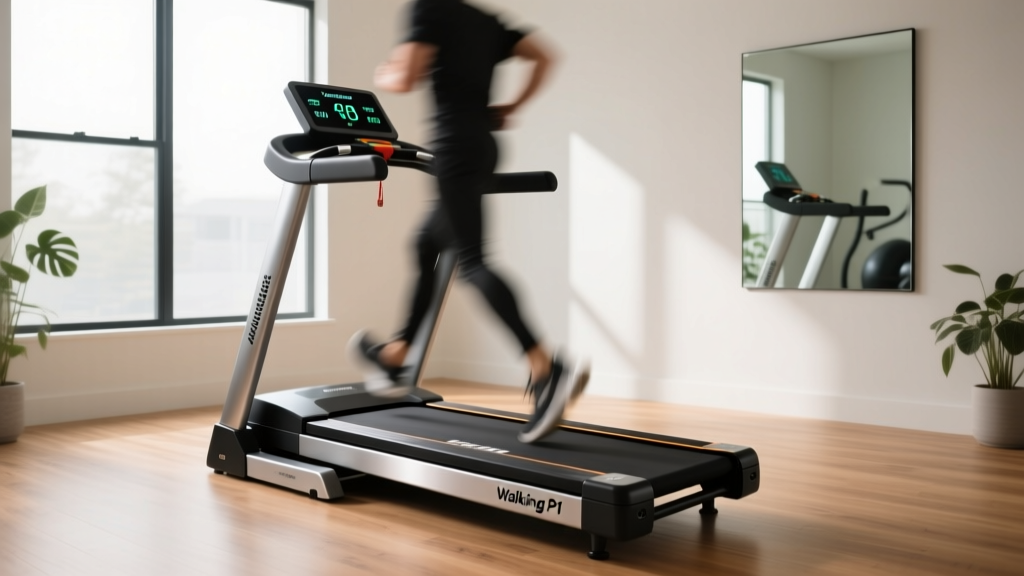
WalkingPad P1 Folding Treadmill: 2026 Budget Analysis
Is the WalkingPad P1 folding treadmill worth the investment? We break down 2026 pricing, hidden costs, and ROI versus other compact portable cardio gear.

The True Cost of Compact Cardio: Why the WalkingPad P1 Stands Out
The shift toward remote and hybrid work models has permanently altered how we approach daily movement. According to the Centers for Disease Control and Prevention (CDC), adults need at least 150 minutes of moderate-intensity aerobic activity weekly, a metric that sedentary home-office setups severely compromise. This has triggered a massive surge in demand for compact portable cardio equipment options. Among these, the Kingsmith WalkingPad P1 folding treadmill has emerged as a premium contender, famous for its 180-degree hinge fold. But does its premium price tag translate to genuine long-term value, or are you just paying for a clever hinge mechanism?
In this comprehensive 2026 budget breakdown and value analysis, we dissect the actual cost of owning the WalkingPad P1. We will compare it against alternative portable cardio machines, calculate the real-world cost-per-use, and expose the mechanical edge cases that budget-conscious buyers must consider before swiping their credit cards.
WalkingPad P1 Quick Specs & 2026 Pricing
- Base Retail Price: $429 - $459 (Fluctuates based on seasonal sales)
- Motor: 1.25 HP Continuous Duty (2.5 HP Peak)
- Speed Range: 0.5 mph to 6.0 mph
- Running Area: 47.2" L x 17.3" W
- Folded Dimensions: 32.5" x 21.5" x 6.1" (Slides under most standard sofas)
- Unit Weight: 62 lbs
- Max User Capacity: 240 lbs
WalkingPad P1: Hidden Costs and Maintenance Budgeting
When evaluating the WalkingPad P1 folding treadmill, the $450 upfront cost is just the entry fee. To accurately assess value, we must factor in the hidden costs of ownership over a standard 3-year lifecycle.
1. Shipping and Relocation
At 62 lbs, the P1 is dense. While it features front transport wheels, moving it up a flight of stairs or across thick carpet requires significant effort. If you live in a multi-story home, budget for a two-person lift to avoid damaging the internal hinge alignment during transport.
2. Consumables: Lubrication and Belt Care
Unlike commercial gym treadmills with wax-infused belts, the P1 requires manual silicone lubrication. WalkingPad recommends lubricating the deck every 30 to 45 miles of use. A bottle of 100% silicone treadmill lubricant costs about $12 and lasts roughly a year for moderate users. Over three years, add $36 to your total cost of ownership.
3. Replacement Parts
The 17.3-inch wide running belt is highly specific. If you develop a gait asymmetry and wear down the belt edge, a replacement belt and deck kit will cost between $65 and $85 directly from the manufacturer, plus shipping. Factor in a potential $80 maintenance reserve over the machine's lifespan.
Value Matrix: WalkingPad P1 vs. Alternative Portable Cardio
To understand the P1's market position, we must compare it against other compact portable cardio equipment options available in 2026. Below is a direct value comparison matrix.
| Equipment Type & Model | Avg. Price | Footprint (In Use) | Noise Level | Primary Limitation |
|---|---|---|---|---|
| WalkingPad P1 Folding Treadmill | $449 | 55" x 21.5" | Low (65 dB) | Narrow belt width |
| UREVO Under-Desk Treadmill (UTLM002) | $189 | 48" x 19" | Medium (72 dB) | No handrail; max 3.5 mph |
| Sunny Health & Fitness Mini Stepper (SF-S0978) | $75 | 16" x 13" | Medium (Squeaks over time) | High joint impact; cylinder failure |
| XTERRA Fitness FB150 Folding Bike | $199 | 33" x 18" | Very Low (Magnetic) | Bulky when folded; seat discomfort |
The Under-Desk Alternative: UREVO UTLM002
At $189, the UREVO under-desk treadmill is less than half the price of the P1. However, it lacks a handrail and caps out at 3.5 mph. This restricts it strictly to NEAT (Non-Exercise Activity Thermogenesis) walking while working. As Cornell University Ergonomics Web notes, prolonged walking while typing can lead to wrist and shoulder fatigue due to the stabilization required without armrests. The P1’s fold-up handrail allows for actual 6.0 mph jogging, bridging the gap between passive movement and active cardiovascular training.
The Budget Alternative: Mini Steppers
A $75 mini stepper seems like a financial no-brainer. Yet, hydraulic cylinders on budget steppers routinely lose pressure and begin to squeak after 6 to 8 months of daily use. Furthermore, the vertical impact on the knees and lower back makes it unsuitable for users with joint sensitivities, severely limiting its long-term utility compared to the low-impact rolling stride of a treadmill.
Calculating Your Cost-Per-Use and ROI
To determine if the WalkingPad P1 folding treadmill is a sound financial decision, we apply a Cost-Per-Use (CPU) framework. Let us assume a moderate usage scenario: a 30-minute walk, 5 days a week, over a 2-year period (520 total sessions).
The 2-Year CPU Breakdown
- Initial Hardware Cost: $449.00
- Silicone Lubricant (2 bottles): $24.00
- Electricity Cost: ~$18.00 (Based on 1.25 HP motor and avg. US kWh rates)
- Total 2-Year Investment: $491.00
- Total Sessions: 520
- Cost-Per-Use: $0.94 per session
At under a dollar per session, the P1 easily beats the cost of a boutique fitness studio or a commercial gym membership (which averages $40-$60/month). According to Harvard Health Publishing, consistent daily walking is one of the most effective, sustainable methods for cardiovascular health and weight management. If the P1's under-sofa storage capability ensures you actually use it daily, the ROI is undeniable.
Real-World Failure Modes and Edge Cases
No budget analysis is complete without examining how the equipment fails. The WalkingPad P1 has specific mechanical vulnerabilities that buyers must weigh against its convenience.
1. The 17.3-Inch Belt Width Constraint
Standard commercial treadmills feature 20-inch to 22-inch wide belts. The P1’s 17.3-inch width requires focused, linear walking. Users with a naturally wide gait, or those who like to watch a tablet while walking, often experience "edge-stepping." This causes the belt to drift laterally, requiring manual re-centering with an Allen wrench. If you weigh over 200 lbs and have a wide stance, the narrow deck will feel restrictive and may accelerate edge-wear on the belt.
2. Hinge Mechanism Wear
The P1’s signature 180-degree folding hinge is an engineering marvel, but it introduces a structural weak point. If you fold and unfold the unit daily while the motor is running, or if you drop the front deck abruptly when unfolding, the locking pins can warp. Over 18 months, this can result in a slight "clicking" noise or a micro-stutter in the deck when heavy footsteps land directly over the hinge seam.
3. Motor Thermal Limits
The 1.25 HP continuous motor is perfectly adequate for walking (up to 4.0 mph). However, if a 220 lb user attempts to jog at 6.0 mph for 60 minutes, the motor will generate excess heat. The internal thermal protection sensor will trigger an automatic shutoff to prevent fire hazards, leaving you stranded mid-stride. The P1 is a walking and light-jogging machine; it is not built for sustained, high-intensity interval running.
Final Verdict: Who Actually Gets Value from the P1?
The WalkingPad P1 folding treadmill is not a budget piece of equipment in the traditional sense; it is a premium spatial-saving device. Its value proposition is entirely dependent on your living environment and fitness goals.
Buy the P1 if: You live in a small apartment or multi-use room where a traditional treadmill would dominate the space. You prioritize NEAT and light jogging, and you have the discipline to slide it out from under your bed or sofa daily. The 180-degree fold is genuinely unmatched for spatial efficiency.
Skip the P1 if: You have a dedicated home gym space, you weigh over 220 lbs, or your primary goal is high-speed running. In those cases, the $450 budget is better spent as a down payment on a used commercial-grade treadmill with a 22-inch belt and a 3.0 HP motor, or allocated toward a high-quality folding magnetic bike for joint-friendly, high-resistance cardio.
Ultimately, the best compact portable cardio equipment is the one you will actually use. By understanding the true costs, physical limitations, and maintenance requirements of the WalkingPad P1, you can make an informed financial decision that supports your long-term health in 2026 and beyond.
More gear to consider
All reviews
Air Bike vs Assault Bike vs ProForm 625 Treadmill

The Fall of Treadmill Injuries: Curved vs. Motorized Setup

Inspire T7S Treadmill Motor Guide: Sizing, CHP, and Rivals
Elliptical vs Treadmill: Adapting the 10 3 30 Treadmill Routine

ProForm 505 Treadmill Setup vs Walking Pads: 2026 Review
