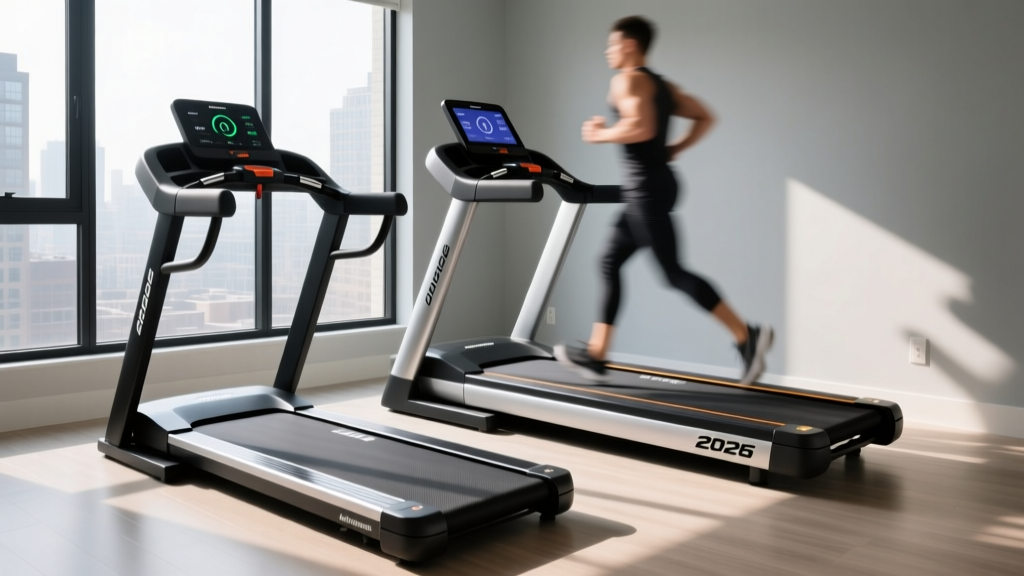
Walking Pad vs Treadmill: Best for an Uphill Treadmill Workout?
Compare walking pads and traditional treadmills for your uphill treadmill workout. Expert reviews, 2026 incline models, and a beginner step-by-step guide.

The Incline Dilemma: Walking Pad vs. Traditional Treadmill
The viral popularity of the 12-3-30 routine and other incline-based cardio programs has completely transformed how beginners approach home fitness. Suddenly, everyone wants to do an uphill treadmill workout to boost cardiovascular health, engage the posterior chain, and burn calories without the high impact of running. But as you browse the 2026 home fitness market, you will inevitably face a major crossroad: should you invest in a budget-friendly, space-saving walking pad, or commit to a traditional folding treadmill?
While walking pads are fantastic for casual under-desk stepping, attempting a rigorous uphill treadmill workout on a machine not engineered for high-incline load can lead to motor burnout, belt drift, and even injury. In this comprehensive guide, we break down the biomechanics, hardware limitations, and real-world performance of walking pads versus treadmills, followed by a beginner-friendly step-by-step guide to your first safe incline session.
Machine Review: Top 2026 Models for Incline Training
To understand the hardware differences, we need to look at exact specifications. Continuous Horsepower (CHP), belt length, and incline mechanisms are the three pillars of a successful incline walking machine. Below is a comparison of three distinct tiers of equipment popular this year.
| Feature | UREVO Strol 2E (Walking Pad) | NordicTrack T Series 8 (Compact Treadmill) | Horizon 7.4 (Full-Size Treadmill) |
|---|---|---|---|
| 2026 Price | $279 | $499 | $999 |
| Max Incline | 5% (Manual) | 10% (Power) | 15% (Power) |
| Motor | 2.5 HP Peak (~1.25 CHP) | 2.6 CHP | 2.75 CHP |
| Belt Size | 17' x 43' | 18' x 55' | 22' x 60' |
| Incline Type | Manual (Adjustable feet) | Power (Push-button) | Power (Push-button) |
| Best For | Casual flat walking | Beginner incline routines | Advanced uphill workouts |
Deep Dive: Why Hardware Matters on an Incline
UREVO Strol 2E: At $279, this is a top-seller for small apartments. However, its 5% manual incline is achieved by physically adjusting the rear feet. The ~1.25 CHP motor is adequate for flat walking at 2.5 MPH, but if a 180 lb user attempts a sustained 30-minute uphill treadmill workout at max incline, the amperage draw spikes. This often triggers the machine's thermal protection sensor, shutting the belt down mid-stride.
NordicTrack T Series 8: Priced around $499, this compact treadmill bridges the gap. The 10% power incline is excellent for beginners mimicking the famous 12-3-30 workout (simply cap it at 10%). The 2.6 CHP motor handles the increased gravitational load without overheating, though the 55-inch belt can feel restrictive for users taller than 6'0".
Horizon 7.4: At $999, this is the gold standard for dedicated incline walkers. The 15% power incline and robust 2.75 CHP motor deliver a stutter-free belt experience. More importantly, the 60-inch belt length accommodates the natural backward drift that occurs when walking uphill.
Biomechanics & Safety: The Hidden Risks of Incline Walking
According to the Cleveland Clinic, incline walking drastically increases glute and hamstring activation while keeping joint impact low. However, altering the deck angle changes your biomechanics in ways that cheap walking pads cannot safely accommodate.
⚠️ Warning: The 'Belt Drift' Phenomenon
When a walking pad is elevated, your center of mass shifts backward. Because walking pads typically feature 40-to-43-inch belts, users naturally drift toward the rear motor housing within 5 minutes. This 'belt drift' forces you to shorten your stride unnaturally, leading to Achilles strain, or worse, your heel catches the plastic motor cover, causing a sudden fall. Always use a machine with at least a 55-inch belt for sustained uphill sessions.
Furthermore, the Mayo Clinic emphasizes the importance of proper posture during walking exercises. On a walking pad lacking sturdy, waist-high handrails, beginners tend to lean backward or hunch over when the incline increases, negating the core-engagement benefits and placing undue stress on the lumbar spine.
Step-by-Step Beginner Guide: Your First Uphill Treadmill Workout
If you have secured a safe, capable machine (like the NordicTrack or Horizon models reviewed above), it is time to build your foundational routine. This 25-minute beginner protocol is designed to build calf endurance and cardiovascular stamina without triggering shin splints or plantar fasciitis.
Step 1: The Flat Warm-Up (Minutes 0–5)
Set the incline to 0% and the speed to 2.5 MPH. Focus on a heel-to-toe foot strike. Swing your arms naturally to establish a rhythmic baseline. This lubricates the ankle and knee joints, preparing the tendons for the increased load.
Step 2: The Progressive Ramp (Minutes 5–11)
Increase the speed to 3.0 MPH. Every two minutes, raise the incline by 2%. By minute 11, you should be at a 6% incline. This gradual ramp allows your Achilles tendon to adapt to the increased dorsiflexion required by the slope.
Step 3: The Steady-State Climb (Minutes 11–21)
Set your target incline (between 8% and 10% for beginners) and maintain 3.0 MPH. Critical Rule: Do not hold the handrails. The American Heart Association notes that supporting your body weight on the rails reduces caloric expenditure by up to 20% and ruins your postural alignment. Lean slightly forward from the ankles, not the waist, and pump your arms.
Step 4: The Controlled Descent (Minutes 21–25)
Drop the speed to 2.5 MPH and lower the incline back to 0%. Walking flat after a steep climb often feels jarring on the shins; the slow speed allows your anterior tibialis muscle to cool down safely, preventing delayed onset muscle soreness (DOMS) in the lower legs.
Pro-Tip for 2026 Smart Treadmills: If your machine features automatic programming, do not use pre-set 'Hill' intervals for your first month. Interval training introduces rapid changes in belt angle that can catch beginners off guard. Stick to manual steady-state climbs until your proprioception adapts to the moving deck.
Frequently Asked Questions
Can I put a walking pad on a slant board to simulate an incline?
While some DIY enthusiasts attempt to place the front of a walking pad on a wooden block or slant board, this is highly discouraged. Walking pad frames are engineered for flat-load distribution. Elevating one end twists the chassis, which misaligns the belt track, voids the warranty, and can cause the internal motor mount to snap under dynamic stepping loads.
How often should a beginner do an uphill treadmill workout?
Limit incline walking to 2 or 3 sessions per week. The steep angle places immense eccentric load on the calf muscles and Achilles tendons. Alternating incline days with flat walking or cycling allows the connective tissues to recover and adapt.
Is a 15% incline necessary for weight loss?
No. A 15% incline is an advanced metric. A beginner walking at 3.0 MPH on a 6% incline will achieve a highly effective Zone 2 heart rate, which is optimal for fat oxidation and cardiovascular base-building, without the severe joint fatigue associated with maximum-grade climbing.
Final Verdict
If your primary fitness goal in 2026 is to perform a structured, results-driven uphill treadmill workout, a traditional folding or full-size treadmill is a non-negotiable investment. Walking pads remain brilliant tools for NEAT (Non-Exercise Activity Thermogenesis) and casual flat stepping, but their mechanical limitations make them unsafe and inefficient for dedicated incline training. Choose a machine with a minimum 2.5 CHP motor, power incline capabilities, and a belt length that respects your natural stride, and your cardiovascular health will reap the rewards for years to come.
More gear to consider
All reviews
Home Stair Climber Guide: Treadmill Gradient Conversion Mistakes
Assault vs Air Bike Care: What Muscles Does Incline Treadmill Work?

Victorian Era Treadmill to 2026 Walking Pads: Evolution & Buyer Guide

Spirit 185 Treadmill Setup & Motor Horsepower Guide
Air Bike vs Assault Bike: Better Than 30 min on the treadmill?
