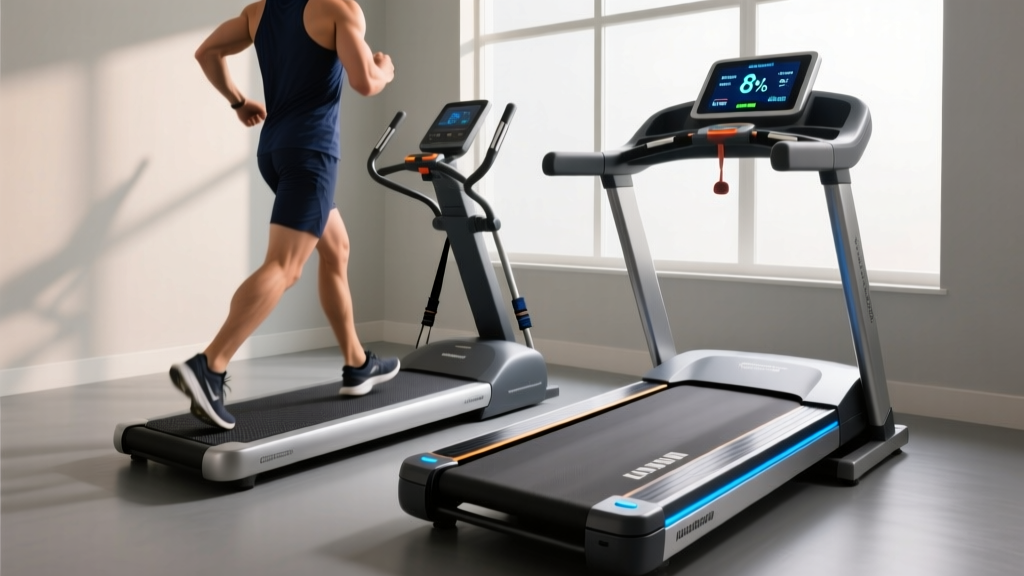
Walking Pad vs Incline Treadmill: Does Incline Treadmill Work Core?
Compare walking pads and incline treadmills. We answer if an incline treadmill works core muscles with a beginner-friendly step-by-step biomechanics guide.

The home fitness market in 2026 is heavily divided between two distinct camps: the ultra-compact, under-desk walking pad and the traditional, motor-heavy incline treadmill. If you are a beginner trying to optimize your home gym footprint while maximizing muscle engagement, you have likely asked a critical question: does incline treadmill work core muscles better than flat walking, and is it worth the extra space compared to a walking pad?
As a senior reviewer for FitGearPulse, I have tested dozens of cardio machines to break down the biomechanics of incline walking. Below, you will find a comprehensive comparison of walking pads versus incline treadmills, followed by a beginner-friendly, step-by-step guide to actively engaging your core on an incline.
The Biomechanics: Does Incline Treadmill Work Core Muscles?
To understand whether an incline treadmill targets your midsection, we must look at the physics of walking on a gradient. When you walk on a flat surface (0% grade), your body’s center of mass moves horizontally. The core muscles—primarily the transverse abdominis and the rectus abdominis—act mostly as passive stabilizers.
However, when you elevate the treadmill deck to a 10% to 15% incline, the gravity vector shifts. Your torso naturally wants to fall backward. To prevent this and maintain an upright posture, your central nervous system recruits your core musculature to act as an active tether. According to research highlighted by the American Council on Exercise (ACE), dynamic movements that challenge your center of gravity force the deep core stabilizers to fire continuously.
Expert Insight: Electromyography (EMG) studies show that walking at a 15% incline can increase rectus abdominis and oblique activation by up to 40% to 60% compared to walking on a flat surface. The steeper the grade, the harder your core must work to keep your pelvis neutral and your spine protected.
Walking pads, by design, max out at a 0% to 5% incline (with most strictly at 0%). Therefore, while walking pads are excellent for NEAT (Non-Exercise Activity Thermogenesis) and step-count goals, they simply cannot provide the mechanical resistance required to stimulate core muscle growth or significant endurance adaptations.
2026 Head-to-Head Comparison Matrix
Before we dive into the step-by-step core activation guide, let us compare three top-tier machines dominating the 2026 market to see how they stack up in terms of core engagement potential, pricing, and spatial footprint.
| Feature | UREVO Strol 2E (Walking Pad) | NordicTrack T Series 10 | Horizon Fitness 7.4 |
|---|---|---|---|
| Machine Type | Flat Walking Pad | Budget Incline Treadmill | Premium Incline Treadmill |
| 2026 Price Range | $329 - $359 | $599 - $649 | $999 - $1,099 |
| Max Incline Grade | 0% (Flat) | 10% | 15% |
| Core Engagement | Low (Passive stabilization) | Moderate (Good for beginners) | High (Optimal for deep core) |
| Footprint | 5.5 sq ft (Storable) | 12 sq ft (Folds up) | 16 sq ft (Folds up) |
| Max Speed | 4.0 MPH | 10.0 MPH | 12.0 MPH |
Takeaway: If your primary goal is slipping a machine under a standing desk for light calorie burn, the UREVO is unmatched. But if you are asking 'does incline treadmill work core', you need a machine capable of hitting at least a 10% grade, making the NordicTrack or Horizon mandatory.
Step-by-Step Guide to Activating Your Core on an Incline
Owning an incline treadmill does not automatically guarantee a core workout. Many beginners unknowingly use form compensations that completely shut off their abdominal muscles. Follow this beginner-friendly protocol to ensure your core is doing the heavy lifting.
Step 1: Set the 'Minimum Effective Dose' Grade
Do not jump straight to a 15% incline. Start your treadmill at an 8% grade at a brisk walking pace (2.5 to 3.0 MPH). This angle is steep enough to shift your center of gravity backward, forcing your anterior core to engage, but gentle enough to prevent calf strain while you learn the movement pattern.
Step 2: The 'No-Hold' Rule (Crucial)
This is the most common point of failure. If you grip the handrails or the console, you create an artificial triangle of support. You are essentially doing a plank on your arms, bypassing the core entirely. Let your arms hang freely. If you feel like you are falling backward, lower the speed, do not grab the rails. As noted by Cleveland Clinic experts, holding onto treadmill rails drastically reduces caloric expenditure and ruins natural spinal alignment.
Step 3: Engage the 'Zip-Up' Cue
Before you increase the speed, practice the 'zip-up' cue. Imagine you are pulling up a tight pair of jeans from your pubic bone to your belly button. This subtle movement engages the transverse abdominis (your body's natural weight belt) and tilts your pelvis into a neutral position, protecting your lower back from the arching that often happens on steep inclines.
Step 4: Implement 90-Degree Arm Drive
Bend your elbows to 90 degrees and pump your arms in opposition to your legs (left arm forward with right leg). The rotational torque created by your arm swing forces your obliques to fire rapidly to stabilize your torso against the twisting motion.
Beginner Pro-Tip: Try carrying light 2 lb to 3 lb dumbbells while walking at an 8% incline. The added distal weight on your arms increases the rotational drag, forcing your obliques and rectus abdominis to work up to 20% harder to maintain your posture.3 Common Form Failures (And How to Fix Them)
Even with the right machine, poor biomechanics will render your core workout useless. Watch out for these specific failure modes:
- Failure Mode 1: Anterior Pelvic Tilt (The 'Duck' Posture). As the incline gets steeper, beginners tend to stick their glutes out and arch their lower back to compensate for the slope. This completely deactivates the lower abs and places sheer force on the lumbar spine. Fix: Tuck your tailbone slightly and squeeze your glutes at the peak of each stride.
- Failure Mode 2: Over-Striding. Reaching your lead foot too far up the belt forces your hips to open excessively, breaking core tension. Fix: Take shorter, quicker steps. Aim for a cadence of 110-120 steps per minute. Keep your feet landing directly beneath your hips.
- Failure Mode 3: The 'Console Lean'. Leaning forward so your chest is hovering over the digital display shifts the load entirely to your quadriceps and calves. Fix: Maintain a tall spine. Imagine a string pulling the crown of your head toward the ceiling. Your torso should be angled forward only slightly, hinging from the ankles, not bending at the waist.
Final Verdict: Which Machine Should You Buy?
The choice between a walking pad and an incline treadmill ultimately depends on your spatial constraints and your physiological goals.
If you work from home, have less than 10 square feet of dedicated gym space, and simply want to combat the sedentary nature of a desk job, a high-quality walking pad like the UREVO Strol 2E is a brilliant investment for daily step accumulation. According to Harvard Health Publishing, consistent daily walking is foundational for cardiovascular health, even without extreme intensity.
However, if your goal is to build functional core strength, improve posterior chain power, and simulate outdoor hiking trails from your living room, a walking pad will fall short. To truly answer the question 'does incline treadmill work core' with a resounding yes, you need the mechanical resistance provided by a 10% to 15% motorized incline. For beginners on a budget, the NordicTrack T Series 10 offers the perfect entry point. For those wanting maximum core recruitment and joint-friendly cushioning, the Horizon 7.4 remains our top premium pick for 2026.
Ditch the handrails, engage your transverse abdominis, and let gravity do the work. Your core will thank you.
More gear to consider
All reviews
NordicTrack T Series 5 Starter Treadmill for Real Results: Troubleshooting

WellFit TM006 Treadmill Reviews: Setup & Noise Level Comparison

Rowing Machine Buying Guide: Technique & Star Trac 4TR Treadmill Fixes

Sunny Health and Fitness Treadmill Reviews: 2026 Buying Guide
Cherokee D'Ass Treadmill Review & Office Care Guide
