
U50 Treadmill Maintenance: Small Space Longevity Guide
Maximize your U50 treadmill's lifespan in tight spaces. Expert maintenance tips, folding hinge care, and belt alignment for compact home gyms.

The shift toward micro-apartments and multi-use living spaces has made compact fitness equipment a necessity rather than a luxury. When conducting a thorough folding treadmill for small spaces review, the U50 treadmill consistently emerges as a top contender due to its 10-inch folded profile and sub-100-pound frame. However, compact engineering introduces unique mechanical vulnerabilities. The very design choices that allow the U50 to slide under a bed or into a narrow closet also restrict airflow, stress folding hinges, and accelerate belt wear.
As we navigate the fitness equipment landscape in 2026, understanding the specific maintenance care and longevity tips for the U50 treadmill is critical. A compact treadmill is not simply a scaled-down version of a commercial club model; it requires a highly specific, proactive maintenance regimen to prevent catastrophic component failure. This guide provides deep, actionable expertise to ensure your U50 folding treadmill survives the rigors of daily use in a confined footprint.
The U50 Folding Treadmill Review: Small-Space Engineering & Vulnerabilities
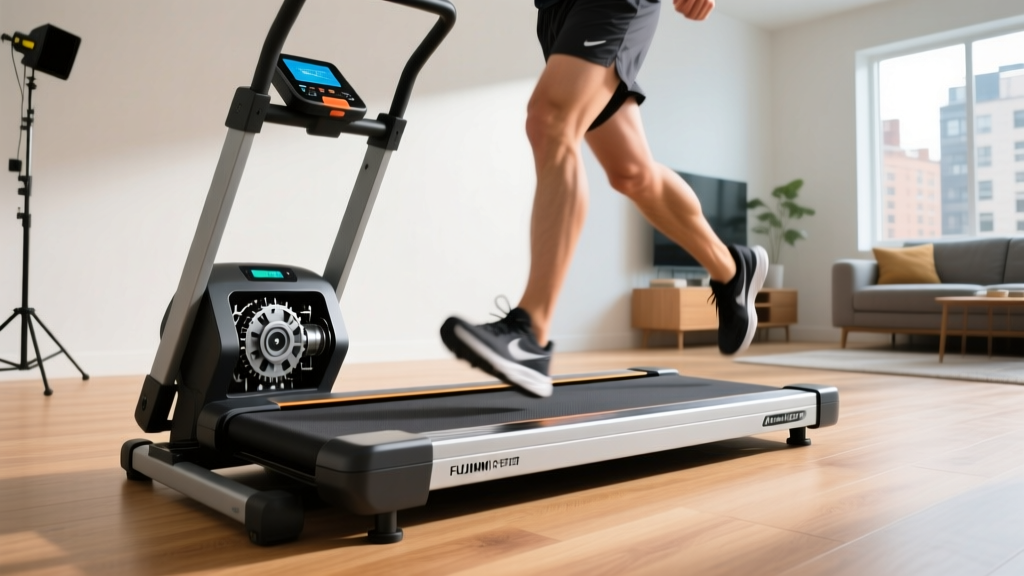
To properly maintain the U50 treadmill, you must first understand its engineering constraints. The U50 typically utilizes a 1.5 to 2.0 Continuous Horsepower (CHP) motor paired with a 15-inch by 43-inch running deck. In a full-sized treadmill, a 2.0 CHP motor has a massive hood and extensive ventilation. In the U50, the motor hood is flattened to allow the deck to fold completely flush.
This flattened hood creates a thermal bottleneck. According to equipment longevity analyses by Consumer Reports, compact folding treadmills experience thermal throttling up to 30% faster than upright models when subjected to continuous running (as opposed to walking). If the U50 is pushed into a corner or shoved against a wall immediately after a workout, the trapped ambient heat can degrade the motor control board (MCB) soldering over time.
⚠️ CRITICAL WARNING: The Post-Workout Cool DownNever fold the U50 treadmill or push it into a closet immediately after a high-intensity run. The motor requires a minimum of 15 minutes of ambient air exposure to dissipate internal heat. Folding it while hot traps thermal energy against the plastic shroud, warping the hood and frying the lower control board.
The Static Electricity Threat in Carpeted Micro-Apartments
Small spaces are frequently carpeted to reduce noise and define zones without physical walls. Carpeting, combined with the friction of a dry treadmill belt, generates significant static electricity. In a massive commercial treadmill, the heavy steel frame grounds this charge. In a lightweight, 90-pound folding treadmill like the U50, a static discharge has nowhere to go but into the sensitive electronics.
Static shock is the number one cause of premature MCB failure in folding treadmills. A single arc of static electricity jumping from the user, through the deck, and into the console can wipe the EEPROM chip or short the MOSFETs on the motor board. Replacing a U50 lower control board costs between $85 and $140, not including labor or downtime.
The Dielectric Barrier: 100% Silicone Lubrication
The only way to prevent static buildup is to eliminate the friction that causes it. This requires strict adherence to a lubrication schedule using 100% pure silicone treadmill lubricant. Never use WD-40, petroleum-based oils, or household sprays; these will dissolve the urethane coating on the U50’s MDF deck, resulting in a $160+ deck replacement.
The 15-Milliliter Rule: Belt Lubrication for Compact Decks
Because the U50 features a shorter 43-inch deck, users often over-apply lubricant, assuming more is better. Over-lubrication causes the silicone to squeeze out the sides of the belt, attracting dust and pet hair—which act as an abrasive paste, destroying the belt from the outside in.
- Measure Exactly 15ml: Use the applicator bottle’s measurement lines. 15ml is the exact volume required to coat the 15x43 inch contact area without overspill.
- Loosen the Belt: Use a 5mm Allen wrench to turn the rear roller bolts counter-clockwise by exactly three full turns.
- Apply to the Center: Lift the belt and apply the silicone in a zig-zag pattern down the absolute center of the deck, avoiding the outer 2 inches of the deck edges.
- Retighten and Distribute: Turn the bolts clockwise three full turns to restore original tension. Run the treadmill at 2.0 MPH for three minutes without stepping on it to evenly distribute the silicone.
Step-by-Step: Tensioning a 15-Inch Compact Belt
The narrower 15-inch belt on the U50 is highly susceptible to lateral drifting. If the belt rubs against the plastic side rails, it will fray within weeks. The American Council on Exercise (ACE) emphasizes that biomechanical inconsistencies caused by a drifting belt can lead to subtle gait alterations and joint strain.
The Quarter-Turn Diagnostic Method:
- Run the U50 at 3.0 MPH empty.
- Observe the rear roller. If the belt drifts to the left, insert your 5mm Allen wrench into the left rear cap.
- Turn the bolt clockwise by exactly one quarter-turn (90 degrees).
- Wait 30 seconds for the belt to track.
- If it still drifts, repeat on the left. Never adjust the right side to fix a left drift; this over-tensions the belt, creating excessive amperage draw on the 2.0 CHP motor and triggering the thermal reset switch.
Preventative Maintenance Matrix for the U50
Consistency is the bedrock of equipment longevity. Use this matrix to schedule your U50 treadmill maintenance care.
| Interval | Component | Action Required | Tool / Material |
|---|---|---|---|
| Weekly | Motor Hood Vents | Vacuum dust from side intake grills to prevent thermal throttling. | Crevice vacuum attachment |
| Monthly | Running Belt | Check tension and lateral alignment using the quarter-turn rule. | 5mm Allen Wrench |
| Bi-Annual | Deck Lubrication | Apply exactly 15ml of 100% silicone to the deck center. | Pure Silicone Lube |
| Annual | Folding Hinge Pivot | Apply white lithium grease to the main frame pivot bolts. | White Lithium Grease |
Hinge, Struts, and Frame: Managing Folding Mechanism Fatigue
The defining feature of the U50 as a folding treadmill for small spaces is its hydraulic soft-drop hinge. This mechanism relies on a pressurized gas cylinder to lower the 90-pound deck safely to the floor. The most common user-induced failure mode is riding the deck down or, conversely, letting it drop too rapidly, which blows the internal O-ring seal of the hydraulic strut.
When the seal blows, the cylinder loses pressure, and the deck will slam into the floor, potentially cracking the MDF running deck or damaging the floorboards beneath. Replacement struts cost around $45, but installation requires removing the main pivot bolt, which can be seized if not maintained.
Expert Insight: 'To preserve the hydraulic strut on any compact folding treadmill, always lift the deck from the designated center grab-bar, not the edges. Lifting from the edges applies torsional twist to the pivot rod, accelerating the wear on the nylon bushings and causing the frame to develop a permanent, unfixable squeak.'
Spatial Clearances: Preventing Motor Burnout in Tight Corners
When reviewing the U50 treadmill for small spaces, spatial clearance is just as vital as the machine's physical dimensions. The U50’s motor draws air from the front and sides of the hood and exhausts it out the rear. If you position the treadmill facing a wall with less than 18 inches of clearance, or shove the rear against a baseboard, the motor will suffocate.
In 2026, modern brushless DC motors (often found in updated compact models) are highly efficient, but they still generate localized heat. Ensure a minimum of 24 inches of clearance behind the treadmill and 12 inches on both sides. Furthermore, never place the U50 directly on a thick, high-pile rug. The weight of the user will sink the treadmill into the rug fibers, completely blocking the under-deck ventilation channels and causing the motor to overheat within 20 minutes of continuous use. Always use a high-density, low-pile PVC equipment mat to stabilize the footprint and protect your flooring while maintaining vital undercarriage airflow.
By treating the U50 not just as a piece of furniture that folds away, but as a precision machine requiring thermal management, static mitigation, and mechanical lubrication, you can easily extend its operational lifespan from the industry average of 3 years to upwards of 7 to 10 years, even in the most demanding micro-apartment environments.
More gear to consider
All reviews
Infinadeck Treadmill vs Stationary Bike Types: Maintenance Guide

What Is a Good Treadmill for Seniors vs Stationary Bikes? Care Guide

Elliptical vs Treadmill: 12-3-30 Routine & How Many Days a Week?

No Electricity Treadmill for Office Desks: 2026 Value Breakdown
Compact Portable Cardio 2026: Preventing Treadmill Abuse and Motor Murder
