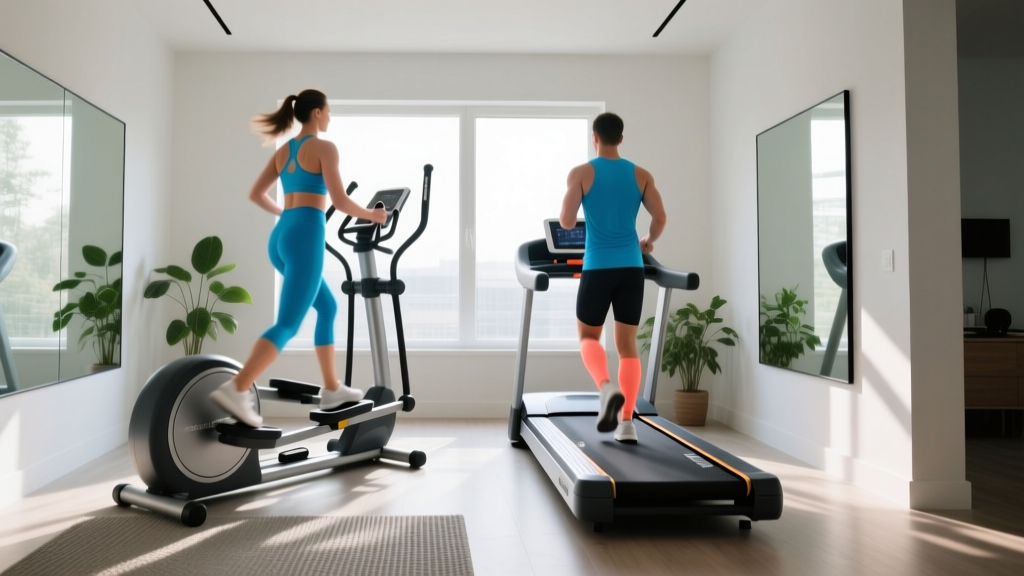
Elliptical vs Treadmill: Is Treadmill Walking Bad for Your Knees?
We break down the elliptical vs treadmill debate, analyzing upfront costs, long-term value, and if treadmill walking is bad for your knees.

Building a home gym in 2026 requires navigating a complex matrix of upfront capital, ongoing maintenance, and long-term physiological sustainability. When narrowing down the cornerstone of your cardio setup, the debate almost always lands on the elliptical vs treadmill. But beyond the sticker price, there is a hidden physiological ledger to consider. A frequent and critical question we receive at FitGearPulse is: is walking on a treadmill bad for your knees?
The answer isn't a simple yes or no; it depends on biomechanics, machine engineering, and your pre-existing joint health. In this comprehensive budget and value analysis, we will dissect the true Total Cost of Ownership (TCO) of both machines, evaluate the biomechanical impact on your joints, and help you determine which cardio investment yields the highest long-term ROI for your body and your wallet.
The Physiological Ledger: Is Treadmill Walking Bad for Your Knees?
To understand the value of a cardio machine, you must first factor in the "physio tax"—the potential medical costs associated with joint degradation. According to the Arthritis Foundation, low-impact exercises are heavily recommended for preserving cartilage, but treadmills occupy a gray area.
Ground Reaction Forces (GRF) Explained
When you walk on a treadmill at a standard pace of 3.0 mph, your knees absorb a Ground Reaction Force (GRF) equivalent to 1.2 to 1.5 times your body weight with every heel strike. If you weigh 180 lbs, your knee joints are absorbing up to 270 lbs of force per step. Over a 3-mile walk (roughly 6,000 steps), that equates to over 1.6 million pounds of cumulative force distributed across your meniscus and patellar tendons.
However, this does not inherently mean treadmill walking is "bad" for healthy knees. Modern mid-tier and premium treadmills utilize elastomer cushioning systems or variable-durometer rubber decks that reduce this impact shock by 15% to 30% compared to walking on asphalt or concrete. The danger arises when users purchase ultra-budget treadmills (under $300) with rigid, unyielding MDF decks, or when users with pre-existing osteoarthritis ignore the cumulative micro-trauma of daily heel strikes.
"While the elliptical provides a true zero-impact, closed-kinetic-chain movement, a high-quality treadmill with a calibrated flex deck remains safe for walking for the vast majority of the population. The real risk to the knees comes from improper incline mechanics and worn-out running belts that alter natural gait." — Biomechanical Analysis of Home Cardio Equipment, 2025
Upfront CapEx: 2026 Equipment Pricing Tiers
When comparing the elliptical vs treadmill for home cardio, the initial capital expenditure (CapEx) varies wildly based on build quality, motor size, and stride mechanics. Here is a realistic 2026 pricing breakdown across three distinct tiers.
1. The Entry-Level Tier (Budget-Conscious)
- Elliptical: Sunny Health & Fitness SF-E3912 ($159). Features a basic magnetic resistance system and a notably short 13-inch stride. Warning: Short strides force excessive knee flexion at the apex of the pedal stroke, which can ironically trigger patellofemoral pain syndrome.
- Treadmill: ProForm Carbon TL ($399). Equipped with a 1.5 HP motor and a 50-inch belt. Adequate for walking, but the motor will overheat and degrade rapidly if used for running.
2. The Mid-Tier (The Sweet Spot for Value)
- Elliptical: Schwinn 430 ($749). Offers a much better 18-inch stride, 20 resistance levels, and a heavy-duty flywheel that ensures smooth momentum, reducing jerky movements that stress the knee joint.
- Treadmill: Sole F63 ($1,199). The undisputed king of mid-tier treadmills. Features a 3.0 HP motor, a 60-inch belt, and Sole's signature Cushion Flex deck, which actively reduces joint impact compared to outdoor walking.
3. The Premium Tier (Commercial-Grade Longevity)
- Elliptical: Bowflex Max Trainer M9 ($2,299). Blends elliptical mechanics with stair-climbing vectors. Highly engaging, but the steep pedal angle requires strong baseline knee stability.
- Treadmill: NordicTrack Commercial 1750 ($2,499). Features a massive 22-inch HD touchscreen, a 3.5 CHP motor, and advanced Runners Flex cushioning that allows you to toggle between soft (joint-saving) and firm (road-simulation) deck settings.
The Hidden OpEx: Maintenance and Subscription Costs
A true budget breakdown must include Operating Expenses (OpEx). Cardio machines are not static furniture; they are moving mechanical systems that require upkeep.
Treadmill Maintenance Realities
- Belt Lubrication: Treadmill belts require 100% silicone lubrication every 3 to 6 months. Failure to do so increases friction, forcing the motor to draw excess amperage, eventually frying the motor control board (a $150-$250 replacement).
- Deck Warping: If sweat drips onto an unsealed MDF deck, it will warp and create a "dead spot" that alters your gait, leading to asymmetrical knee loading.
- Electricity: A 3.0 HP treadmill running at 6 mph draws roughly 900-1200 watts. Heavy daily use will noticeably impact your monthly utility bill.
Ellipticals, by contrast, have lower motor dependency (many are self-generating or use minimal wattage for the console). However, their pivot joints and rail bearings require periodic tightening and cleaning to prevent the "wobble" that causes lateral knee strain.
5-Year Total Cost of Ownership (TCO) Matrix
| Cost Factor | Mid-Tier Elliptical (e.g., Schwinn 430) | Mid-Tier Treadmill (e.g., Sole F63) |
|---|---|---|
| Initial Purchase Price | $749 | $1,199 |
| 5-Year Maintenance (Lube, Parts) | $45 (Joint grease, battery replacements) | $90 (Silicone lube, belt tensioning) |
| 5-Year Electricity Cost (Est.) | $35 | $180 |
| Premium App Subscriptions (Optional) | $0 (JRNY is optional, basic console is free) | $0 (Sole console is free, iFIT optional) |
| Estimated 5-Year TCO | $829 | $1,469 |
Caloric ROI: Which Machine Burns More?
If your primary goal is metabolic conditioning and weight management, you must evaluate the caloric return on investment. According to data published by Harvard Health Publishing, the caloric burn between the two machines is surprisingly close when effort levels are matched, but the perceived exertion differs vastly.
A 155-pound individual will burn approximately 324 calories in 30 minutes on an elliptical at a moderate pace, compared to 252 calories walking on a treadmill at 3.5 mph. To match the elliptical's burn on a treadmill, you must either increase the speed to a jog (4.5 mph, burning ~360 calories) or utilize a steep incline (10-15% grade). However, walking on a steep treadmill incline significantly increases the sheer force on the patellar tendon, which loops back to our core question regarding knee safety. For users with knee sensitivities, the elliptical provides a vastly superior caloric ROI without the accompanying joint sheer force.
The Biomechanical Trap: When Ellipticals Hurt Your Knees
While the elliptical is universally championed as the "knee-safe" alternative to the treadmill, budget constraints often lead consumers into a biomechanical trap. As noted by the American Council on Exercise (ACE), proper machine fit is critical for injury prevention.
If you purchase a budget elliptical with an 18-inch or shorter stride length (common in machines under $500), your knees will experience excessive flexion at the top of the pedal ellipse. This unnatural compression forces the patella (kneecap) to grind against the femoral groove, accelerating cartilage wear. Information Gain: If you are over 5'6" tall and have a history of knee pain, you must mandate a minimum 20-inch stride length when shopping for an elliptical. This typically pushes your minimum budget to the $700+ threshold.
Final Verdict: Matching Your Budget to Your Biomechanics
So, is walking on a treadmill bad for your knees? Only if you compromise on deck cushioning to save money, or if you attempt to force high-incline walking on compromised joints. The elliptical vs treadmill decision ultimately comes down to aligning your financial budget with your physiological budget.
Buy the Treadmill If:
- You have healthy knees and prioritize bone-density loading (which requires impact).
- You have a budget of at least $1,000 to secure a machine with a high-quality flex deck and a 3.0 HP motor.
- You prefer the natural biomechanics of walking and want to train for outdoor 5Ks or hiking.
Buy the Elliptical If:
- You have a history of meniscus tears, osteoarthritis, or patellar tendinitis.
- You want a higher caloric burn at a lower perceived rate of exertion.
- Your budget is closer to $750, allowing you to secure a mid-tier elliptical with a proper 20-inch stride, whereas $750 only buys a low-end, high-impact treadmill.
By looking past the initial price tag and evaluating the 5-year TCO alongside the biomechanical realities of your joints, you can make a home cardio investment that pays dividends in both longevity and health.
More gear to consider
All reviews
Yesoul Treadmill Review 2026: Best Folding Pick for Small Spaces
Best QVC Treadmills for Office Use: 2026 Under Desk Review

Getting Your Ass on the Treadmill: Curved Manual vs Motorized

Stair Climbers vs Treadmill Running Classes: 2026 Home Guide

Treadmill Keeps Shocking Me? Air Bike vs Assault Bike Value Guide
