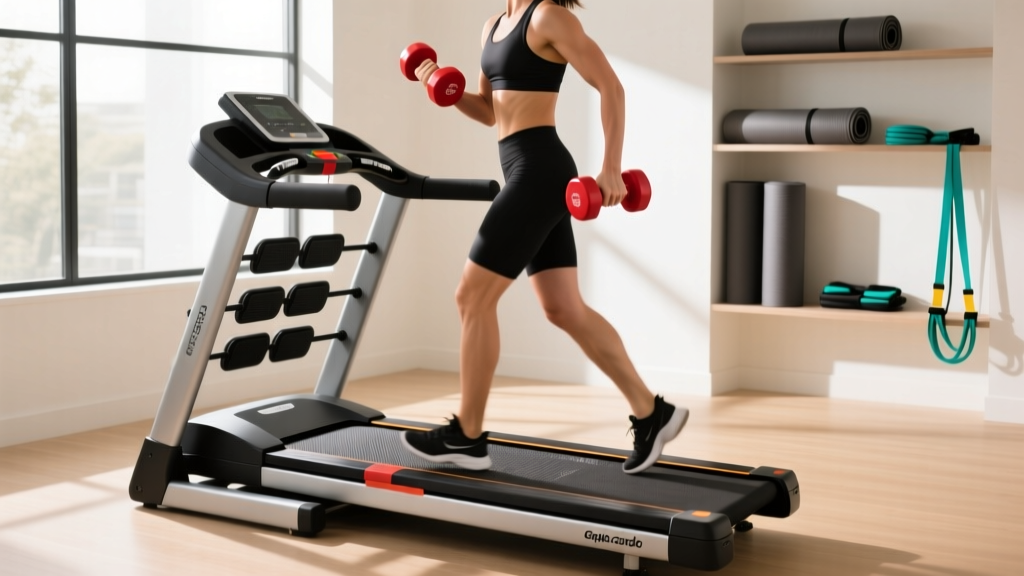
Treadmill Walk With Weights: Maintenance for Compact Pads
Learn how to safely do a treadmill walk with weights on compact portable cardio equipment. Expert maintenance tips to prevent motor burnout and belt wear.

The Rise of the Weighted Treadmill Walk on Portable Gear
The fitness landscape in 2026 has seen a massive surge in the popularity of compact portable cardio equipment options, specifically under-desk treadmills and folding walking pads. As remote work and small-space living dominate, users are constantly looking for ways to maximize the caloric output of these low-profile machines. One of the most effective methods is the treadmill walk with weights—often referred to as 'rucking' or weighted walking. By adding a 10 to 25-pound weighted vest or holding light dumbbells, users can increase caloric burn by up to 30% without needing to run.
However, adding external load to a compact walking pad fundamentally changes the mechanical stress placed on the machine. While a full-sized commercial treadmill is built to absorb high-impact forces, portable cardio equipment operates with smaller motors, narrower decks, and lighter frames. If you plan to incorporate a treadmill walk with weights into your daily routine, understanding the specific maintenance care and longevity tips for your compact machine is critical to preventing premature motor burnout and belt delamination.
How Added Weight Impacts Compact Treadmill Mechanics
To maintain your equipment, you must first understand the physics of a weighted walk. When you perform a treadmill walk with weights, the static load (your body weight plus the vest) increases, but the dynamic impact force increases non-linearally. A 160-pound user wearing a 20-pound vest doesn't just add 20 pounds of pressure to the deck; the foot-strike impact can generate peak forces exceeding 250 pounds per step.
⚠️ Motor Strain Warning: Most compact walking pads advertise a 'Peak HP' of 2.0 to 2.5. However, their Continuous Duty Horsepower (CHP) is often less than 1.0. Added weight forces the motor to draw higher amperage continuously to overcome belt friction, generating excess heat that can melt the motor controller board if not properly maintained.Asymmetrical Loading vs. Distributed Loading
How you carry the weight matters for machine longevity. Holding 5-pound dumbbells in each hand creates an asymmetrical gait. This uneven foot-strike pattern causes localized friction on one side of the treadmill belt, leading to accelerated edge wear and deck warping. Conversely, a snugly fitted weighted vest distributes the load evenly across your center of gravity, ensuring uniform belt wear and significantly extending the lifespan of your portable cardio equipment.
Essential Maintenance Schedule for Weighted Walking
Standard manufacturer maintenance guidelines assume an unweighted user walking at moderate speeds. When you introduce a treadmill walk with weights, you must accelerate your maintenance schedule. According to general equipment care standards highlighted by Consumer Reports, friction is the number one enemy of treadmill longevity.
| Maintenance Task | Standard Use (Unweighted) | Weighted Use (Rucking/Vest) |
|---|---|---|
| Belt Lubrication (100% Silicone) | Every 100 miles / 3 months | Every 40 miles / 6 weeks |
| Belt Tension & Alignment Check | Monthly | Bi-Weekly |
| Motor Compartment Vacuuming | Every 6 months | Every 2 months |
| Deck Inspection (Warping/Grooves) | Annually | Every 4 months |
Step-by-Step: Proper Belt Lubrication for Heavy Loads
- Unplug the Machine: Never lubricate a walking pad while it is connected to power.
- Loosen the Rear Rollers: Use the provided Allen wrench to turn the rear adjustment bolts counter-clockwise by exactly 3 full turns.
- Apply Silicone: Use a 100% pure silicone treadmill lubricant (avoid any products containing petroleum distillates, which destroy PVC belts). Apply exactly 15ml in a zig-zag pattern down the center of the deck.
- Retighten and Distribute: Tighten the bolts back to their original position. Plug the machine in and run it at 1.5 MPH for 3 minutes to distribute the silicone evenly.
Top Compact Portable Cardio Options for Weighted Walks
Not all walking pads are engineered to handle the dynamic load of a treadmill walk with weights. If you are buying new or evaluating your current setup, look for models with a stated weight capacity at least 50 pounds higher than your combined body and vest weight. Here are the top 2026 contenders for weighted walking:
- KingSmith WalkingPad R2: Priced around $499, this model features a 2.0 Peak HP motor and a robust aluminum frame. It handles up to 240 lbs, making it ideal for a 180 lb user adding a 20 lb vest. Its wider 17-inch belt accommodates the slightly wider gait often adopted during rucking.
- UREVO Strol 2E: Retailing for approximately $350, this compact portable cardio option offers a 2.25 Peak HP motor and a 265 lb max capacity. It includes a built-in incline feature; however, never use the incline feature while wearing a weighted vest, as the combined gravitational pull will instantly overheat the compact motor controller.
- Sunny Health & Fitness SF-T723016: While an excellent budget under-desk option at $160, its 1.5 Peak HP motor and 220 lb limit make it unsuitable for weighted walks. Stick to unweighted use for this specific model to avoid voiding the warranty.
Biomechanics and Joint Health Considerations
While maintaining the machine is vital, maintaining your body is paramount. The Centers for Disease Control and Prevention (CDC) recommends at least 150 minutes of moderate-intensity aerobic activity weekly, and weighted walking is an excellent way to achieve this while building bone density. However, adding weight changes your biomechanics.
'When performing a treadmill walk with weights on a compact pad, keep your speed below 3.5 MPH. Compact belts are typically shorter (40-45 inches). If your stride lengthens due to the added momentum of a weighted vest, you risk stepping on the rear motor housing or the front roller cap, which can cause severe ankle sprains and catastrophic machine failure.'
Furthermore, the Mayo Clinic notes that proper footwear is essential for walking routines. When using a walking pad with weights, avoid thick-soled running shoes. The elevated heel strike increases the lever-arm force on the walking pad's front deck, which is the most common point of structural snapping on folding portable treadmills. Opt for zero-drop or low-profile cross-training shoes to distribute force evenly.
Troubleshooting Common Failure Modes from Weighted Use
If your compact machine begins to fail under the stress of weighted walking, it will usually communicate this through specific error codes or physical symptoms. Here is how to diagnose and address them:
1. The E01 or E02 Error Code (Motor Overcurrent)
The Cause: The motor controller detects that the amperage draw has exceeded safe limits, usually due to high belt friction combined with heavy user weight. The Fix: Stop immediately. Unplug the machine for 30 minutes to allow the thermal fuse to reset. Once cooled, perform the belt lubrication steps outlined above. If the error persists, the motor controller board has likely suffered thermal damage and will need replacement (typically a $45-$80 part directly from the manufacturer).
2. Belt Slipping or 'Stuttering'
The Cause: The belt has stretched due to the constant heavy load, or the drive belt connecting the motor to the front roller has lost tension. The Fix: First, adjust the rear roller bolts clockwise by a quarter-turn on each side to tighten the walking belt. If the belt still stutters when your foot strikes the deck, the internal drive belt is loose. You will need to unscrew the front motor hood and use a socket wrench to adjust the motor mount tensioner bolt.
3. Squeaking from the Folding Hinge
The Cause: The added downward force of a weighted walk causes micro-flexing in the folding mechanism of portable treadmills, leading to metal-on-metal friction. The Fix: Apply a lithium-based white grease (not WD-40, which attracts dust) to the hinge pins and locking safety latches every 30 days.
Final Thoughts on Portable Equipment Longevity
Integrating a treadmill walk with weights into your routine using compact portable cardio equipment is a highly efficient, space-saving strategy for cardiovascular and muscular endurance. However, these machines are precision instruments that require respect for their mechanical limits. By shifting from a reactive repair mindset to a proactive, accelerated maintenance schedule—focusing on frequent silicone lubrication, symmetrical weight distribution via vests, and strict speed limits—you can easily double the operational lifespan of your walking pad, ensuring it supports your fitness journey for years to come.
More gear to consider
All reviews
Is Treadmill Distance Accurate vs Upright, Recumbent & Spin Bikes?

Under-Desk Treadmill Review: Maximizing Every Mile on a Treadmill

Curved vs Motorized Treadmills: How to Tighten the Belt on a ProForm

Elliptical vs Treadmill: Value Analysis for the Treadmill Worker

ProForm Treadmill Incline Not Working? Top Portable Cardio
