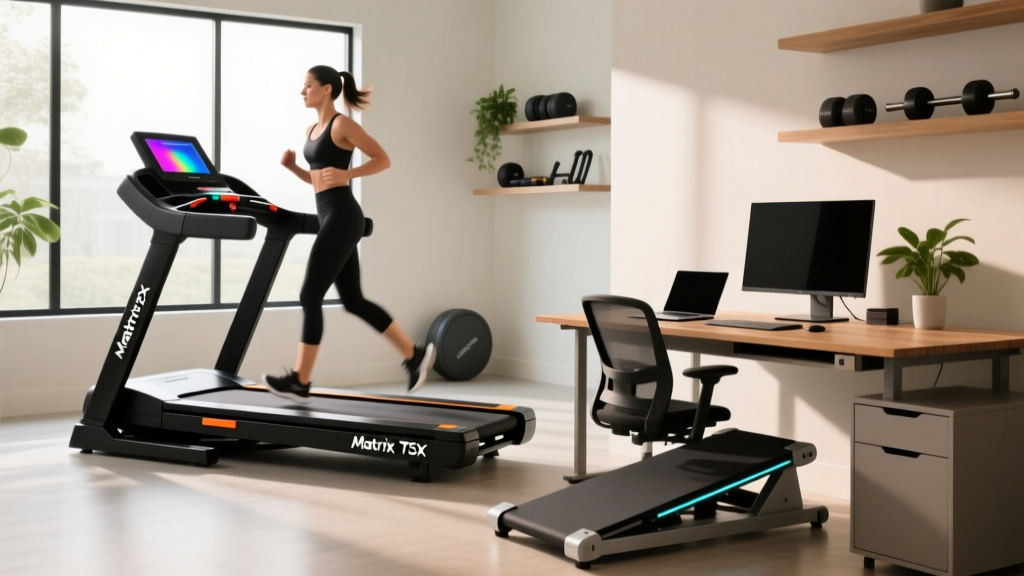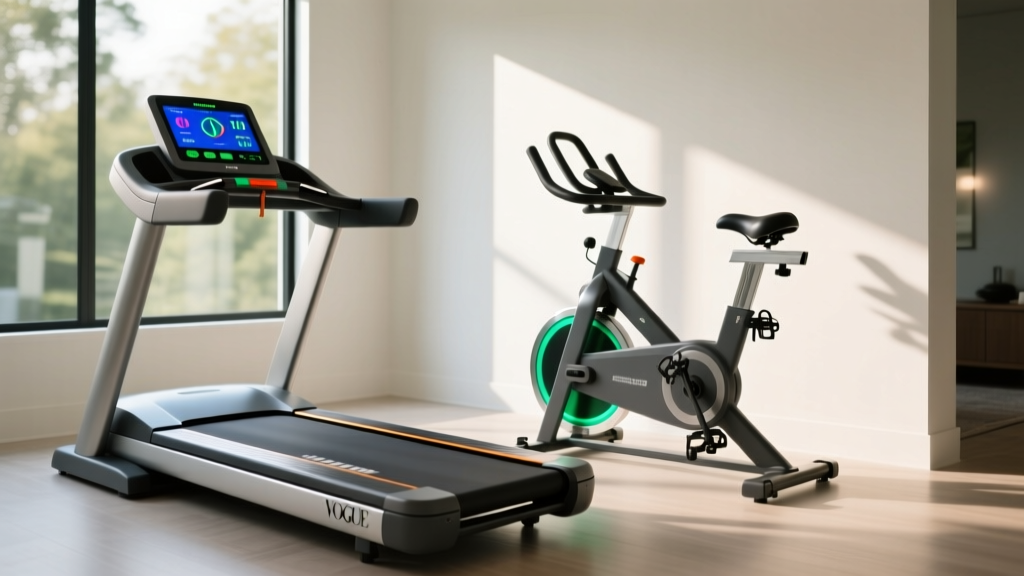
Treadmill vs Cycling: Step-by-Step Buying Guide & Feature Comparison
Confused by treadmill vs cycling? Follow our beginner step-by-step buying guide comparing key features, joint impact, and costs to find your perfect fit.

The Ultimate Home Cardio Dilemma: Treadmill vs Cycling
Choosing between a treadmill and an indoor cycling bike is the most common crossroads for beginners building a home gym. Both machines deliver exceptional cardiovascular benefits, but their biomechanical impact, spatial requirements, and long-term ownership costs are vastly different. According to the American Heart Association, adults need at least 150 minutes of moderate-intensity aerobic activity per week, a goal easily achievable on either machine. However, picking the wrong equipment for your specific lifestyle, joint health, and living space often leads to expensive clothes racks.
This beginner-friendly, step-by-step buying guide breaks down the 'treadmill vs cycling' debate. We will compare exact feature sets, real-world pricing, and biomechanical data to help you make an informed investment for your home.
Step 1: Conduct a Spatial and Structural Audit
Before looking at motor sizes or digital screens, you must measure your space. Treadmills and indoor cycles have drastically different footprints and structural demands.
Pro-Tip: The Ceiling Clearance RuleWhen measuring for a treadmill, do not just measure the floor. Measure your ceiling height. A standard treadmill deck sits 8 to 10 inches off the ground. When you add a 15% incline, the rear of the deck rises, and your head moves closer to the ceiling. Always add at least 15 to 20 inches to your own height to ensure you won't hit the ceiling during an incline sprint.
Dimensional Breakdown
- Treadmills: Require an average footprint of 77 inches long by 32 inches wide. Crucially, you must leave at least 24 inches of clearance behind the belt for safety fall zones, and 20 inches on each side for ventilation and mounting.
- Indoor Cycles: Require a much smaller footprint, typically 48 inches long by 24 inches wide. They do not require rear fall-zone clearance, making them ideal for apartments or multi-use rooms.
- Weight & Flooring: A quality treadmill (like the Sole F80) weighs around 280 lbs and generates dynamic downward force when a user runs. You may need a high-density EVA equipment mat to protect hardwood floors and dampen acoustic vibrations. Magnetic resistance bikes (like the Schwinn IC4) weigh roughly 100 lbs and generate zero impact vibration.
Step 2: Evaluate Biomechanics and Joint Impact
Your joint health and injury history should heavily dictate your choice. The Mayo Clinic emphasizes that varying your aerobic exercise is key to preventing overuse injuries, but the baseline impact of your primary machine matters.
Treadmill Biomechanics
Running or walking on a treadmill is a high-impact, weight-bearing exercise. Every time your foot strikes the belt, your joints absorb a force equal to 1.5 to 2 times your body weight. While modern treadmills feature cushioned decks (such as NordicTrack's FlexSelect cushioning) that reduce impact by up to 30% compared to asphalt, it remains a high-stress activity for the knees, hips, and lower back. However, this weight-bearing nature is excellent for maintaining bone density.
Indoor Cycling Biomechanics
Cycling is a zero-impact, closed-kinetic-chain exercise. Your feet are fixed to the pedals, meaning there is no ground-reaction force traveling up your skeletal system. This makes indoor cycling the gold standard for users with arthritis, prior knee surgeries, or plantar fasciitis. The primary risk factor in cycling is improper bike fit—specifically, a saddle height that is too low, which increases patellofemoral (knee cap) compression.
Step 3: Compare the Core Feature Sets
When comparing treadmill vs cycling machines, you are comparing two entirely different mechanical systems. Below is a feature matrix highlighting what you must look for in 2026 models.
| Feature Category | Treadmill Requirements | Indoor Cycling Bike Requirements |
|---|---|---|
| Drive System | Minimum 3.0 CHP (Continuous Horsepower) motor for running. DC motors are standard. | Magnetic resistance with a belt drive (avoid chain drives for home use due to noise). |
| Running Surface / Ergonomics | Belt must be at least 20 inches wide by 55 inches long. 4-ply belts last longer than 1-ply. | Q-factor (distance between pedals) should be 150mm-170mm to mimic natural hip alignment. |
| Incline / Resistance | 0% to 15% incline is standard. Premium models offer -3% to 40% (e.g., NordicTrack X22i). | 100 micro-levels of silent magnetic resistance. No physical friction pads. |
| Tech & Connectivity | HD touchscreens (10-24 inches), Bluetooth FTMS for Zwift integration, auto-follow incline. | Rotating screens for floor workouts, dual-sided pedals (SPD clip-in and toe cages). |
Step 4: Calculate the Total Cost of Ownership (TCO)
Beginners often make the mistake of only looking at the MSRP. The true cost of home cardio equipment includes delivery, maintenance, and digital subscriptions.
Upfront and Hidden Costs
- Delivery & Assembly: Treadmills are massive. Threshold delivery is often free, but in-home assembly usually costs an extra $150 to $250. Bikes can often be unboxed and assembled by one person in 45 minutes.
- Maintenance: Treadmills require silicone belt lubrication every 150 miles or 3 months. The belt may need tensioning or replacement after 3 to 5 years ($100-$200 part cost). Magnetic resistance bikes are virtually maintenance-free; you only need to wipe down the sweat guard and check crank bolt tension annually.
- Subscriptions: To unlock auto-adjusting resistance/incline and live classes, you will likely pay for a subscription. Peloton's All-Access membership is $44/month. iFIT (used by NordicTrack and ProForm) is $39/month for a family plan. Echelon offers tiers ranging from $15 to $40/month. Over three years, a $40/month subscription adds $1,440 to your TCO.
Step 5: Real-World Model Matchmaking
To ground this guide in reality, here are three head-to-head matchups based on different budget tiers available in 2026.
The Budget Tier (Under $1,000)
- Treadmill: Horizon T101 ($699). Features a 2.5 CHP motor and a 55-inch belt. It lacks a touchscreen but includes a tablet holder and Bluetooth audio. Best for walkers and light joggers.
- Cycling: Schwinn IC4 ($999). The undisputed king of budget bikes. It features a magnetic resistance system, dual-sided pedals, and crucially, native Bluetooth FTMS connectivity, allowing you to ride in Zwift or Peloton Digital without being locked into one ecosystem.
The Mid-Range Tier ($1,000 - $1,500)
- Treadmill: Sole F80 ($999). A gym-quality workhorse with a 3.5 CHP motor, a 22" x 60" belt, and heavy-duty steel framing. It supports up to 350 lbs and folds up to save space.
- Cycling: Echelon EX5s ($1,299). Offers an integrated 24-inch HD screen that rotates 180 degrees for off-bike stretching and weightlifting classes, bridging the gap between cardio and strength training.
The Premium Tier ($2,000+)
- Treadmill: NordicTrack X22i ($2,999). An incline trainer that reaches 40% incline and -6% decline. It features a 22-inch pivoting touchscreen and automatic trainer control that adjusts your incline and speed based on global trail routes.
- Cycling: Peloton Bike+ ($2,495). Features a 23.8-inch rotating screen, Apple GymKit integration, and 'Auto-Follow' resistance that automatically adjusts your magnetic brake to match the instructor's cues.
Step 6: The 14-Day Decision Protocol
If you are still paralyzed by the treadmill vs cycling debate, use this practical decision framework before checking out:
The Consistency TestLook at your past fitness history. Did you enjoy running outdoors in varying weather? If yes, a treadmill replicates that well. Do you prefer sitting, watching TV, or reading while exercising? Indoor cycling allows for stable upper-body positioning, making it much easier to read a book or work on a laptop while maintaining a steady Zone 2 heart rate.
Final Verdict
Choose a treadmill if you prioritize bone density, have ample floor and ceiling space, enjoy weight-bearing mechanics, and want a machine that allows for walking, jogging, and sprinting seamlessly. Choose an indoor cycling bike if you have joint restrictions, live in a smaller apartment, want minimal acoustic noise, and prefer interactive, gamified fitness ecosystems like Zwift or Peloton. Both are phenomenal tools for cardiovascular health; the 'best' machine is simply the one you will actually use.
More gear to consider
All reviews
Stair Climber Machine for Home Use Guide vs Treadmills for Heavy Users

Air Bike vs Assault Bike Layouts & Lifetime Fitness T3 Treadmill
Is Running Outside or on a Treadmill Better? A Noise & Impact Guide
Lubricating NordicTrack Treadmills for Home: Belt Maintenance Guide

Sore Knees After Running on Treadmill? Top Rowing Alternatives