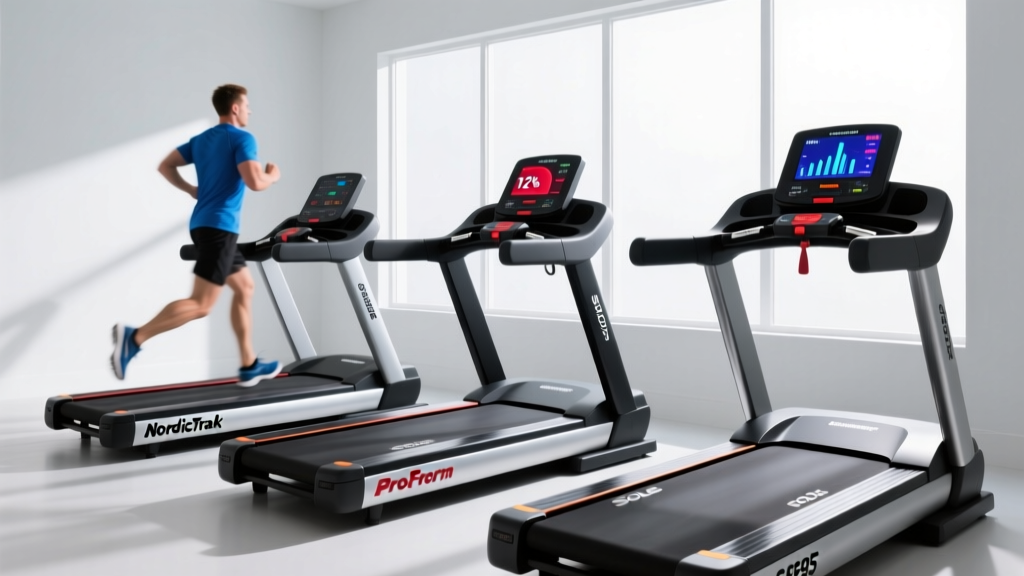
Treadmill Vert Calculator: Comparing Top Incline Models for 2026
Use our treadmill vert calculator framework to compare the NordicTrack X32i, ProForm 9000, and Sole F85 for maximum vertical gain and motor sustainability.

The Rise of Indoor Vert Training and the Math Behind It
As trail running, rucking, and mountaineering continue to surge in popularity through 2026, the demand for high-incline treadmills has fundamentally shifted the cardio equipment market. Athletes are no longer just looking for speed; they are hunting for vertical gain. However, comparing treadmills based solely on their advertised 'maximum incline percentage' is a flawed approach that leads to poor purchasing decisions and inaccurate training logs.
To truly evaluate incline treadmills, we must use a treadmill vert calculator framework that accounts for trigonometric realities, motor thermal limits, and spatial constraints. In this head-to-head comparison, we pit the three dominant incline heavyweights against each other: the NordicTrack X32i (40% incline), the ProForm Pro 9000 (30% incline), and the Sole F85 (15% incline).
The Treadmill Vert Calculator: A Trigonometric Reality Check
Most basic online vert calculators use a simplified formula: Distance (miles) × 5,280 × (Incline % / 100). This assumes the incline percentage represents the sine of the angle. It does not. Incline percentage is the tangent (Rise / Run).
The True Vert Formula:
Vertical Feet = Distance (ft) × sin(atan(Incline % / 100))
Why this matters: At a standard 15% incline (Sole F85), the basic formula overestimates your vert by a negligible 1.3%. But at a massive 40% incline (NordicTrack X32i), the basic formula overestimates your vertical climb by 7.8%. If you log 10,000 feet on a basic calculator at 40%, you actually only climbed 9,220 true vertical feet. Precision matters when training for events like the Leadville Trail 100 or the Grand Canyon rim-to-rim.
Head-to-Head Matrix: The 2026 Incline Heavyweights
Before dissecting the engineering and biomechanics, let us look at the raw specifications and true vertical output capabilities of these three machines. The 'Max True Vert/Hour' metric assumes a sustained 3.0 mph walking pace at maximum incline.
| Feature / Model | NordicTrack X32i | ProForm Pro 9000 | Sole F85 |
|---|---|---|---|
| Max Incline | 40% | 30% | 15% |
| Motor (Continuous Duty) | 4.0 CHP | 3.6 CHP | 4.0 CHP |
| True Vert Gain/Hour (at 3mph) | 5,882 ft | 4,585 ft | 2,482 ft |
| Deck Length | 65" | 60" | 60" |
| 2026 MSRP | $3,999 | $2,499 | $1,999 |
Motor Thermal Throttling: The Hidden Incline Killer
The most common failure mode for treadmills used in high-vert training is not belt snapping or console failure; it is the catastrophic burnout of the Motor Control Board (MCB) due to thermal throttling. When you walk at 2.0 mph on a 30% or 40% grade, the motor must output massive torque to lift your body weight against gravity.
The Low-Speed Cooling Problem
Most DC treadmill motors rely on an internal cooling fan directly attached to the motor rotor. At running speeds (6.0+ mph), the fan spins fast enough to dissipate heat. At steep walking speeds (2.0 mph), the fan spins too slowly to cool the intense amperage draw required for a 40% incline. According to equipment repair data, sustained low-speed, high-incline walking is the number one cause of premature motor death in home gyms.
- NordicTrack X32i: Mitigates this with a 4.0 CHP motor featuring advanced external cooling fins and a secondary forced-air induction system specifically designed for low-speed rucking and hiking simulations.
- ProForm Pro 9000: Features a 3.6 CHP motor. While adequate for 30% grades, users exceeding 220 lbs will notice the motor casing running hot during 60+ minute vert sessions. We recommend taking a 5-minute cool-down walk at 0% incline every 45 minutes to allow the internal fan to shed heat.
- Sole F85: Despite maxing out at 15%, its 4.0 CHP motor is virtually bulletproof for standard incline walking because the torque demands at 15% do not trigger the thermal limits of the MCB.
Biomechanical Load: What Extreme Incline Does to Your Tendons
Transitioning from flat ground to a 40% incline drastically alters your kinetic chain. The Hospital for Special Surgery (HSS) notes that extreme incline walking significantly shifts the load away from the patellofemoral joint (knees) and places it heavily on the posterior chain, specifically the Achilles tendon and the plantar fascia.
Clinical Warning: If you are using a treadmill vert calculator to plan a 5,000-foot indoor climbing week, be aware that a 40% incline increases Achilles tendon strain by up to 35% compared to a 15% incline. Progressive overload is mandatory to avoid insertional Achilles tendinopathy.
Furthermore, the American Council on Exercise (ACE) highlights that gluteus maximus activation nearly doubles when moving from a 10% to a 30% grade. If your goal is alpine mountaineering conditioning, the ProForm Pro 9000 (30%) offers the perfect biomechanical sweet spot: enough grade to trigger massive glute and hamstring adaptation, but not so steep that it forces you into an unnatural, toe-heavy stride that risks calf strains.
Deck Clearance and the 'Ceiling Strike' Edge Case
One of the most frequently overlooked aspects of buying an incline treadmill is spatial geometry. When a treadmill deck tilts to 40%, the front of the machine raises significantly. If you fail to calculate this, you will literally hit your head on your ceiling during your workout.
The Ceiling Strike Formula
- Base Deck Height: Most premium treadmills sit about 8 to 9 inches off the floor.
- Incline Lift: Multiply the usable deck length by the incline percentage. For the 65-inch deck of the NordicTrack X32i at 40%: 65 × 0.40 = 26 inches of lift.
- Total Front Height: 8" (base) + 26" (lift) = 34 inches (2 feet, 10 inches) off the ground.
- User Clearance: Add your height to the total front height. A 6'0" (72") user standing at the front of the deck will have their head at 106 inches (8 feet, 10 inches).
The Verdict on Space: If you have standard 8-foot (96-inch) ceilings, you cannot safely use the NordicTrack X32i at its maximum 40% incline unless you are shorter than 5'6". For standard basement or garage gyms with 8-foot ceilings, the Sole F85 (max 15% lift) or the ProForm Pro 9000 (max 30% lift, requiring roughly 8'4" ceilings for a 6-foot user) are the only mathematically viable options.
Final Verdict: Matching the Machine to Your Vert Goals
Choosing the right machine requires looking past the marketing and applying the treadmill vert calculator framework to your specific physiological and spatial reality.
Best for Elite Alpine Conditioning: NordicTrack X32i ($3,999)
Unmatched 40% incline and a 65-inch deck prevent stride clipping. However, it requires 9-foot ceilings for average-height users and demands strict adherence to motor cooling protocols during low-speed rucking.
Best Biomechanical Sweet Spot: ProForm Pro 9000 ($2,499)
The 30% max incline provides immense posterior chain activation without pushing the Achilles tendon into the danger zone. It fits in most modern homes with 8.5-foot ceilings and offers the best true-vert-per-dollar ratio in 2026.
Best for High-Volume Durability: Sole F85 ($1,999)
While capped at 15%, its 4.0 CHP motor will outlast the competition under daily, high-mileage use. Ideal for marathoners looking for moderate hill resistance without the spatial and mechanical headaches of extreme-grade machines.
For more data on how incline walking impacts cardiovascular efficiency, refer to ongoing biomechanical studies published by Runner's World and sports science journals. Ultimately, logging true vertical feet indoors requires respecting the math, the mechanics, and the limits of your own anatomy.
More gear to consider
All reviews
Elliptical vs Treadmill: Weighing ProForm Treadmill Support Costs

How Many Steps is 2 Miles on a Treadmill? Motor HP Guide

Treadmill Motor HP Guide for Your 5K Treadmill Training Plan
400m on Treadmill Sprints: Belt Maintenance & Cost Analysis

Elliptical vs Treadmill: 30 Min HIIT Treadmill Workout Trends 2026
