Rowing Machine Guide: What Does the Treadmill Target vs. Rowing?
Discover what the treadmill targets compared to rowing. Master ergometer technique, troubleshoot common mistakes, and read our 2026 buying guide.

The Biomechanical Shift: Treadmill vs. Ergometer
When fitness enthusiasts ask what does the treadmill target, the answer is predominantly the lower body—specifically the quadriceps, hamstrings, calves, and glutes—along with general cardiovascular conditioning. Treadmills rely on a continuous, repetitive pushing motion against a moving belt. However, transitioning from a treadmill to a rowing machine (ergometer) introduces a massive shift in biomechanics. While the treadmill isolates lower-body push mechanics, rowing is a full-body, pull-based power movement that engages approximately 86% of the body's musculature, according to research cited by the Concept2 technique database.
Quick Comparison Matrix:- Treadmill Primary Targets: Quads, calves, glutes, hamstrings, cardiovascular system.
- Rowing Machine Primary Targets: Lats, rhomboids, core, glutes, quads, hamstrings, biceps, and cardiovascular system.
- Impact Level: Treadmills (high impact on joints); Rowers (zero impact, seated).
Because the movement patterns are so drastically different, runners and walkers frequently make critical errors when they first sit on a rowing machine. This guide will troubleshoot those common technique mistakes, help you diagnose hardware issues, and provide a definitive 2026 buying guide for your home gym.
Top 3 Rowing Technique Mistakes (And How to Fix Them)
The most common rowing errors stem directly from applying a 'treadmill mentality' to the ergometer. Here is how to troubleshoot your stroke.
Mistake 1: The 'Legs-Only' Drive (Shooting the Slide)
The Problem: Because users know what the treadmill targets (the legs), they instinctively try to power the rowing stroke entirely with their quads. This results in 'shooting the slide,' where the hips and seat shoot backward before the handle moves. This disconnects the leg power from the upper body, placing immense, dangerous shear force on the lumbar spine.
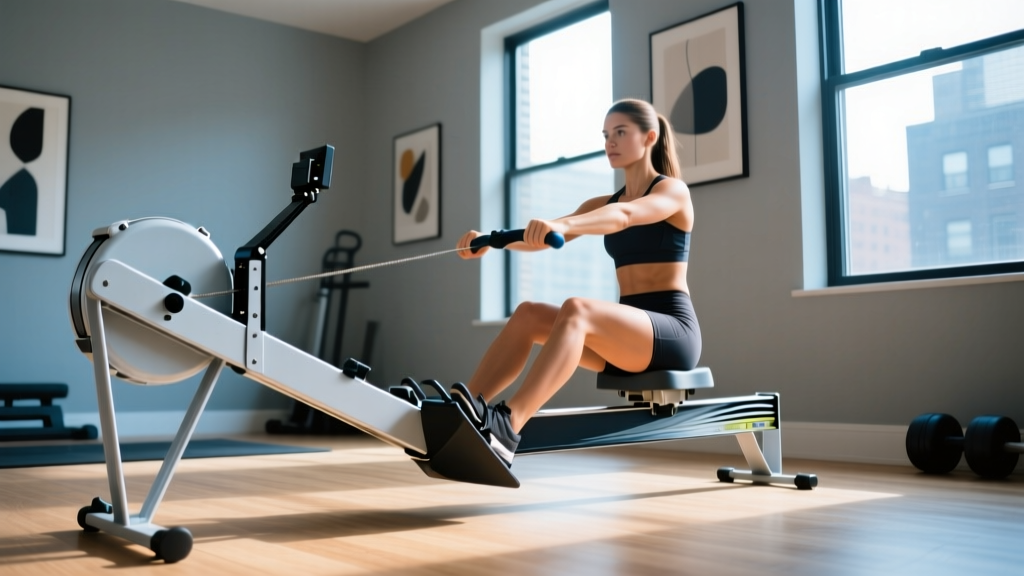
The Fix: The rowing stroke is a sequenced transfer of power: Legs, Core, Arms. During the 'Drive' phase, your arms must remain completely straight like ropes until your legs are nearly fully extended. Only then should you hinge at the hips and pull with the arms. If you notice your seat moving backward but the handle isn't moving with it, drop your damper setting to 3 and focus on keeping your shoulders in front of your hips during the first half of the drive.
Mistake 2: Gripping the Handle Like a Lifeline
The Problem: Unlike treadmill handrails which are used for balance, the rowing handle requires active pulling. Beginners often over-grip, wrapping their thumbs tightly and squeezing with maximum force. This leads to premature forearm fatigue, blistering, and a breakdown in wrist posture (flexion) at the catch.
The Fix: Use a 'hook grip.' Wrap your fingers around the handle, but keep your thumbs resting lightly on top or beside it. Your wrists must remain completely flat and neutral throughout the stroke. The power should transfer through the skeletal structure of your forearms, not the muscular tension of your grip.
Mistake 3: Rushing the Recovery
The Problem: On a treadmill, your cadence (steps per minute) is dictated by the belt speed. On a rower, users often rush back to the 'catch' (the starting position) to mimic a high stepping cadence. This ruins the work-to-rest ratio. The drive should be explosive (1 second); the recovery should be controlled and relaxing (2 seconds).
The Fix: Implement a 1:2 stroke ratio. Count 'one' on the drive, and 'two, three' on the slide forward. Your stroke rate (s/m) should hover between 18 and 24 s/m for steady-state cardio, not 30+.
Hardware Troubleshooting: Fixing Squeaks, Slips, and Screen Errors
Even the best technique won't save a poorly maintained machine. Below is a troubleshooting matrix for the three main resistance types found in modern ergometers.
| Resistance Type | Common Symptom | Troubleshooting & Fix |
|---|---|---|
| Air (e.g., Concept2) | Grinding noise on the chain; heavy catch. | Clean chain with paper towel, apply 1 tsp of purified mineral oil or 20W-50 motor oil. Wipe excess. Clean the monorail with Windex. |
| Magnetic (e.g., Sunny, Echelon) | Belt slipping; inconsistent drag at high resistance. | Check internal Kevlar belt tension. If the machine uses a nylon strap, inspect for fraying at the spool. Tighten the rear idler pulley if accessible. |
| Water (e.g., WaterRower) | Sluggish paddle; water looks cloudy/green. | Drop a water purification tablet (chlorine) into the tank. Never use bleach. Ensure water level is between the 13-17 liter marks for optimal drag. |
2026 Ergometer Buying Guide: Matching Machine to Your Mechanics
Understanding what the treadmill targets versus what a rower targets is only half the battle; selecting the right hardware for your home gym is the other. Here are the top contenders for 2026, categorized by use case.
The Gold Standard: Concept2 RowErg (Model D)
- Price Range: $990 - $1,095
- Resistance: Air with variable damper (1-10)
- Best For: Serious athletes, CrossFitters, and data purists.
- The Verdict: The Concept2 remains the undisputed king of ergometers. Its PM5 monitor is universally compatible with third-party apps like ErgData and Zwift. The air resistance perfectly mimics the physics of moving a boat through water, meaning the harder you pull, the more resistance it generates. It requires minimal maintenance and holds its resale value better than any other fitness equipment on the market.
The Immersive Smart Rower: Hydrow (2nd Generation)
- Price Range: $2,495 (plus $44/mo subscription)
- Resistance: Electromagnetic with patented drag feel
- Best For: Visual learners, scenic route lovers, and tech-forward homes.
- The Verdict: Hydrow replaces the raw, utilitarian feel of an air rower with a sleek, silent electromagnetic brake and a massive 22-inch HD touchscreen. The 'Live Outdoor Reality' workouts feature Olympic rowers coaching you through real waterways. However, if your Wi-Fi drops, the machine's value proposition plummets. It is an incredible luxury purchase, but less ideal for pure, unplugged interval training.
Budget Magnetic: Sunny Health & Fitness SF-RW5515
- Price Range: $230 - $280
- Resistance: Magnetic (12 levels)
- Best For: Beginners, apartment dwellers, and tight budgets.
- The Verdict: If you are just transitioning from a treadmill and want to test the waters without spending $1,000, this is the entry point. It is whisper-quiet due to the magnetic brake. The trade-off? The rail is shorter (max user height is roughly 5'10''), the monitor is rudimentary, and the stroke lacks the smooth, infinite scaling of air resistance.
Step-by-Step Stroke Sequence Checklist
Print this checklist and tape it near your monitor to ensure you maintain proper form, avoiding the common pitfalls of treadmill-trained athletes.
- The Catch: Shins vertical (no further), torso hinged forward at 11 o'clock, arms straight, lats engaged.
- The Drive (Phase 1): Push through the heels. Arms stay locked. Hips and shoulders move backward at the exact same speed.
- The Drive (Phase 2): As legs approach full extension, swing the torso back to 1 o'clock.
- The Drive (Phase 3): Draw the handle to the lower ribs (sternum), keeping elbows tucked past the torso.
- The Finish: Legs flat, torso slightly leaned back, handle resting at the ribs. Pause for a micro-second.
- The Recovery (Reverse Order): Extend arms fully -> Hinge torso forward to 11 o'clock -> Bend knees and slide back to the catch.
'Remember, the rowing machine is not a test of how fast you can slide back and forth. It is a test of how much wattage you can apply to the flywheel per stroke. Slow down your slide, explode on the drive.'
— Aligns with cardiovascular guidelines from the World Health Organization, which emphasize the quality and intensity of aerobic muscle engagement over sheer repetition speed.
Frequently Asked Questions
Should I set the damper to 10 for the best workout?
No. A damper setting of 10 is equivalent to rowing a heavy, slow wooden boat. It will exhaust your lower back before your cardiovascular system gets a proper workout. Set the damper between 3 and 5. This yields a 'drag factor' of 100-130, which accurately simulates the water resistance of a sleek racing shell.
Can I use a rowing machine if I have knee pain from treadmill running?
Yes, rowing is highly recommended for joint rehabilitation because it is zero-impact. However, ensure you do not compress your knees past a 90-degree angle at the catch. If you have severe patellar tendonitis, limit the forward slide until your mobility improves.
How often should I oil the chain?
For every 40-50 hours of use, or once a month if you row 3+ times a week. Always use purified mineral oil or synthetic motor oil; never use WD-40, as it will strip the factory lubrication and attract dust to the chain links.
More gear to consider
All reviews
Walking Pads vs. Traditional Types of Treadmills (2026)

Star Trac 4 Series Treadmill: Feature Comparison & Buyer Mistakes
Rowing Machine Buying Guide & Technique vs Borgusi Treadmill Review

Beyond the iMovr Treadmill: Stair Climber Home Guide 2026

Rowing Machine Guide & Technique vs Treadmill with Weighted Vest