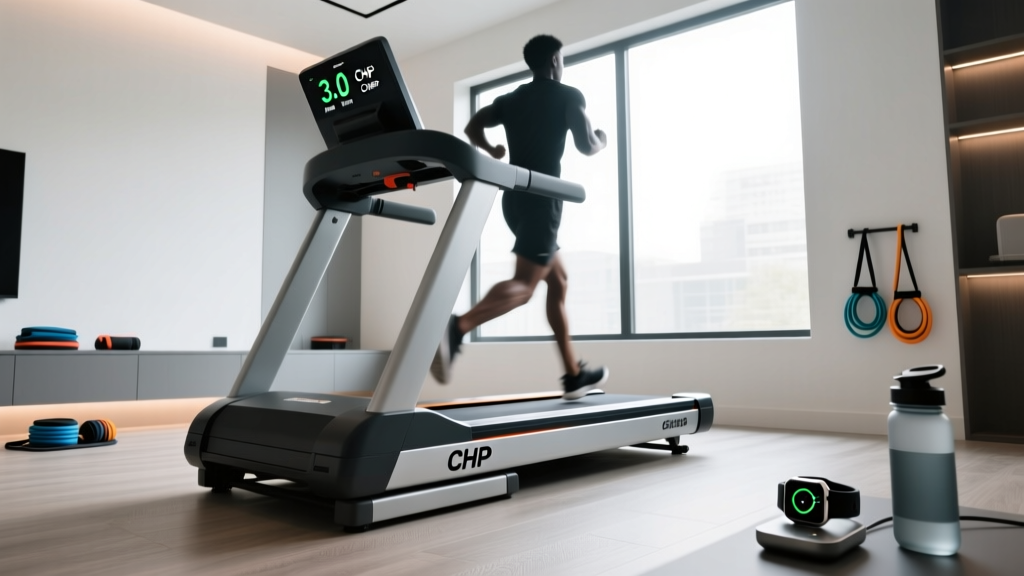
1 Hour on Treadmill Everyday Results: Is Your Motor Size Enough?
Discover the true 1 hour on treadmill everyday results. Learn how motor size, CHP ratings, and daily use impact your machine's lifespan and performance.

The Fitness vs. Hardware Paradox: Daily Cardio Expectations
When fitness enthusiasts search for 1 hour on treadmill everyday results, they are usually looking for transformative cardiovascular improvements, significant calorie deficits, and enhanced endurance. According to the CDC's physical activity guidelines, exceeding the baseline 150 minutes of moderate aerobic activity per week yields compounding health benefits. Committing to 60 minutes of daily treadmill work will undoubtedly accelerate your fitness results. However, there is a hidden bottleneck that most buyers ignore until their machine abruptly shuts down mid-stride: the treadmill motor.
While your body might be adapting to the daily one-hour workload, an underpowered treadmill motor will degrade rapidly under high-volume, continuous friction. In 2026, the market is flooded with budget-friendly treadmills boasting deceptive horsepower claims. If you are running or power-walking for an hour every single day, understanding motor sizing, failure modes, and troubleshooting protocols is the difference between a lifelong fitness investment and a $600 paperweight.
The Horsepower Illusion: Peak HP vs. Continuous HP (CHP)
The most common mistake consumers make is reading the bold 'Peak Horsepower' (HP) sticker on the box and assuming it reflects the machine's true capability.
⚠️ The Marketing Trap: Peak HP measures the absolute maximum power the motor can draw for a fraction of a second before failing. Continuous Horsepower (CHP) measures the power the motor can sustain indefinitely during a normal workout. A budget treadmill advertising '2.5 HP' might only possess a 1.25 CHP motor. For a 1-hour daily workout, you must base your purchasing and troubleshooting decisions strictly on the CHP rating.Home treadmills utilize Direct Current (DC) motors, which rely on internal carbon brushes and a Pulse Width Modulation (PWM) control board to regulate speed. Unlike the Alternating Current (AC) motors found in commercial gym treadmills, DC motors generate significant internal heat. If the CHP is too low for your body weight and pace, the motor overworks, the PWM board overheats, and the system triggers a thermal shutdown to prevent a fire hazard.
Motor Size Requirements by User Weight and Pace
To achieve your daily results without destroying your hardware, match your CHP to your specific usage profile. The Sole Fitness engineering specifications and industry standards dictate the following baselines for high-volume (1+ hour daily) users:
| User Weight | Activity (1 Hr/Day) | Minimum Required CHP | Example 2026 Models |
|---|---|---|---|
| Under 150 lbs | Brisk Walking (3-4 mph) | 2.0 CHP | Horizon T101 (2.5 CHP) |
| 150 - 200 lbs | Jogging (4-6 mph) | 2.75 CHP | NordicTrack T 7.5S (2.75 CHP) |
| 150 - 200 lbs | Running (6+ mph) | 3.0 CHP | Horizon 7.4 (3.0 CHP) |
| 200 - 250+ lbs | Running (6+ mph) | 3.5 to 4.0 CHP | Sole F80 (3.5 CHP) |
"If you weigh over 200 pounds and run for an hour daily on a 2.5 CHP motor, you are effectively asking a lawnmower engine to pull a trailer. The amp draw will spike, the belt will jerk, and the lower control board will fry within 90 days." — FitGearPulse Hardware Testing Team
Common Motor Failure Modes from High-Volume Use
When you push a treadmill for 60 minutes every day, specific hardware components bear the brunt of the mechanical stress. Recognizing these failure modes is the first step in troubleshooting.
- Thermal Overload Tripping: DC motors have internal thermal breakers. If the motor casing exceeds 105°C, the breaker trips, causing the treadmill to stop suddenly. It will not restart until it cools for 15-30 minutes.
- PWM Board Burnout: The lower control board sends voltage to the motor. When a motor struggles (due to user weight or belt friction), it pulls more amps. The PWM board attempts to compensate by sending more voltage, eventually melting its internal relays.
- Carbon Brush Depletion: DC motors use carbon brushes to conduct electricity to the spinning armature. An hour a day equals 365 hours a year. Cheap motor brushes can wear down to the metal spring in under 18 months, leading to arcing, a distinct ozone smell, and total motor failure.
- Drive Belt Slippage: The ribbed belt connecting the motor pulley to the front roller can stretch and glaze under high-heat, high-duration use, causing a 'hesitation' or 'jerking' sensation underfoot that mimics a motor issue.
Step-by-Step Troubleshooting for Overworked Motors
Before ordering a $300 replacement motor or scrapping the machine, perform this diagnostic sequence to isolate the root cause of your treadmill's performance drop.
Step 1: The Deck Friction Test
Up to 70% of 'motor' problems are actually belt friction problems. A dry belt forces the motor to work exponentially harder. Unplug the machine. Reach under the walking belt and feel the deck. If it is completely dry, or if you notice a buildup of black rubber dust, the friction coefficient is too high. Apply 100% silicone treadmill lubricant (approx. 1 oz) between the belt and the deck. This single step can reduce motor amp draw by up to 40%.
Step 2: The Amp Draw Test (The Ultimate Diagnostic)
To know exactly how hard your motor is working, you need a digital clamp multimeter.
- Remove the motor hood.
- Clamp the meter around the red (positive) wire connecting the lower control board to the motor.
- Turn the treadmill on and set it to 3.0 mph with no one on it. A healthy motor should draw between 2 to 4 amps.
- Step onto the treadmill and walk at 3.0 mph. The amp draw should rise to 5 to 8 amps (depending on user weight).
- If the amp draw spikes above 12-15 amps while walking, your motor is suffocating under mechanical resistance (bad deck/belt) or the motor's internal bearings are seizing.
Step 3: Inspect the Drive Belt and Pulley
If the motor sounds like it is spinning at the correct RPM, but the walking belt is stuttering or stopping, the issue is the drive belt. Check the tension. You should only be able to lift the drive belt about 1/4 inch off the motor pulley. If it is loose, adjust the motor mount bolts to increase tension. If the belt is glazed or cracked, replace it (typically a $15-$25 part).
💡 Pro-Tip: The 'Coast Down' Diagnostic
If your treadmill displays an 'Error 1' or 'Speed Sensor' code during your 1-hour runs, it often means the motor is bogging down so much that the console thinks the belt has stopped. Watch the treadmill when you hit the stop button. If it stops abruptly rather than coasting to a gradual halt, your deck friction is critically high, or the motor bearings are binding.
Upgrading vs. Replacing: The 2026 Cost Breakdown
If your daily 1-hour regimen has indeed killed your treadmill motor, you face a financial decision. Here is the realistic repair vs. replace matrix for 2026:
- Motor Replacement: A new OEM DC motor costs between $180 and $350. If your treadmill originally cost under $600 (e.g., a basic ProForm or Horizon T-series), replacing the motor is economically illogical. The control board and roller bearings are likely next in line to fail.
- Control Board Replacement: If the motor tests fine but receives no voltage, a new PWM board costs $120 to $220. This is a highly repairable fault worth fixing on mid-tier machines.
- The Upgrade Path: If you are committed to the 1-hour daily results and weigh over 180 lbs, reinvest your repair budget into a machine built for high-volume abuse. The Sole F80 (approx. $1,199) features a 3.5 CHP motor and a lifetime motor warranty, while the Horizon 7.4 (approx. $999) offers a robust 3.0 CHP motor with superior cooling fans designed specifically for extended daily run times.
FAQ: Daily Treadmill Use and Hardware Lifespan
Will walking for 1 hour a day ruin a budget treadmill?
Not necessarily, provided you are under the weight limit and maintain the belt. Walking generates significantly less downward force and requires less continuous torque than running. A 2.0 CHP motor can easily handle a 150 lb user walking for an hour daily, provided the deck is lubricated every 3 months.
How often should I lubricate my treadmill if I use it 7 days a week?
Standard manuals recommend lubrication every 150 miles. If you run 5 mph for 1 hour a day, you are logging 35 miles a week. This means you need to inspect and potentially lubricate your belt every 4 to 5 weeks to protect the motor from excessive amp draw.
Do treadmill cooling fans actually prevent motor burnout?
Yes, but they must be clean. High-end models feature internal motor cooling fans attached to the armature shaft. Over time, these fans suck in household dust and pet hair, clogging the vents. Vacuum your motor hood every two months to ensure the internal fan can dissipate the heat generated by your daily one-hour workouts.
More gear to consider
All reviews
Omni VR Treadmill vs Stationary Bike Types: 2026 Market Trends

AFG Sport Treadmill & Stationary Bike Maintenance Guide

Rowing vs Treadmill Routine to Lose Weight: Buying & Technique

Treadmill Abuse Death Risks: Safety Features & Buying Guide

Vision Fitness Treadmill T9200: 2026 Small Space Value Analysis
