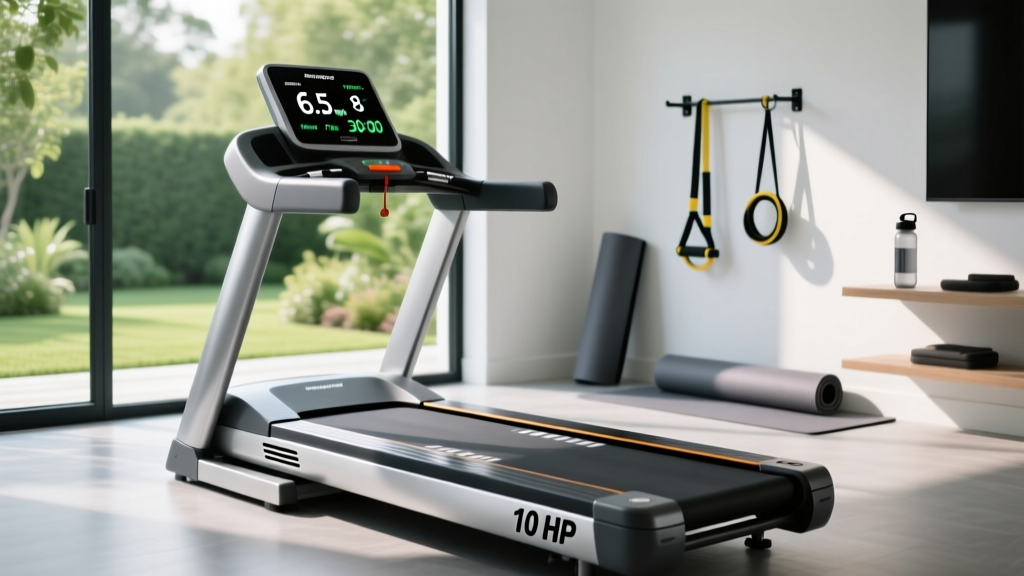
Treadmill Motor Guide: How Many Minutes on Treadmill to Lose Weight
Discover how many minutes on a treadmill to lose weight and the exact motor HP you need to sustain high-volume cardio routines without hardware failure.

The Intersection of Weight Loss Goals and Treadmill Hardware
When fitness enthusiasts ask, "how many minutes on treadmill to lose weight?", the conversation almost exclusively revolves around calorie deficits, heart rate zones, and metabolic conditioning. Rarely does the discussion pivot to the mechanical heart of the machine itself: the drive motor. Yet, your weight loss timeline is directly bottlenecked by your treadmill’s Continuous Duty Horsepower (CHP). If your hardware cannot sustain the required weekly volume without thermal throttling or premature degradation, your fitness goals will stall.
According to Harvard Health Publishing, significant and sustained weight loss generally requires 200 to 300 minutes of moderate-to-vigorous cardiovascular exercise per week. If you are logging 45 to 60 minutes a day, five days a week, an undersized treadmill motor will overheat, trip its thermal breaker, or permanently fry its control board. This in-depth guide bridges the gap between physiological weight loss requirements and the mechanical engineering of 2026’s top cardio machines.
The Quick Answer: Minutes vs. Motor Strain
To lose 1 to 2 pounds per week, the CDC recommends a baseline of 150 minutes of moderate activity, but Mayo Clinic experts note that weight loss specifically demands upward of 250+ minutes weekly. Translation: You need a machine rated for high-volume, continuous runtime. A 2.0 CHP motor will fail under this load; you need a minimum of 3.0 CHP for sustained daily running.
Decoding Treadmill Horsepower: The Marketing Trap
Before calculating your exact motor requirements, you must understand how manufacturers label their machines. In the fitness equipment industry, horsepower (HP) is the most manipulated metric.
Peak HP vs. Continuous Duty HP (CHP)
- Peak HP: This is the absolute maximum power the motor can draw for a fraction of a second before stalling. It is a useless metric for weight loss routines. A treadmill boasting "4.0 Peak HP" might only sustain 1.5 CHP during a 30-minute jog.
- Continuous Duty HP (CHP): This is the power the motor can output continuously over an extended workout session without overheating. Always base your purchasing decision on CHP.
Flywheel Mass and Amp Draw
Motor size does not exist in a vacuum. A 3.0 CHP motor paired with a lightweight 12-lb flywheel will work significantly harder (drawing more amps) to maintain belt momentum than a 3.0 CHP motor paired with a 20-lb flywheel. Higher flywheel mass reduces the electrical strain on the motor, allowing you to hit your 300-minute weekly weight loss target with less thermal buildup.
Motor Size Matrix: Matching HP to Your Weight Loss Routine
Use the matrix below to determine the minimum CHP required based on your body weight and your weekly weight-loss cardio volume. Note that user weight drastically increases the amp draw on a DC treadmill motor.
| User Weight | Walking (150 mins/wk) | Jogging (200 mins/wk) | Running (300+ mins/wk) |
|---|---|---|---|
| Under 150 lbs | 2.0 CHP | 2.5 CHP | 3.0 CHP |
| 150 - 200 lbs | 2.5 CHP | 3.0 CHP | 3.5 CHP |
| 200 - 250 lbs | 3.0 CHP | 3.5 CHP | 4.0 CHP |
| 250+ lbs | 3.5 CHP | 4.0 CHP | 4.0+ CHP (Commercial) |
Top 2026 Treadmills with Motors Built for High-Volume Weight Loss
As of 2026, supply chain stabilizations and advancements in brushless DC motor manufacturing have brought high-CHP machines back into accessible price brackets. Here are three models engineered specifically to handle the 250+ minute weekly volume required for aggressive weight loss.
1. Sole Fitness F80 (3.5 CHP)
- Price: $1,199.99
- Motor Specs: 3.5 CHP Brushless DC, heavy-duty cooling fan
- Weight Loss Suitability: Exceptional for heavy runners. The 3.5 CHP motor paired with Sole's 24-lb flywheel ensures minimal amp draw during long, steady-state Zone 2 cardio sessions (ideal for fat oxidation).
- Edge Case: The console fan is adequate, but if placed in a humid, un-air-conditioned garage, the thermal sensor may trip at the 55-minute mark.
2. Horizon Fitness 7.4 (3.0 CHP)
- Price: $999.00
- Motor Specs: 3.0 CHP, Rapid Charge USB integration
- Weight Loss Suitability: Best for walkers and light joggers aiming for 200 minutes a week. It utilizes a quick-dial tension system that reduces belt friction, indirectly preserving the motor.
- Edge Case: Not recommended for users over 220 lbs attempting sprint intervals, as the PWM (Pulse Width Modulation) board can overheat under rapid acceleration loads.
3. NordicTrack Commercial 1750 (3.5 CHP)
- Price: $1,999.00
- Motor Specs: 3.5 CHP Self-Cooling Motor
- Weight Loss Suitability: Perfect for users utilizing interactive coaching (iFIT) to maintain the mental stamina required for 300+ weekly minutes. The motor dynamically adjusts to incline/decline shifts without lagging.
- Edge Case: Requires an active iFIT subscription to unlock manual mode; otherwise, the motor's full manual override capabilities are restricted.
Real-World Failure Modes: When Undersized Motors Die
What actually happens when you force a 2.0 CHP treadmill to run 45 minutes a day for weight loss? The failure cascade is predictable and expensive.
- Belt Friction and Amp Spikes: As the belt dries out, friction increases. The motor must draw more amps to maintain your target speed. A 2.0 CHP motor rated for 10 amps will suddenly pull 18 amps.
- Thermal Cutoff Tripping: The internal thermal switch detects the heat spike and shuts the machine off mid-stride. This is a safety feature, but it ruins your workout consistency.
- PWM Board Frying: If the thermal switch fails or is bypassed, the excessive current melts the solder joints on the Pulse Width Modulation board, resulting in a $250 to $400 replacement cost.
- Demagnetization: Chronic overheating can permanently demagnetize the internal magnets of a DC motor, leading to a permanent loss of torque that no software update can fix.
"Consistency is the primary driver of weight loss. A treadmill that requires a 20-minute cool-down period after 30 minutes of use inherently caps your caloric expenditure and breaks your psychological momentum. Buy the motor size your future, fitter self will need, not just what your current budget prefers."
— FitGearPulse Engineering Team, 2026 Hardware Analysis
Maintenance Protocols to Extend Motor Life During Heavy Use
If you are committing to 250+ minutes a week to lose weight, you are putting commercial-level wear on a residential machine. Implement these protocols to protect your motor investment:
The 90-Day Lubrication Rule
Most manufacturers suggest lubricating the belt every 300 miles. For a 180-lb user running 15 miles a week, that is every 5 months. However, for high-volume weight loss routines, lubricate every 90 days using 100% silicone treadmill lube. This single action reduces motor amp draw by up to 30%, drastically lowering operating temperatures.
Belt Tension Calibration
A belt that is too tight puts lateral stress on the motor bearings and the rear roller. You should be able to lift the center of the running belt exactly 2 to 3 inches off the deck. If it lifts 4 inches, it’s too loose (causing slipping); if it lifts 1 inch, it’s choking the motor.
Frequently Asked Questions
Can I use a walking pad for my 300-minute weekly weight loss goal?
No. Walking pads (under-desk treadmills) typically feature 1.0 to 1.5 HP motors designed for low-speed, intermittent use. Attempting to log 60-minute daily sessions on a walking pad will void the warranty and likely burn out the motor within the first month.
Does incline training require more motor horsepower?
Yes. Running at a 10% to 15% incline shifts the load from horizontal momentum to vertical lifting. The motor must work significantly harder to pull your body weight up the deck. If you plan to do high-incline walking (like the viral 12-3-30 method) for weight loss, add 0.5 CHP to the baseline recommendations in our matrix.
Are AC motors better than DC motors for home weight loss routines?
AC (Alternating Current) motors are found in commercial gym treadmills. They run cooler and last longer under 24/7 use but are heavier, louder, and require 220V outlets. For 95% of home users logging up to 10 hours a week, a high-quality 3.5 CHP Brushless DC motor is the superior, more cost-effective choice.
More gear to consider
All reviews
Stair Climber vs Nautilus 618 Treadmill: Home Buying Guide

Under Desk Treadmill Review: Value for Garmin Treadmill Running
Skip the Viral Treadmill Walking Workout: Home Stair Climber Guide
UREVO 2-in-1 Folding Walking Pad Treadmill & Stationary Bike Care

Skip Treadmill Lubrication: Beginner Rowing Machine Buying Guide
