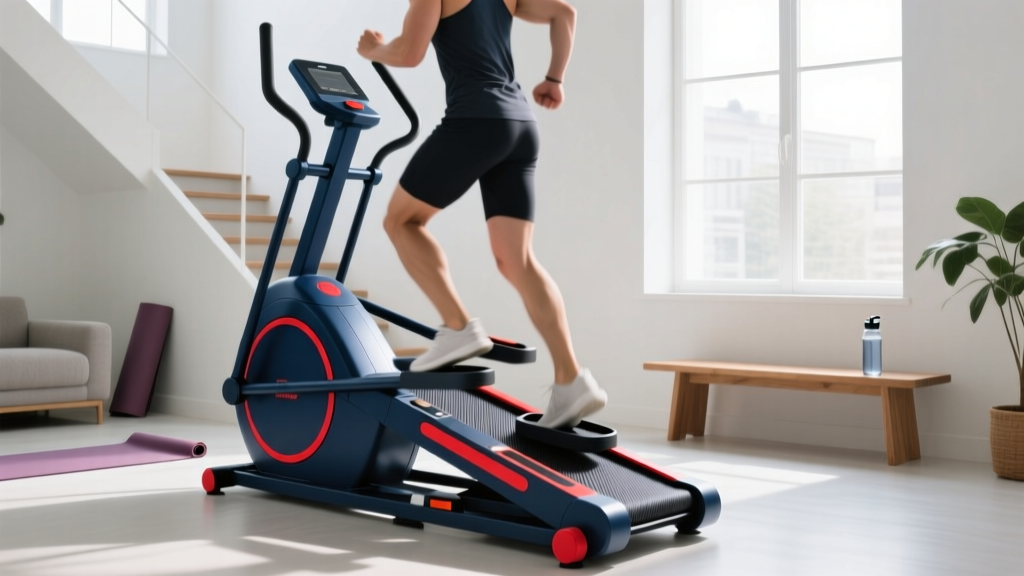
Running on Treadmill Hurts Knees? Home Stair Climber Guide & Fixes
If running on treadmill hurts knees, transition safely. This troubleshooting guide covers home stair climber mechanics, form mistakes, and top models.

The Biomechanics: Why Running on a Treadmill Hurts Your Knees
If you have ever stepped off your treadmill and felt that familiar, sharp ache beneath your kneecap, you are not alone. The phrase "running on treadmill hurts knees" is one of the most common search queries in home fitness troubleshooting. To understand why this happens, we have to look at the biomechanics of the moving belt. When you run outdoors, your hamstrings and glutes actively pull your body forward over your planted foot. On a motorized treadmill, the belt pulls your foot backward beneath you. This alters your natural gait cycle, often leading to a heavier heel-strike and an over-striding motion.
According to the American Academy of Orthopaedic Surgeons, high-impact activities like running generate ground reaction forces equivalent to 2.5 to 3 times your body weight. For a 180-pound runner, that translates to roughly 450 to 540 pounds of sheer compressive force traveling up the tibia and into the patellofemoral joint with every single stride. Over a 3-mile run, that is thousands of repetitive micro-traumas to the knee cartilage and patellar tendon.
Warning: The Eccentric Loading TrapBecause the treadmill belt accelerates your foot backward, your quadriceps must work eccentrically (lengthening under tension) to decelerate the leg. This eccentric overload is a primary culprit for patellar tendinopathy, commonly known as "jumper's knee," which feels like a deep, burning ache just below the kneecap during and after your workout.
The Pivot: Why a Home Stair Climber is the Ultimate Low-Impact Alternative
If running on treadmill hurts knees, the most effective intervention is not necessarily buying a new pair of $200 running shoes; it is changing the vector of your exercise. Stair climbing is a closed-chain kinetic exercise. Your foot remains planted on a solid pedal, eliminating the jarring heel-strike impact entirely. The Mayo Clinic frequently recommends closed-chain, low-impact cardio for individuals managing osteoarthritis or chronic joint pain, as it builds the surrounding musculature without degrading the cartilage.
By shifting your home gym focus to a stair climber, you engage the gluteus maximus, hamstrings, and quadriceps through a deep range of motion, effectively bulletproofing your knees by strengthening the muscles that support them.
Top Home Stair Climbers for Knee-Sensitive Users (2026 Market)
Not all stair climbers are created equal. When knee preservation is the goal, step depth and pedal ergonomics are critical. Here are the top three models on the market tailored for home use:
- StairMaster SC7i (Approx. $3,499): The gold standard. It features an 8-inch step depth and a 16-level magnetic resistance system. The deep step forces proper hip extension, taking the shear force off the knee and placing it squarely on the glutes. It requires a ceiling clearance of at least 9 feet.
- Bowflex Max Trainer SE7 (Approx. $1,999): An elliptical-stepper hybrid. If even the slight weight-bearing compression of a traditional stepper irritates your joints, the SE7 provides a zero-impact, gliding vertical climb with 20 resistance levels and upper-body integration.
- Sunny Health & Fitness SF-SBE957 (Approx. $399): A budget-friendly hydraulic mini-stepper. While it lacks the deep 8-inch range of motion of the SC7i, it offers a low-cost entry point for seated or standing low-impact cardio. Note: The weight capacity is capped at 220 lbs, and the shallow 4-inch step requires stricter form to avoid knee strain.
Joint Load Comparison: Treadmill vs. Stair Climber
| Biomechanical Metric | Motorized Treadmill | Stair Climber |
|---|---|---|
| Peak Joint Impact Force | 2.5x - 3.0x Body Weight | 1.0x - 1.2x Body Weight |
| Primary Muscle Activation | Calves, Hip Flexors, Quads | Glutes, Hamstrings, Quads |
| Eccentric Deceleration | High (Belt Pull) | Low (Controlled Descent) |
| Patellar Tendon Shear | High (Heel Strike) | Low (Mid-Foot Planted) |
5 Common Stair Climber Mistakes That Still Cause Knee Pain
Transitioning away from the treadmill is only half the battle. The American Council on Exercise (ACE) notes that improper form on low-impact machines can negate their joint-saving benefits. If you switch to a stair climber but still experience knee pain, you are likely committing one of these five critical errors:
- The "Handrail Crutch" (Slouching): Leaning your body weight onto the handrails reduces caloric burn by up to 20% and, more importantly, shifts your center of gravity backward. This prevents full hip extension and forces the quadriceps and patellar tendon to absorb the entire load of the step-up. Fix: Keep your hands resting lightly on the rails for balance only. Your torso should be upright or slightly hinged forward at the hips.
- Toe-Stepping: Pressing only with the balls of your feet overloads the calf muscles and creates an anterior shear force on the knee joint. Fix: Drive through the mid-foot and heel.
- Short-Stepping (Shallow ROM): Taking rapid, shallow 2-inch steps turns the workout into a calf-bounce rather than a leg press. This limits glute activation and overworks the knee joint. Fix: Aim for a minimum 6-inch to 8-inch step depth. Slow the machine speed down to maintain this depth.
- Locking the Knees at the Top: Hyperextending your leg at the peak of the step transfers the load from your muscles directly into your skeletal structure and joint capsules. Fix: Maintain a "soft knee" (a micro-bend) at the top of every single press.
- Ignoring the Hip Hinge: Standing perfectly straight up limits the stretch on the gluteus maximus. Fix: Hinge forward slightly (about 10 to 15 degrees) from the hips, keeping your spine neutral, to engage the posterior chain.
Form Troubleshooting: The "Mid-Foot" Protocol
To completely eliminate anterior knee pain on a stair climber, implement the Mid-Foot Protocol. When your foot strikes the pedal, your heel must make contact simultaneously with the ball of your foot. As you drive the pedal down, visualize pushing through your heel. This subtle shift in weight distribution instantly disengages the calves and recruits the hamstrings and glutes, acting as a natural shock absorber for the patella.
"The knee is a victim of its neighbors. If the ankle is stiff and the hip is weak, the knee will take the beating. Driving through the heel on a stair climber forces the hip to do the work it was designed for."
— Sports Biomechanics Principle
Your 14-Day Transition Plan
Do not attempt to match your treadmill volume on your first day with the stair climber. The muscular endurance required for vertical climbing is vastly different from horizontal running. Follow this 14-day troubleshooting transition plan to adapt your tendons and muscles without triggering inflammation:
- Days 1-4: 15 minutes at a slow pace (40-50 steps per minute). Focus entirely on heel-driven mid-foot strikes and maintaining an upright posture without gripping the rails.
- Days 5-9: 20-25 minutes. Introduce interval training: 2 minutes at 60 SPM (Steps Per Minute), followed by 2 minutes at 45 SPM. Monitor your knees for any delayed onset soreness in the patellar tendon.
- Days 10-14: 30+ minutes. Begin utilizing the machine's resistance levels rather than just speed to increase cardiovascular demand. Keep the step depth deep and controlled.
By understanding the biomechanical flaws of treadmill running and mastering the closed-chain mechanics of the stair climber, you can maintain elite cardiovascular fitness while allowing your knee joints the recovery and respect they require.
More gear to consider
All reviews
Folding Treadmill Review: Space Safety and the Corey Treadmill Death
2026 Review: Folding Treadmills From Commercial Treadmill Brands

Curved vs Motorized Setup: How to Disassemble a ProForm Treadmill

Home Use Treadmill XM-Q1: Step-by-Step Noise Comparison Guide

XTERRA TRX4500 Treadmill Review: Noise Comparison & Fixes
