Treadmill Icon vs 3 Bike Types: A Budget & Value Breakdown
Compare the cost of a flagship treadmill icon against upright, recumbent, and spin bikes. Discover the true ROI and budget breakdown for 2026 home gyms.

The Flagship Treadmill Icon: Baseline Cost & Hidden Depreciation
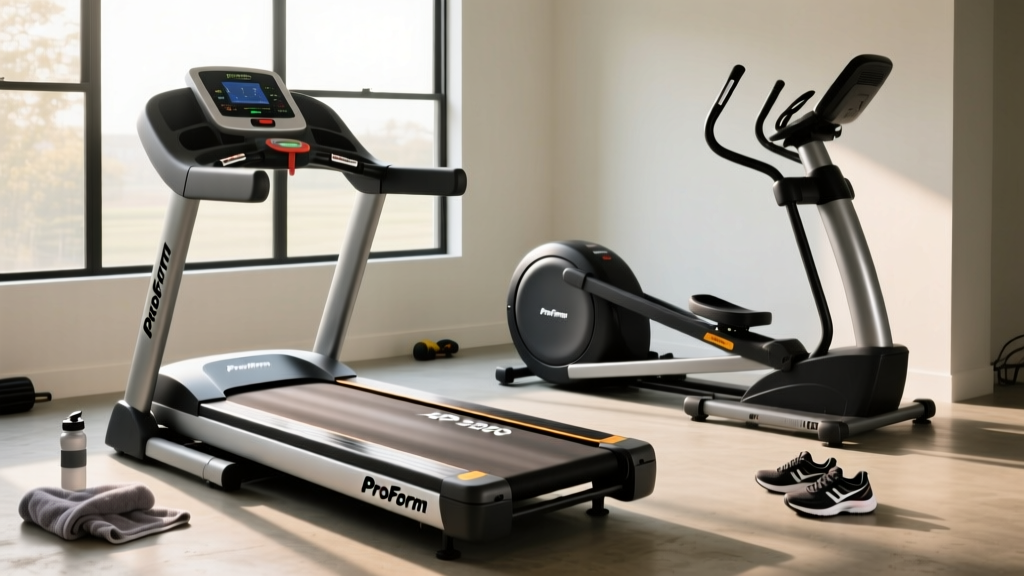
For decades, the quintessential treadmill icon has represented the ultimate home gym status symbol. When buyers picture a premium home fitness setup, they usually envision a $3,000+ flagship machine with a massive HD touchscreen, a 4.0 CHP motor, and an integrated subscription ecosystem. However, from a strict budget breakdown and value analysis perspective, anchoring your entire cardio budget to a single flagship treadmill is often a misallocation of funds.
In 2026, the average premium treadmill costs between $2,499 and $3,999. But the upfront price is only the beginning. Treadmills suffer from high mechanical depreciation. The deck requires silicone lubrication every 150 miles, drive belts stretch and require tensioning, and the continuous impact of foot strikes inevitably leads to motor controller board fatigue. Furthermore, a premium treadmill demands roughly 20 to 25 square feet of dedicated floor space and draws significant amperage, often requiring a dedicated 20A circuit to prevent breaker trips.
⚠️ The Subscription Trap: Most flagship treadmills heavily restrict their manual modes or auto-incline features unless you pay a monthly connected fitness fee (typically $39 to $44/month). Over a 5-year lifespan, this adds $2,340 to $2,640 to your total cost of ownership, effectively doubling your initial hardware investment.This financial reality forces a critical question: Could that same $3,000 budget deliver a higher return on investment (ROI), better joint longevity, and more versatile programming if allocated toward specialized stationary bike types instead? Let us break down the value of upright, recumbent, and spin bikes.
Stationary Bike Types: Upright, Recumbent, and Spin Value Breakdown
Unlike the monolithic footprint of a treadmill, stationary bikes offer targeted biomechanical benefits and vastly superior long-term reliability. Without the destructive force of repetitive foot-strike impact, bike frames and components experience a fraction of the mechanical stress, leading to significantly lower lifetime maintenance costs.
1. Spin Bikes (Indoor Cycles): The High-Intensity ROI
Spin bikes are engineered for high-cadence, out-of-the-saddle intervals and aggressive riding postures. They replicate the geometry of a road bike, featuring a heavier flywheel (or advanced magnetic eddy-current resistance) and a low Q-factor (the horizontal distance between the pedals).
- Market Leaders & Pricing: The Schwinn IC4 ($999) offers exceptional entry-level value with dual-sided pedals and Bluetooth FTMS connectivity. The Keiser M3i Plus ($2,395) represents the premium tier, featuring a rear-mounted flywheel that completely eliminates sweat corrosion—a primary failure mode on cheaper front-flywheel models.
- Maintenance & Upkeep: Near zero. Magnetic resistance systems have no physical friction pads to replace. You will only need to periodically tighten the pedal cranks and wipe down the frame to prevent rust.
- Value Proposition: Highest caloric burn per minute. According to the American Heart Association, vigorous indoor cycling easily satisfies the 75-minute weekly vigorous activity requirement in just three 25-minute sessions.
2. Upright Bikes: The Traditional Compromise
Upright bikes mimic the posture of a standard commuter bicycle but feature a wider, plush saddle and a step-through frame. They engage the core and upper body slightly more than recumbent models but lack the aggressive geometry of a spin bike.
- Market Leaders & Pricing: The Sole B94 ($1,399) is a powerhouse in this category, featuring a 40-pound flywheel and a 10-inch articulating screen. The Horizon Fitness Elite UB5 ($1,099) is a strong alternative for lighter users.
- Maintenance & Upkeep: Very low. The primary wear items are the seat post clamp and the pedal straps. The internal poly-V belts are sealed and typically last 10+ years without adjustment.
- Value Proposition: Ideal for steady-state zone 2 cardio. They offer a smaller footprint (approx. 8 sq ft) and do not require the user to support their upper body weight, making them highly sustainable for 60+ minute endurance sessions.
3. Recumbent Bikes: Longevity and Rehab Value
Recumbent bikes place the user in a reclined position with the pedals extending forward. This design fundamentally alters the biomechanics of the pedal stroke, removing axial loading from the spine and drastically reducing shear force on the knee joint.
"For individuals managing osteoarthritis or recovering from lower extremity injuries, the recumbent bike provides a closed-chain kinetic environment that builds quadriceps strength without compromising joint integrity." — American Academy of Orthopaedic Surgeons (AAOS)
- Market Leaders & Pricing: The Schwinn 270 ($899) remains the undisputed budget king, offering 25 resistance levels and a ventilated lumbar-supporting mesh backrest. The Horizon Comfort R ($1,199) upgrades the pedal stroke with a lower step-through threshold.
- Maintenance & Upkeep: Minimal. The seat rail may require occasional silicone spray to prevent squeaking during adjustments, but the drivetrain is virtually indestructible under normal home use.
- Value Proposition: Unmatched accessibility. If your household includes aging parents or users with lower back pathology, a recumbent bike ensures the equipment actually gets used rather than becoming an expensive clothes rack.
2026 Comparative Value Matrix
To visualize the financial and spatial efficiency of these machines, we have mapped the total 5-year cost of ownership (including hardware, estimated maintenance, and baseline subscription costs where applicable).
| Machine Type | Avg Upfront Cost | 5-Yr Maintenance | Space Req (Sq Ft) | Joint Impact |
|---|---|---|---|---|
| Flagship Treadmill | $2,800 - $3,500 | $450 (Belts/Lube) | 22 - 25 | High (Hips/Knees) |
| Spin Bike | $999 - $2,395 | $50 (Pedal clips) | 6 - 8 | Low (Saddle sores) |
| Upright Bike | $1,099 - $1,399 | $0 - $25 | 8 - 10 | Very Low |
| Recumbent Bike | $899 - $1,199 | $0 - $15 | 12 - 15 | Zero-Axial Load |
Note: Data aligns with general physical activity guidelines and spatial recommendations outlined by the Centers for Disease Control and Prevention (CDC) for safe home exercise environments.
Budget Allocation Frameworks: Where Should Your Money Go?
Rather than defaulting to the most expensive machine on the showroom floor, use these budget frameworks to maximize your home gym's utility based on your actual financial ceiling.
Tier 1: The $1,200 High-Yield Apartment Setup
The Strategy: Abandon the treadmill entirely. Purchase a mid-tier magnetic spin bike (e.g., Schwinn IC4 at $999) and allocate the remaining $200 to a high-density EVA foam equipment mat and a premium third-party app subscription like Zwift or SYSTM ($15/month). The ROI: You achieve 90% of the cardiovascular benefits of a $3,000 treadmill while occupying 30% of the floor space and eliminating mechanical maintenance headaches.
Tier 2: The $2,500 Multi-Generational Home
The Strategy: Split the budget to serve different biomechanical needs. Buy a recumbent bike (Schwinn 270, $899) for aging family members or active recovery days, and an upright bike (Horizon UB5, $1,099) for steady-state endurance work. Use the remaining $500 to buy a set of adjustable dumbbells for resistance training. The ROI: Total household adherence increases dramatically because the equipment matches the specific physical limitations and goals of every user in the home.
Tier 3: The $4,000 'Treadmill Icon' Route
The Strategy: When should you actually buy the flagship treadmill? Only if you are a dedicated runner training for marathons, you have a dedicated climate-controlled room with a 20A electrical circuit, and you inherently value the psychological immersion of a 30-inch screen simulating Alpine trails. The ROI: Financially, the ROI is lower than bikes due to depreciation and maintenance. However, the specificity of adaptation for a runner cannot be replicated on a bicycle. If your primary goal is running performance, the premium hardware cost is justified.
Final Verdict: Rethinking the Centerpiece
The allure of the classic treadmill icon is undeniable, but it is fundamentally a luxury purchase disguised as a fitness necessity. For the vast majority of home gym builders in 2026, stationary bikes—whether the high-intensity spin bike, the versatile upright, or the rehabilitative recumbent—offer a mathematically superior value proposition. They demand less space, draw less power, require virtually zero mechanical maintenance, and provide scalable cardiovascular conditioning that aligns perfectly with long-term joint health. Before dropping $3,500 on a motorized belt, critically evaluate if a $1,200 magnetic bike setup might just deliver the exact results you are looking for.
More gear to consider
All reviews
ProForm TLX Treadmill vs Under Desk Models: Office Layout Review
Treadmill Removal to Rowing: Buying Guide & Technique Mistakes

Curved Manual vs Electrical Treadmills: 2026 Buyer's Guide

Walking Pad vs Treadmill: Hitting 10k Steps on a Treadmill (2026)

Elliptical vs Treadmill: Budget Value of a Pink Treadmill Setup