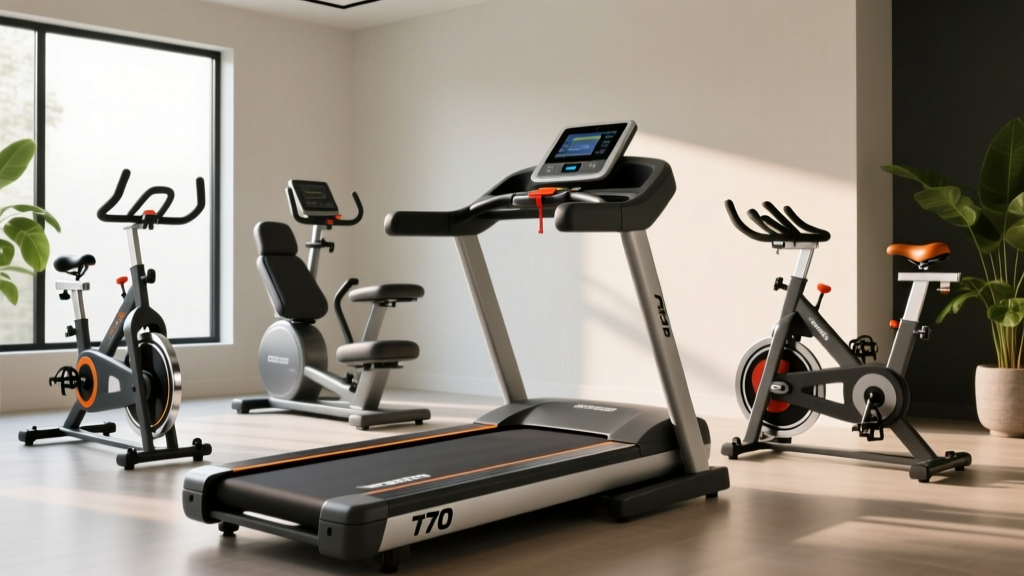
Budget Breakdown: T70 Treadmill vs Upright, Recumbent & Spin Bikes
We break down the 2026 costs, maintenance, and ROI of the T70 treadmill against upright, recumbent, and spin bikes to maximize your home gym budget.

The Cardio Dilemma: T70 Treadmill vs. The Bike Trinity
Allocating a $1,000 home gym budget in 2026 requires ruthless prioritization. For years, the mid-tier T70 treadmill (typically priced between $899 and $1,099) has been the default anchor for home cardio setups. It offers a familiar biomechanical motion, a 2.5 HP continuous duty motor, and a 20-inch by 55-inch running surface that accommodates most casual runners. However, as home fitness has evolved, buyers are increasingly cross-shopping the T70 treadmill against the 'bike trinity': upright, recumbent, and spin bikes.
But which machine actually delivers the best long-term value? When you factor in upfront capital, hidden maintenance costs, spatial footprint, and biomechanical return on investment (ROI), the cheapest machine on the showroom floor is rarely the most economical over a five-year lifespan. In this comprehensive budget breakdown, we pit the T70 treadmill against the three primary stationary bike types to help you engineer the most efficient home cardio investment.
The Upfront Capital Matrix: 2026 Pricing & Footprint
Before analyzing long-term value, we must establish the baseline capital expenditure (CapEx). The T70 treadmill sits squarely in the mid-range bracket, competing directly with premium uprights and mid-tier recumbents, while outpricing budget spin bikes but falling far short of commercial indoor cycles.
| Equipment Type | Benchmark Model | Avg. 2026 Price | Footprint (L x W) | Weight Capacity |
|---|---|---|---|---|
| T70 Treadmill | Mid-Tier T70 Series | $899 - $1,099 | 70' x 30' | 300 - 325 lbs |
| Upright Bike | Schwinn IC4 / Bowflex C6 | $799 - $999 | 45' x 22' | 330 lbs |
| Recumbent Bike | Nautilus R614 | $699 - $899 | 65' x 28' | 300 lbs |
| Spin Bike (Indoor Cycle) | Keiser M3i (Premium) / Yosuda (Budget) | $300 - $2,295 | 48' x 24' | 250 - 350 lbs |
Total Cost of Ownership (TCO): Hidden Maintenance & Failure Modes
The true cost of cardio equipment is revealed in its Total Cost of Ownership (TCO). Treadmills are high-friction, high-impact machines. Bikes are low-friction, closed-loop systems. This mechanical reality drastically alters their 5-year maintenance budgets.
T70 Treadmill Maintenance Realities
The T70 treadmill requires strict, scheduled maintenance to prevent catastrophic failure. The most common edge-case failure in the $1,000 treadmill bracket is motor controller burnout. When a user weighing over 220 lbs runs at sustained inclines (10%+), the 2.5 HP motor draws excessive amperage, overheating the controller board. Replacement costs hover around $250 to $350 out of warranty.
- Belt & Deck Lubrication: Must be performed with 100% silicone lubricant every 150 miles or 3 months. Failure to do so causes MDF deck delamination and increases motor amp-draw by up to 40%.
- Belt Replacement: Expect to replace the running belt every 3 to 5 years ($120 - $180 part cost).
- 5-Year Estimated TCO: $250 (lubricants, belt replacements, and minor roller adjustments).
Stationary Bike Maintenance Realities
Stationary bikes eliminate the high-impact friction of a treadmill belt, but each subtype carries unique mechanical risks.
- Upright Bikes: Magnetic resistance systems are virtually maintenance-free. However, the pedal crank arms on sub-$500 models are prone to stripping if not torqued to 35 Nm during assembly. 5-Year TCO: <$50.
- Recumbent Bikes: The step-through design and seated backrest put zero lateral stress on the frame. The primary failure point is the console wiring harness degrading from humidity. 5-Year TCO: <$30.
- Spin Bikes: Chain-drive spin bikes require monthly tensioning and lubrication. More importantly, sweat corrosion is a massive hidden cost. The highly acidic nature of human sweat will corrode unprotected steel flywheels and bottom brackets within 18 months if not wiped down with an enzymatic cleaner post-ride. Belt-drive models (like the Keiser M3i) eliminate chain maintenance but carry a massive upfront premium. 5-Year TCO: $50 - $150 (cleats, chain lube, replacement pedals).
Biomechanical ROI: Caloric Yield vs. Joint Preservation
When evaluating value, we must measure the 'Cost-Per-Calorie' and the long-term impact on joint health. According to data synthesized by the American Council on Exercise (ACE), the caloric expenditure between these machines varies wildly based on user effort and biomechanical engagement.
The Caloric Hierarchy
Running on a T70 treadmill at a 10-minute mile pace (6.0 MPH) yields approximately 650 to 750 calories per hour for a 180 lb individual. Because running is a weight-bearing exercise, it demands continuous core stabilization and upper body arm swing, driving up the metabolic demand.
Conversely, a vigorous spin bike session (sustaining 85-95 RPM with moderate magnetic resistance) burns roughly 550 to 650 calories per hour. Upright bikes fall slightly behind due to the lack of upper body engagement, while recumbent bikes—which isolate the lower body and support the lumbar spine—yield the lowest hourly burn rate of 350 to 450 calories.
'While treadmills offer superior peak caloric expenditure, the repetitive ground-reaction forces (up to 2.5 times body weight per stride) make them unsuitable for individuals with advancing osteoarthritis or prior meniscal tears. Low-impact modalities like recumbent and upright cycling preserve cartilage while maintaining cardiovascular baseline.' - Mayo Clinic Fitness & Joint Health Guidelines
Deep Dive: Which Bike Type Beats the T70 Treadmill?
If you are considering pivoting away from the T70 treadmill to save space or protect your joints, which of the three bike types offers the best financial and physiological value?
1. The Upright Bike: The Best All-Around Compromise
The modern magnetic upright bike (e.g., Schwinn IC4) is the closest 1:1 financial competitor to the T70 treadmill. Priced around $799, it offers Bluetooth connectivity to third-party apps like Zwift and Peloton Digital without requiring a proprietary subscription ecosystem. Value Verdict: Superior to the T70 for users with limited space, knee pain, or a desire for gamified indoor cycling. It lacks the bone-density benefits of weight-bearing running, but its near-zero maintenance profile makes it a smarter 5-year financial hold.
2. The Recumbent Bike: The Niche Rehabilitation Tool
Recumbent bikes are highly specialized. They are the undisputed champions of lumbar support and safe cardiovascular conditioning for seniors or those recovering from lower-body surgery. However, from a strict budget perspective, spending $800 on a Nautilus R614 recumbent bike yields a lower daily caloric ROI than the T70 treadmill. Value Verdict: Only purchase a recumbent bike over a T70 treadmill if a physician has explicitly contraindicated weight-bearing impact exercises. Otherwise, the cost-per-calorie is too high for the average consumer.
3. The Spin Bike: The High-Intensity Enthusiast's Choice
If your goal is High-Intensity Interval Training (HIIT), a dedicated spin bike destroys the T70 treadmill in value. Sprint intervals on a treadmill require a dangerous 'jumping' technique to bypass the slow acceleration of a 2.5 HP motor. On a spin bike with a 40lb flywheel, resistance changes are instantaneous. Value Verdict: A $500 belt-drive spin bike offers a better high-intensity ROI than a $1,000 T70 treadmill, provided you are diligent about post-workout sweat cleanup to prevent corrosion.
Depreciation and the Secondary Market
Fitness equipment depreciates like vehicles. According to historical resale trends tracked by Consumer Reports, motorized treadmills suffer the steepest depreciation curves. A $1,000 T70 treadmill will typically fetch just $350 to $450 on the secondary market after 24 months. Buyers are inherently wary of used treadmill motors and worn decks.
Stationary bikes, particularly recognized spin bike brands and magnetic uprights, hold their value significantly better. A well-maintained $800 upright bike can easily be resold for $500+ after two years, as there are no hidden motorized failure points to spook used buyers. If you anticipate moving or upgrading your gym within three years, the bike trinity offers vastly superior capital preservation.
The Final Verdict: How to Allocate Your Budget
The decision between the T70 treadmill and a stationary bike ultimately hinges on your biomechanical needs, spatial constraints, and willingness to perform maintenance.
Buy the T70 Treadmill If:- You prioritize weight-bearing exercises for bone density.
- You have a dedicated, climate-controlled room with at least 15 sq ft of space.
- You are committed to a strict 90-day belt lubrication schedule.
- You live in an apartment or multi-use space where footprint and noise are concerns.
- You suffer from plantar fasciitis, knee tendinopathy, or lower back pain.
- You want a 'buy it and forget it' machine with near-zero mechanical maintenance.
- You plan to resell the equipment within 3 years and want to minimize depreciation losses.
In 2026, the smartest home gym investments are those that align with your actual daily habits. The T70 treadmill remains a powerhouse for caloric expenditure, but the modern magnetic upright and spin bike offer a compelling, low-maintenance alternative that protects both your joints and your long-term wallet.
More gear to consider
All reviews
Home Stair Climber Guide: Is a Treadmill Good for Weight Loss?

Urevo Foldable Treadmills: Belt Maintenance & Value Analysis

Matrix Treadmill Comparison: Features & Buyer Mistakes
PaceMaster ProSelect Treadmill: 2026 Feature Buying Guide
Cardio Machine Noise Guide: NordicTrack C2100 Treadmill Comparisons
