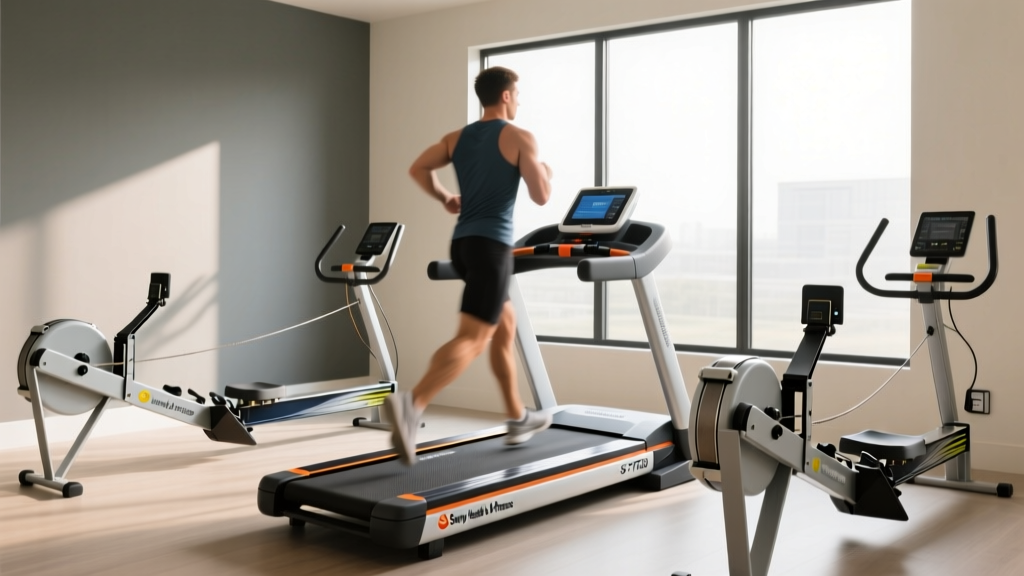
Sunny Health & Fitness SF-T7515 Smart Treadmill vs Rowers
Compare the Sunny Health & Fitness SF-T7515 smart treadmill against top rowing machines. Explore specs, technique, and 2026 buying advice.

The Home Gym Dilemma: Compact Treadmills vs. Full-Body Ergonomics
When outfitting a home gym in 2026, space and budget are the ultimate gatekeepers. You are often forced to choose between a high-tech walking/running solution and a full-body cardiovascular powerhouse. In this head-to-head comparison, we pit the highly popular Sunny Health & Fitness SF-T7515 Smart Treadmill against the category-defining mechanics of indoor rowing machines. Whether you are looking at budget-friendly magnetic rowers or premium air-resistance ergometers, understanding the biomechanical and spatial trade-offs is critical before dropping $400 to $1,100 on cardio equipment.
Quick Matchup Summary
- Best for Joint Preservation: Rowing Machine (Zero-impact, seated ergonomics)
- Best for Bone Density & Convenience: Sunny SF-T7515 (Weight-bearing, auto-incline walking)
- Price Range: $380–$420 (Treadmill) vs. $160–$1,100 (Rowers)
Analyzing the Sunny Health & Fitness SF-T7515 Smart Treadmill
The Sunny Health & Fitness SF-T7515 Smart Treadmill has dominated the budget cardio market by integrating premium features into a sub-$400 footprint. It features a 2.5 HP peak motor and a rare 12% auto-incline function, allowing users to simulate steep hill climbs without manual adjustments. The integration with the SunnyFit app via Bluetooth FTMS provides real-time tracking and virtual routing.
Limitations to Consider
However, the SF-T7515 is not without physical constraints. The running belt measures exactly 16 inches wide by 44 inches long. For users over 5'10", this restricts natural stride length during runs over 6.0 MPH, making it fundamentally a walking and light-jogging machine. Furthermore, the 265-pound maximum user weight capacity means it is best suited for lighter individuals. If you are a heavier athlete or a tall sprinter, the belt dimensions and motor thermal limits will become a failure point within the first year of heavy use.
Rowing Machine Buying Guide: Air, Magnetic, and Water Resistance
If the treadmill's weight and height restrictions are dealbreakers, a rowing machine offers a universal fit. But which resistance type should you buy in 2026?
- Air Resistance (e.g., Concept2 RowErg): The gold standard for competitive rowers. The harder you pull, the more resistance the flywheel generates. It is infinitely variable but notably loud. Expect to pay around $1,100.
- Magnetic Resistance (e.g., Sunny SF-RW5515): Uses magnetic brakes for a near-silent, smooth glide. Resistance is fixed by the console (usually 12-16 levels) regardless of stroke intensity. Ideal for apartment living, priced around $160.
- Water Resistance (e.g., WaterRower): Offers the most authentic acoustic and physical feel of a boat on water, utilizing a water tank and impeller. Requires occasional water purification tablets. Priced between $1,000 and $1,500.
Head-to-Head Spec Matrix
| Feature | Sunny SF-T7515 Treadmill | Sunny SF-RW5515 (Magnetic) | Concept2 RowErg (Air) |
|---|---|---|---|
| Retail Price (2026) | ~$399 | ~$169 | ~$1,100 |
| Max User Weight | 265 lbs | 250 lbs | 500 lbs |
| Active Footprint | 62" L x 27" W | 82" L x 19" W | 96" L x 24" W |
| Noise Profile | Moderate (Motor + Footfalls) | Near-Silent | Loud (Whooshing Air) |
| Primary Muscle Focus | Lower Body / Calves | Full Body (86% of muscles) | Full Body (86% of muscles) |
Biomechanics: Proper Rowing Technique and Form
Buying a rower is only half the battle; mastering the stroke is where the cardiovascular and muscular adaptations occur. According to the official Concept2 technique guidelines, a common beginner mistake is treating the rowing machine like an upper-body pull rather than a leg-driven hinge. The power distribution should be roughly 60% legs, 30% core, and 10% arms.
The 4-Phase Stroke Sequence
- The Catch: Shins are vertical (or as close as flexibility allows), torso is hinged forward at a 1-o'clock position, and arms are fully extended. You should feel tension in the hamstrings and lats.
- The Drive: Initiate the movement by pushing explosively through the heels. Do not pull with the arms yet. Once the legs are nearly straight, hinge the hips back to a 10-o'clock position.
- The Finish: Only after the hips have opened do the arms pull the handle into the lower sternum. The core is braced, and the wrists remain perfectly flat.
- The Recovery: Reverse the sequence smoothly: Arms extend first, torso hinges forward past the knees, and finally, the knees bend to return to the catch. The recovery should take twice as long as the drive.
Expert Troubleshooting: If you experience lower back pain while rowing, you are likely "shooting the slide"—meaning your hips are rising faster than your shoulders during the Drive phase, placing sheer force on the lumbar spine. Focus on keeping the chest tall and driving the seat and handle together.
Caloric Expenditure and Joint Loading
When comparing the Sunny Health & Fitness SF-T7515 Smart Treadmill to a rowing machine, joint loading is a critical differentiator. Running or even brisk walking on a treadmill generates ground reaction forces equivalent to 1.5 to 3 times your body weight per stride. Over a 45-minute session, this equates to thousands of micro-impacts on the knees, hips, and lumbar spine.
Conversely, rowing is a closed-chain, zero-impact exercise. The Cleveland Clinic notes that rowing engages 86% of the body's musculature without placing compressive loads on the joints, making it highly recommended for rehabilitation and aging populations. Furthermore, data from Harvard Health Publishing indicates that vigorous stationary rowing can burn between 252 and 440 calories per 30 minutes (depending on body weight), which closely rivals the caloric output of a 6.0 MPH jog on the SF-T7515's 12% incline, but with a fraction of the joint wear.
The Final Verdict: Which Cardio Machine Wins?
The decision ultimately hinges on your physical profile and living environment. The Sunny Health & Fitness SF-T7515 Smart Treadmill is an exceptional, space-conscious choice for users under 265 lbs and under 6 feet tall who prioritize weight-bearing bone density exercises, love tracking virtual walking routes, and want an auto-incline feature rarely found under $500.
However, if you are a taller athlete, require a higher weight capacity, or need a zero-impact, full-body conditioning tool, a rowing machine is the superior long-term investment. For apartment dwellers, the $169 Sunny SF-RW5515 provides silent magnetic resistance, while serious data-driven athletes should stretch their budget to $1,100 for the indestructible Concept2 RowErg. In the head-to-head battle of cardio longevity, the rower's universal ergonomics and full-body recruitment edge out the compact treadmill's convenience.
More gear to consider
All reviews
Training for Half Marathon on Treadmill? Under-Desk Reviews
Cardio Noise Comparison: Setup for Treadmill Speeds and Paces
Treadmill Motor Size Guide: How the Precor TRM 223 Treadmill Compares

Curved Manual vs Motorized: Commercial X22i Treadmill Compared
Folding Treadmill Care: Elliptical or Treadmill Longevity Tips
