Stair Climber Guide vs WalkingPad P1 Classic Foldable Walking Treadmill
Compare top stair climber machines for home use against the WalkingPad P1 Classic foldable walking treadmill. Expert specs, failure modes, and 2026 data.

The Compact Cardio Dilemma: Vertical vs. Horizontal
As urban living spaces shrink and home gym footprints become a premium commodity in 2026, fitness enthusiasts are increasingly forced to choose between vertical and horizontal cardio solutions. The two dominant space-saving paradigms are the vertical stair climber machine and the ultra-compact under-desk treadmill. This comprehensive stair climber machine for home use guide will dissect the biomechanics, mechanical failure points, and spatial requirements of top-tier climbers, while pitting them against the benchmark of horizontal compact cardio: the walkingpad p1 classic foldable walking treadmill.
2026 Market Insight: According to recent home fitness equipment reports, sub-10-square-foot cardio machines have seen a 34% year-over-year growth, driven by hybrid work setups where equipment must be hidden away post-workout.Stair Climber Machine for Home Use: The Buyer's Matrix
When evaluating a stair climber machine for home use, you are generally choosing between two distinct mechanical resistance systems: hydraulic cylinder-based bodyweight climbers and magnetic eddy-current steppers. Each presents unique maintenance profiles and longevity expectations.
1. Hydraulic Bodyweight Climbers (e.g., MaxiClimber Classic)
These units rely on dual hydraulic cylinders to provide resistance as you push down on the pedals. They are exceptionally lightweight (often under 35 lbs) and fold flat against a wall.
- Peak Output: Highly dependent on user weight and speed; no adjustable magnetic dial.
- Common Failure Mode: Hydraulic seal degradation. After 18 to 24 months of daily use, the O-rings inside the cylinder can dry out, leading to fluid weeping and a 'spongy' pedal drop. Replacement cylinders cost roughly $45 to $60.
- Best For: High-intensity interval training (HIIT) and users under 220 lbs.
2. Magnetic Resistance Steppers (e.g., Sunny Health SF-E3912)
These use a magnetic flywheel or adjustable tension bands to simulate stair climbing. They are heavier, more stable, and allow for precise resistance tuning.
- Pivot Joint Mechanics: High-end models use UHMWPE (Ultra-High-Molecular-Weight Polyethylene) bushings at the pedal hinges. If your stepper begins to squeak, it is rarely the metal; it is the bushing requiring dry PTFE lubricant.
- Common Failure Mode: Drive belt stretching. The internal Kevlar-reinforced belts connecting the pedals to the tension unit can stretch after 300+ hours, requiring internal tensioner adjustments.
The Horizontal Alternative: WalkingPad P1 Classic Foldable Walking Treadmill
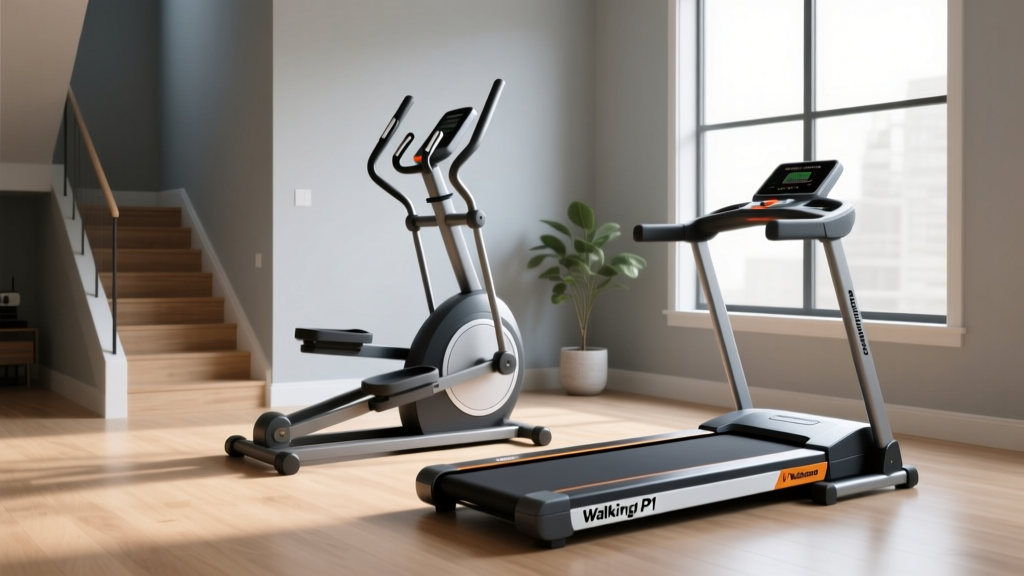
If vertical climbing does not align with your joint health or spatial layout, the walkingpad p1 classic foldable walking treadmill remains the gold standard for horizontal micro-footprint cardio. Unlike traditional treadmills that require a dedicated 30-square-foot zone, the P1 Classic utilizes a patented 180-degree folding hinge.
Deep Dive: P1 Classic Specifications & Edge Cases
| Specification | WalkingPad P1 Classic Data | Expert Notes & Edge Cases |
|---|---|---|
| Motor | 1.25 CHP (2.5 Peak HP) | Adequate for walking up to 7.6 mph. Will thermally trip if used for sustained running over 6 mph. |
| Belt Dimensions | 47.2 x 16.5 inches | Narrow width requires a natural, non-sprawling gait. Not recommended for users over 6'2". |
| Folded Footprint | 56.5 x 21.5 x 5 inches | Slides under standard US sofas (requires 5.5" clearance). |
| Weight Capacity | 220 lbs (Advertised 240 lbs) | Stay under 220 lbs to prevent premature motor brush wear and deck friction overheating. |
Maintenance Alert: The WalkingPad P1 belt will naturally drift to the left or right after roughly 40 hours of use. Keep the included 4mm hex key nearby. To re-center, turn the rear roller bolt on the drifting side clockwise by exactly 90 degrees while the belt is running at 2 mph. Do not over-tighten, or you will strip the tensioner threads.
Head-to-Head: Stair Climber vs. WalkingPad P1 Classic
Choosing between a stair climber machine for home use and the walkingpad p1 classic foldable walking treadmill ultimately comes down to your biomechanical goals and available storage geometry.
| Feature | Vertical Stair Climber (e.g., MaxiClimber) | WalkingPad P1 Classic Foldable Treadmill |
|---|---|---|
| Active Footprint | ~7 sq ft (36" x 28") | ~12 sq ft (57" x 22") |
| Storage Footprint | ~2 sq ft (Leans against wall) | ~4 sq ft (Slides under furniture) |
| Primary Muscle Target | Glutes, Quads, Calves, Lats (if using pull bars) | Calves, Hamstrings, Core (postural stabilization) |
| Joint Impact | Low impact, high flexion torque on knees | Low impact, natural sagittal plane gait |
| Average Price (2026) | $150 - $500 | $399 - $450 |
Biomechanics & Joint Loading: What the Experts Say
When integrating compact cardio into a weekly routine, joint preservation is paramount. According to the American College of Sports Medicine (ACSM), adults should aim for at least 150 minutes of moderate-intensity aerobic activity per week. Both stair climbers and walking pads can fulfill this requirement, but they load the skeletal system differently.
Stair climbing demands deep knee flexion under load. The Cleveland Clinic notes that while stair climbing is excellent for building lower-body bone density and gluteal strength, it can exacerbate patellofemoral pain syndrome (runner's knee) in individuals with pre-existing cartilage wear. The vertical push requires the quadriceps to generate force at angles that compress the patella against the femur.
Conversely, the walkingpad p1 classic foldable walking treadmill promotes a natural heel-to-toe gait cycle. The Mayo Clinic highlights that brisk walking on a flat or slightly inclined surface is one of the most joint-friendly cardiovascular exercises available, making it the superior choice for users managing osteoarthritis or recovering from lower-body injuries. However, because the P1 Classic lacks an incline feature, users must increase speed (up to 7.6 mph) to achieve the same caloric expenditure that a stair climber provides at a much slower cadence.
Routine Maintenance: Ensuring Longevity in 2026
Compact machines are notorious for being treated as disposable because of their lower price points. Treat them like precision instruments, and they will last for years.
Stair Climber Maintenance Checklist
- Monthly: Inspect the pedal pivot bolts. Vibration from stepping can loosen the M8 hex bolts over time. Tighten to 25 Nm of torque using a torque wrench to prevent stripping the aluminum frame threads.
- Bi-Annually: Wipe down the hydraulic cylinder shafts with a microfiber cloth. Dust accumulation acts as an abrasive paste, destroying the internal seals and causing fluid leaks.
- Annually: Check the base stabilizer caps. If the rubber feet wear down unevenly, the machine will wobble during high-cadence intervals, placing asymmetric stress on the main vertical column.
WalkingPad P1 Classic Maintenance Checklist
- Every 30 Miles: Lift the belt and apply 100% pure silicone treadmill lubricant to the deck. Avoid petroleum-based products like WD-40, which will dissolve the factory-applied wax coating on the MDF deck and cause permanent friction damage.
- Every 60 Days: Vacuum beneath the motor hood. The P1's internal cooling fan pulls in ambient air (and pet hair/dust). A clogged intake will cause the motor controller board to overheat and trigger the thermal safety shutoff.
- Storage Protocol: When folding the P1 Classic in half, ensure the locking latch clicks audibly. Dragging an unlocked, folded unit by the handle can bend the internal hinge pins, leading to a misaligned deck that will permanently ruin the walking belt.
Final Verdict: Designing Your Home Cardio Stack
There is no single 'best' machine; there is only the right tool for your specific spatial and physiological constraints. If your primary goal is maximizing caloric burn per minute, building lower-body power, and you have a vacant wall corner to lean equipment against, a hydraulic or magnetic stair climber machine for home use is your optimal investment. Expect to spend between $200 and $500 for a reliable unit.
However, if your lifestyle demands seamless integration into a work-from-home setup, or if you require a low-impact, natural gait modality that can be slid under a bed or sofa in seconds, the walkingpad p1 classic foldable walking treadmill is unmatched in its category. Its 1.25 CHP motor and 180-degree folding chassis make it the definitive horizontal solution for the modern, space-conscious athlete.
More gear to consider
All reviews
Trainer 430i Treadmill vs Stationary Bike Types: 2026 Value Guide

The Fall of Treadmill Injuries: Curved vs. Motorized Setup

Treadmill Motor HP Guide: Powering Your 10 Minute Workout

Cybex 625 Treadmill vs Portable Cardio: Top Compact Picks 2026

2026 Compact Cardio Trends: Portable Picks & Treadmill Fuse Analysis