Home Stair Climber Guide: Is a Treadmill Good for Weight Loss?
Compare stair climbers and treadmills for weight loss. Our 2026 home stair climber buying guide covers StepMills, pedal climbers, and calorie burn data.

The Core Debate: Is a Treadmill Good for Weight Loss vs. Stair Climbers?
When outfitting a home gym, a frequent question among buyers is: is treadmill good for weight loss compared to high-resistance vertical machines like stair climbers? The short answer is yes, but the metabolic pathways, muscle recruitment patterns, and spatial requirements differ drastically between the two. To make an informed equipment investment in 2026, we must look beyond marketing claims and examine the biomechanical data.
Weight loss fundamentally relies on a caloric deficit, and the efficiency of your cardio machine dictates how quickly you can achieve that deficit. According to data from Harvard Health Publishing, a 155-pound individual burns approximately 149 calories in 30 minutes of general stair stepping, compared to 133 calories walking at a brisk 4.0 mph on a treadmill. However, if that same individual runs at 6.0 mph on a treadmill, the burn jumps to 372 calories.
Therefore, while a treadmill is excellent for weight loss—particularly at running speeds—a stair climber provides a superior calorie-to-time ratio for those who prefer low-impact, high-resistance steady-state cardio or HIIT without the joint pounding associated with running.
Machine Anatomy: Rotating StepMills vs. Pedal Climbers
Not all stair climbers are created equal. The home fitness market is currently divided into two primary categories, each with distinct mechanical failure points and spatial footprints.
1. Rotating StepMills (The Staircase)
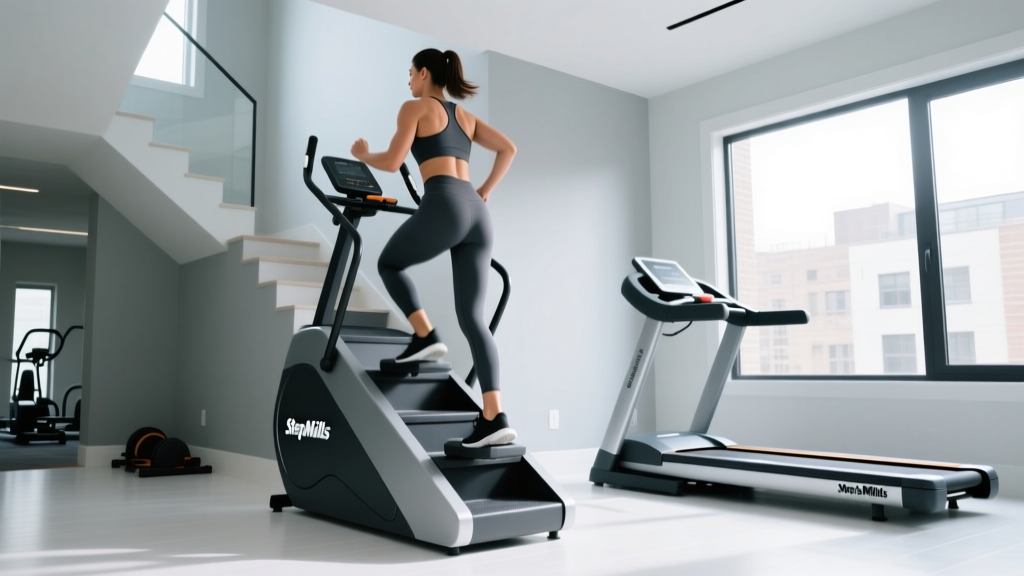
These machines feature an actual revolving staircase. They force a natural gait cycle, demanding significant concentric and eccentric muscle control. The primary drawback is the massive vertical footprint and the heavy flywheel motor required to turn the stairs safely under load.
2. Pedal Climbers (The Stepper)
These utilize two independent pedals driven by hydraulic cylinders or magnetic resistance. They simulate climbing but lack the terminal extension phase of a real step, often resulting in a shallower range of motion and less gluteus maximus activation.
| Feature | Rotating StepMill | Pedal Climber | Hybrid Climber (e.g., Bowflex) |
|---|---|---|---|
| Price Range (2026) | $3,200 - $4,500 | $150 - $400 | $1,800 - $2,800 |
| Footprint | Large (35" x 70") | Compact (25" x 30") | Medium (30" x 48") |
| Ceiling Clearance | High (User + 15") | Standard (User + 5") | Standard (User + 10") |
| Maintenance | High (Belt tracking, motor) | Low (Cylinder leaks) | Medium (Cable tension) |
Top Home Stair Climbers & Hybrids for Weight Loss
If you have decided that vertical climbing aligns with your weight loss goals, here are the top-performing models on the market, analyzed for their specific mechanical advantages and edge cases.
Premium Pick: StairMaster StepMill 5
Price: ~$3,899 | Step Height: 8 inches | Max User Weight: 300 lbs
The StepMill 5 remains the gold standard for home and commercial use. Unlike older models that used aggressive chain drives, the 2026 iterations utilize a precision-machined sprocket system that reduces acoustic noise by up to 15%. The 8-inch step height is ergonomically optimized to mimic standard commercial building stairs, ensuring deep glute and hamstring engagement. Edge Case Warning: The StepMill 5 weighs nearly 280 lbs. It is not suitable for second-floor home gyms with standard joist spacing unless reinforced.
Budget Pick: Sunny Health & Fitness SF-E3912 Magnetic Pedal Climber
Price: ~$179 | Resistance: 8 Magnetic Levels | Max User Weight: 330 lbs
For those with strict spatial constraints, the SF-E3912 offers a surprisingly robust magnetic resistance system, avoiding the common hydraulic cylinder overheating and fluid degradation issues seen in cheaper pedal steppers. While it won't replicate the terminal knee extension of a StepMill, the magnetic flywheel provides a smooth, consistent tension curve ideal for 30-minute steady-state fat-burn zones.
Hybrid Innovator: Bowflex Max Trainer M9
Price: ~$2,499 | Resistance: 20 Levels | App Integration: JRNY
The Max Trainer series blends the low-impact footprint of an elliptical with the vertical resistance of a stair climber. The M9 features a 10-inch stride length that forces a steep climbing angle. Its primary weight-loss advantage is the proprietary Max Intelligence app, which dynamically adjusts resistance based on your real-time heart rate decay, ensuring you remain in the optimal lipolysis (fat-burning) zone during HIIT sessions.
Biomechanics, Edge Cases, and the "Handrail Trap"
⚠️ The Handrail Trap: Biomechanical studies show that heavily leaning on the handrails of a stair climber or treadmill reduces caloric expenditure by 20% to 30%. By supporting your upper body weight, you bypass the core stabilization requirements and reduce the load on your lower extremities. For accurate weight loss tracking, maintain an upright posture and use the rails only for light balance.The Ceiling Clearance Formula
The most common installation failure for home StepMills is inadequate ceiling height. When your foot is at the apex of the step, your head is significantly closer to the ceiling. Use this formula to prevent drywall impacts:
- User Height (in inches)
- + Machine Step-Up Height (usually 10 to 14 inches for StepMills)
- + Safety Clearance (minimum 6 inches)
- = Minimum Required Ceiling Height
Example: A 6-foot (72-inch) user on a machine with a 12-inch step-up height requires a ceiling of at least 90 inches (7.5 feet). Standard 8-foot ceilings will result in head strikes for taller users on rotating StepMills.
Final Verdict: Programming for Weight Loss
So, is a treadmill good for weight loss? Absolutely, provided you are utilizing incline walking (12-15% grade at 3.0 mph) or sustained running. However, if your goal is to maximize lower-body muscle retention while burning calories in a shorter time window, a stair climber is biomechanically superior.
The American Heart Association recommends at least 150 minutes of moderate-intensity or 75 minutes of vigorous aerobic activity per week. A stair climber effortlessly pushes you into the vigorous category within minutes, making it an elite tool for time-efficient weight management. Assess your ceiling height, evaluate your joint tolerance, and choose the machine that guarantees consistent, pain-free adherence to your cardio protocol.
More gear to consider
All reviews
Curved vs Motorized: NordicTrack T Series 8 Review Guide

Stationary Bike Types & Hand Walking on Treadmill: Budget Analysis
Rowing Machine Buying Guide & Technique vs Borgusi Treadmill Review
NordicTrack T6.5 Si Treadmill vs Upright, Recumbent & Spin Bike Care

Weslo Treadmill Troubleshooting: Curved Manual vs Motorized Mistakes
