Stair Climber Guide: Home Cardio vs Treadmill ECG Test Singapore Price
Troubleshoot common home stair climber mistakes and compare DIY cardio metrics against clinical treadmill ECG test accuracy and Singapore pricing.

The Telemetry Trap: Why Your Stair Climber is Lying to You
Home stair climbers and vertical steppers have surged in popularity for their unmatched glute activation and high-VO2 max potential. However, a massive gap exists between consumer-grade machine telemetry and clinical cardiovascular diagnostics. Many users make the critical mistake of trusting the built-in hand-pulse sensors on their machines to gauge cardiac strain, assuming they are getting a medical-grade reading. They are not.
⚠️ Expert Warning: Hand-grip sensors on machines like the Sunny Health & Fitness SF-S901055 or even premium models use basic galvanic skin response or optical photoplethysmography (PPG). During the high-vibration, high-sweat environment of a stair climbing session, these sensors frequently drop data packets, resulting in phantom heart rate spikes or dangerous under-reporting of your actual BPM.Troubleshooting Erratic Heart Rate Readings
If your console is displaying erratic heart rate data (e.g., jumping from 110 BPM to 175 BPM in seconds), the issue is rarely a broken console. It is almost always a signal interference problem.
- The Fix: Abandon grip sensors entirely. Invest in a chest strap monitor like the Polar H10 or Garmin HRM-Pro Plus (approx. $80–$130 USD). These use single-lead ECG technology to read the heart's electrical activity directly, bypassing the sweat and vibration issues inherent to stair climbing.
- Calibration: Ensure your machine's Bluetooth/ANT+ receiver is updated. On the Bowflex Max Trainer M9 ($2,299 USD), you must pair the strap via the JRNY app ecosystem rather than relying on the raw console display for the most accurate burn-rate algorithms.
Biomechanical Errors That Skew Your METs
The most pervasive mistake in home stair climbing is the 'Handrail Lean.' When users set the resistance too high or the step rate too fast, they instinctively lean their body weight onto the handrails. According to biomechanical studies, leaning on the rails of a stair climber can reduce your actual caloric expenditure and metabolic equivalent (MET) output by up to 30%.
'If you are supporting 20% of your body weight on the handrails, the machine's computer—which calculates calorie burn based on your inputted body weight and the machine's mechanical resistance—is overestimating your work output by a massive margin.' — Mayo Clinic Fitness Guidelines
Step-by-Step Posture Correction
- Drop the Resistance: Lower the machine's resistance level by 2 to 3 increments.
- The 'Hover' Test: Remove your hands from the rails entirely. You should be able to swing your arms naturally or lightly rest your fingertips on the rails purely for balance, bearing zero downward weight.
- Engage the Core: Maintain a neutral spine. If you feel your lower back arching or your shoulders hunching forward to reach the console, your stride depth is too shallow or the pedal tension is improperly calibrated.
Clinical vs. Consumer: What Are You Actually Paying For?
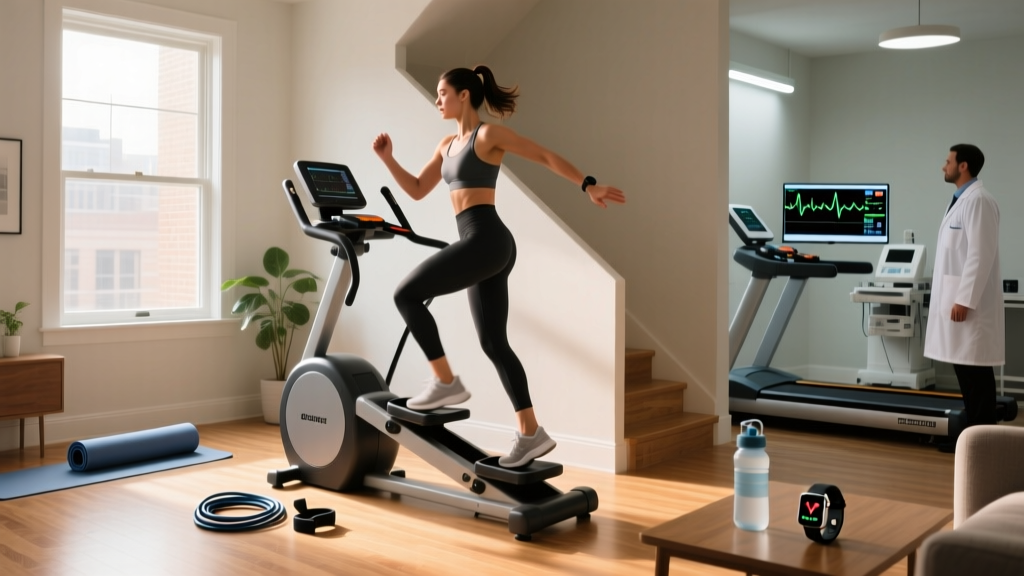
A frequent question we receive from health-conscious expats and locals in Southeast Asia revolves around medical screening versus home fitness tracking. Specifically, many users researching the exact treadmill ECG test Singapore price (typically ranging from $180 to $350 SGD at private cardiology centers like Mount Elizabeth or Gleneagles in 2026) want to know if their high-end home stair climber can replace an annual clinical stress test.
The short answer is an absolute no. Here is a structural breakdown of why consumer cardio machines cannot replace clinical diagnostics.
| Feature | Home Stair Climber (e.g., NordicTrack FS14i) | Clinical Treadmill ECG Stress Test |
|---|---|---|
| Primary Metric | Optical Pulse / Single-Lead HR | 12-Lead Electrical ECG (ST-segment analysis) |
| Ischemia Detection | Impossible (Cannot detect electrical anomalies) | Highly accurate for detecting coronary artery disease |
| Protocol Standardization | Proprietary, gamified algorithms | Standardized Bruce or Balke Protocols |
| Cost (2026) | $1,500 - $3,000 USD (One-time hardware) | $180 - $350 SGD per session (Out-of-pocket) |
As outlined by the American Heart Association, a clinical stress test monitors the heart's electrical vectors to detect ST-segment depression, which indicates myocardial ischemia (restricted blood flow to the heart muscle). Your home stair climber, regardless of its price tag, only measures the mechanical pump rate. It cannot see how the heart is electrically firing under load.
Mechanical Troubleshooting: Squeaks, Slips, and Error Codes
Beyond user error, home stair climbers are subject to intense mechanical stress due to the vertical force vectors involved. Here is how to troubleshoot the most common hardware failure modes in 2026.
1. The 'Spongy' Pedal Drop (Hydraulic Mini-Steppers)
The Problem: On budget-friendly hydraulic mini-steppers (like the Sunny Health & Fitness lineup), users often report that after 15 minutes of use, the pedals lose tension and 'bottom out' easily. The Diagnosis: This is a thermal limitation, not a defect. The internal seals of standard 40mm hydraulic cylinders overheat when subjected to continuous friction. Once the hydraulic fluid exceeds 104°F (40°C), its viscosity drops, leading to a loss of pressure. The Fix: Limit continuous stepping sessions to 15-minute blocks. Apply a high-grade PTFE (Teflon) silicone lubricant to the external pivot joints every 3 months to reduce ambient friction. Never use WD-40, which strips factory grease and accelerates seal degradation.
2. Console Error Code '1' or '2' (Magnetic Resistance Models)
The Problem: Mid-tier pedal treadmills and stair climbers frequently throw an Error 1 (Speed Sensor) or Error 2 (Communication) code mid-workout, abruptly stopping the magnetic resistance brake. The Diagnosis: Dust and sweat accumulation on the optical reed switch or hall-effect sensor located near the internal flywheel. The Fix: Unplug the machine. Remove the lower plastic shroud (usually requiring a Phillips #2 screwdriver). Locate the small sensor aimed at the flywheel's magnets. Wipe the sensor lens and the flywheel track with a microfiber cloth dampened with 90% isopropyl alcohol. Ensure the gap between the sensor and the magnet is exactly 3-5mm; if it has vibrated wider, gently bend the sensor bracket back into alignment.
Structuring a Safe Home 'Stress Test' Protocol
While you cannot replicate a medical ECG at home, you can safely mimic the cardiovascular load progression of a clinical Bruce Protocol using a home stair climber to test your functional VO2 max improvements over time.
💡 The FitGearPulse Home Step Protocol:- Stage 1 (Warm-up): 3 minutes at 40 SPM (Steps Per Minute), Resistance Level 2.
- Stage 2 (Base Load): 3 minutes at 60 SPM, Resistance Level 5.
- Stage 3 (Threshold): 3 minutes at 80 SPM, Resistance Level 8.
- Stage 4 (Peak): Max sustainable SPM, Resistance Level 10+ (Hold until you hit 85% of your Max HR, calculated as 220 minus your age).
- Cool Down: 3 minutes at 30 SPM, Resistance Level 1. Monitor your Heart Rate Recovery (HRR). A drop of fewer than 12 BPM in the first minute of cool-down is a clinical red flag requiring medical follow-up.
Final Verdict: Know Your Machine's Limits
Home stair climbers are phenomenal tools for building lower-body endurance, burning calories, and improving functional mobility. However, treating them as diagnostic medical devices is a dangerous mistake. By upgrading your telemetry with a chest strap, correcting your biomechanical posture, and understanding the mechanical limits of your machine's hydraulics and sensors, you can safely push your cardiovascular limits. Just remember that when it comes to true cardiac electrical health, no consumer gadget replaces the clinical precision of a laboratory stress test.
More gear to consider
All reviews
Elliptical vs Treadmill: Space Design & Kelsey Kane Treadmill Trail
Treadmill Belt Care & Ladder Treadmill Machine Space Layouts

CPT Treadmill Stress Test Prep: Best Compact Portable Cardio Equipment

Upright, Recumbent & Spin Bikes vs HIIT Interval Training Treadmill

1 Hr Treadmill Workouts vs Stationary Bikes: Space Guide