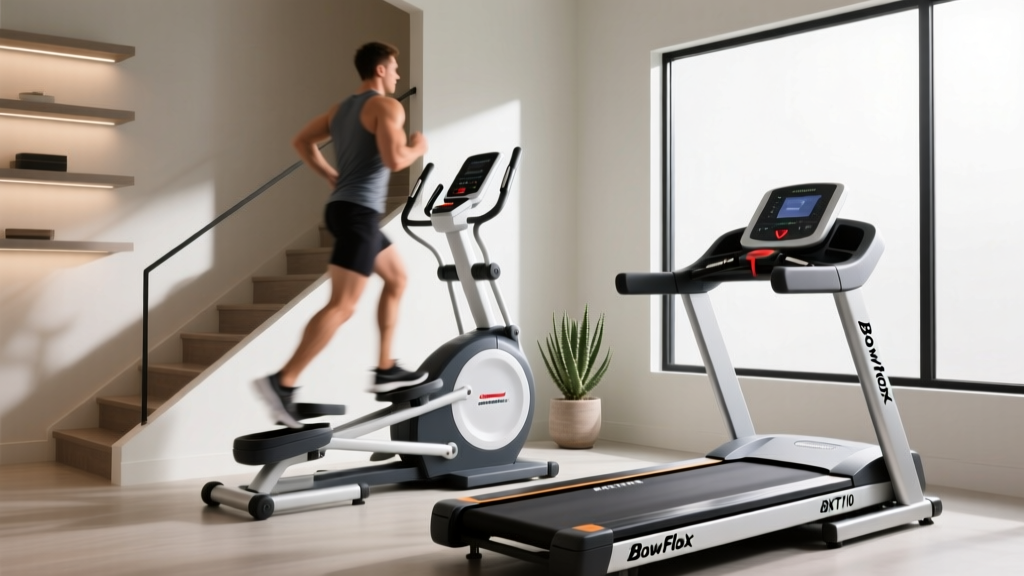
Stair Climber Setup Guide & Bowflex BXT116 Treadmill Review
Master your 2026 home gym with our stair climber installation guide and an in-depth Bowflex BXT116 treadmill review for optimal cardio space planning.

The Home Gym Cardio Anchor: Navigating Space and Power in 2026
Designing a high-performance home gym in 2026 requires more than just selecting the highest-rated equipment; it demands a rigorous understanding of spatial geometry, electrical load limits, and structural flooring dynamics. When outfitting a dedicated cardio zone, fitness enthusiasts typically face a critical decision between two heavy-duty anchors: the vertical stair climber and the traditional premium treadmill.
In this comprehensive stair climber machine for home use guide, we will walk you through the exact installation protocols, clearance mathematics, and flooring requirements necessary to safely integrate a commercial-grade stepper into a residential environment. Furthermore, to provide a complete spatial comparison, we have included a detailed Bowflex BXT116 treadmill review, analyzing its setup realities, legacy market footprint, and specific installation quirks to help you finalize your equipment layout.
Stair Climber Machine for Home Use: Complete Installation Walkthrough
Unlike treadmills or ellipticals, stair climbers (such as the StairMaster FreeClimber or the Rogue E-Stair) introduce unique biomechanical and structural variables to your home gym. The primary challenge is vertical clearance and dynamic point-load weight distribution.
Step 1: Spatial Planning and Ceiling Clearance Mathematics
The most frequent installation failure in residential stair climbers is inadequate ceiling height. Because the user is elevated on the pedals and experiences vertical oscillation during the stepping motion, standard 8-foot ceilings often prove insufficient for taller users.
- The Clearance Formula: Ceiling Height = User Height + 12 inches (for pedal apex clearance and headroom) + 4 inches (machine base step-up height).
- Example: A 6'2" (74") user requires a minimum ceiling height of 90 inches (7.5 feet) just to avoid grazing the ceiling at the top of the stride. However, accounting for overhead lighting and HVAC vents, a 9-foot ceiling is the recommended minimum for safe, unrestricted use.
- Overhead Obstructions: Never install a stair climber directly beneath a ceiling fan, recessed lighting fixture, or smoke detector. The dynamic vibration of a 200+ lb user stepping at 120 steps per minute can dislodge poorly secured fixtures over time.
Step 2: Subfloor Reinforcement and Vibration Dampening
Stair climbers generate immense downward force. When a user steps down, the impact multiplier can briefly exceed 1.5 times their body weight, concentrated on the machine's four leveling feet. This creates a high Pounds per Square Inch (PSI) point-load that can crack standard residential tile or dent engineered hardwood.
Expert Flooring Recommendation: For 2026 home gym builds, we mandate the use of 3/8-inch thick vulcanized rubber mats (minimum 90 durometer hardness) placed beneath the stair climber. Avoid interlocking foam tiles; they compress unevenly under the machine's static weight, causing the stepper's internal chain-drive or rack-and-pinion system to fall out of alignment, leading to premature pedal wobble.Step 3: Electrical and Calibration Setup
Commercial and pro-sumer stair climbers utilize high-torque alternator or stepper-motor resistance systems. These systems draw a significant surge current upon startup and during heavy resistance intervals. According to the Consumer Product Safety Commission (CPSC), heavy motorized fitness equipment must be isolated to prevent circuit overloads and fire hazards.
- Circuit Requirement: Plug the stair climber into a dedicated 15-Amp or 20-Amp circuit. Do not share this circuit with space heaters, air conditioners, or large entertainment systems.
- Leveling Calibration: Once powered on, use a digital torpedo level on the side rails. Adjust the rear leveling feet until the bubble is perfectly centered. An unlevel stair climber will cause the internal resistance brake to drag unevenly, resulting in a "stuttering" pedal feel and voiding the manufacturer warranty.
The Bowflex BXT116 Treadmill Review: Legacy Setup & Space Realities
When evaluating heavy-duty cardio anchors, our Bowflex BXT116 treadmill review highlights the stark contrast in spatial and setup demands compared to vertical climbers. Following Nautilus/Bowflex's corporate restructuring in the mid-2020s, the BXT116 has transitioned into a highly sought-after legacy model on the refurbished and secondary markets, typically pricing between $900 and $1,400 in 2026.
Unboxing and Assembly Realities
The BXT116 is a beast of a machine, featuring a 3.0 HP continuous-duty motor and a massive 20" x 60" running surface. The shipping box weighs over 230 lbs. Do not attempt to move this into a basement or second-story gym without a two-person team and a heavy-duty appliance dolly.
During assembly, the most critical step is deck lubrication. The BXT116 requires a specific 100% silicone treadmill lubricant applied in a zig-zag pattern beneath the belt. Failure to properly lubricate the deck during initial setup will cause the motor to draw excess amperage, eventually tripping your home's circuit breaker during high-speed sprints.
Safety Clearances and the Fall Zone
While stair climbers demand vertical space, treadmills demand horizontal depth. The American Heart Association notes that treadmills remain a staple for sustained cardiovascular conditioning, but they also carry the highest risk of rear-ejection injuries in home gyms.
- Rear Fall Zone: You must maintain a minimum 36-inch clear space behind the rear roller of the BXT116. Never place a wall, a dumbbell rack, or a glass mirror directly behind the treadmill belt.
- Side Clearance: Allow at least 18 inches on the dominant side (usually the right, near the emergency stop key lanyard) for safe mounting and dismounting.
Head-to-Head: Installation & Footprint Comparison Matrix
To help you finalize your 2026 home gym floor plan, we have mapped out the exact installation parameters for a modern stair climber versus the legacy Bowflex BXT116.
| Specification | Pro-sumer Stair Climber (e.g., Rogue / StairMaster) | Bowflex BXT116 Treadmill |
|---|---|---|
| Footprint (L x W) | ~72" x 36" (Compact base) | ~80" x 35" (Elongated) |
| Machine Weight | 280 - 320 lbs | ~215 lbs (Assembled) |
| Min. Ceiling Height | 8'6" to 9'0" (User dependent) | 7'0" (Standard clearance) |
| Required Fall Zone | 12" lateral clearance | 36" rear clearance (Mandatory) |
| Electrical Draw | High Surge (Stepper motor/Alternator) | Steady High Draw (3.0 HP Drive) |
| Flooring Requirement | 3/8" Vulcanized Rubber (High PSI) | Standard 8mm Gym Mat |
Common Installation Failure Modes & Troubleshooting
Even with meticulous planning, home gym installations can encounter friction. Here are the most common setup failures we diagnose for both stair climbers and premium treadmills, along with their immediate fixes.
1. The "Stuttering" Pedal on Stair Climbers
The Symptom: The left pedal hesitates or drops slightly faster than the right when weight is applied.
The Cause: The machine's frame is resting on an uneven floor, causing the internal drive chain to bind against the guide rails.
The Fix: Loosen the rear leveling feet. Place a digital level across the handrail crossbar. Adjust the feet incrementally until the frame is perfectly plumb, then tighten the locking nuts against the base plate.
2. Treadmill Belt Slippage and Motor Overheating
The Symptom: The Bowflex BXT116 belt pauses for a microsecond when your foot strikes the deck, accompanied by a faint burning smell.
The Cause: High friction between the walking belt and the deck, often due to skipped lubrication or overtightening of the rear roller bolts during assembly.
The Fix: Unplug the machine. Use a 3/4" Allen wrench to back off the rear roller adjustment bolts by exactly one full turn on each side. Apply 15ml of 100% silicone lubricant directly to the center of the deck beneath the belt. Plug the machine back in and run it at 3.0 MPH for 5 minutes to distribute the silicone.
3. Console Wi-Fi Connectivity Drops
The Symptom: Interactive programming fails to load, or firmware updates stall at 90%.
The Cause: Home gym locations (basements, garages) often suffer from 2.4GHz/5GHz Wi-Fi dead zones, exacerbated by the thick steel frames of cardio equipment acting as signal shields.
The Fix: Install a dedicated Wi-Fi mesh node in the same room as the cardio equipment. Hardwire the node to your router via MoCA adapters if running Ethernet through drywall is not feasible.
Finalizing Your 2026 Cardio Layout
Choosing between a stair climber and a treadmill ultimately comes down to your architectural constraints and biomechanical goals. If your home gym boasts soaring ceilings and you prioritize high-ROI, low-impact glute and quad conditioning, the stair climber is an unmatched investment. However, if you are working with standard 8-foot ceilings, require a versatile walking-to-sprinting spectrum, and are hunting for incredible value on the secondary market, the legacy footprint outlined in our Bowflex BXT116 treadmill review makes it an enduring champion of the home gym.
Regardless of your choice, respect the physics of the equipment. Measure your clearances twice, reinforce your subfloors, and dedicate the proper electrical circuits. A properly installed cardio machine isn't just a piece of metal and code; it is a decade-long investment in your cardiovascular longevity.
More gear to consider
All reviews
Air Bike vs Assault Bike: Treadmill Mileage Calculator Conversions

Treadmill Pace & Cardio Noise: The Ultimate Quiet Setup Guide
Elliptical vs Treadmill: Space Design & Treadmill Movie Setups
How Much Does a Treadmill Stress Test Cost? Rowing Guide

Do Treadmills Use a Lot of Electricity? Small Space Folding Review
