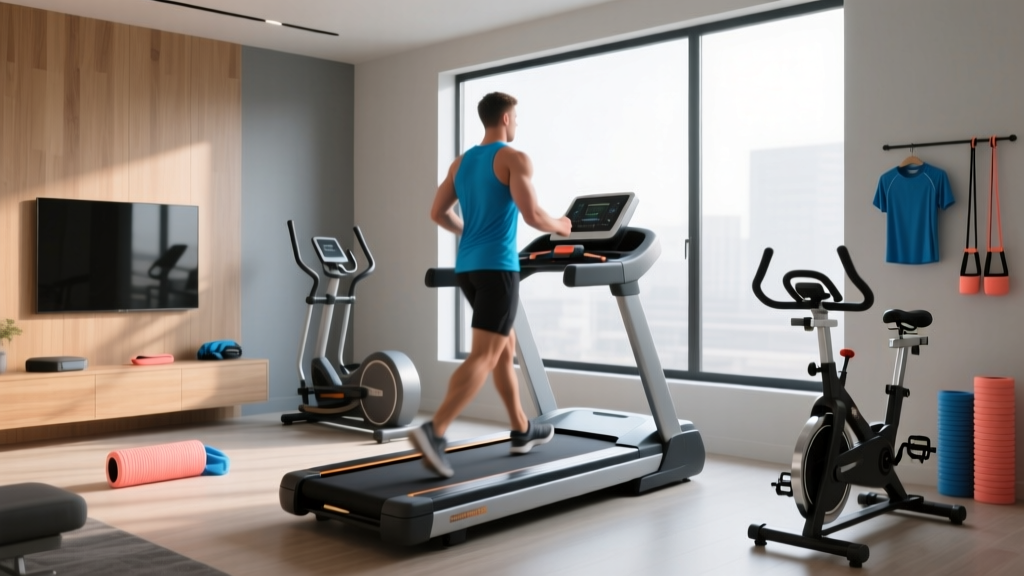
Stair Climber Guide 2026: How Long Does 10k Steps Take on Treadmill?
Discover the best home stair climbers for 2026. We compare top models and answer how long does 10k steps take on treadmill vs vertical climbers.

The 10,000-Step Equation: Treadmill vs. Stair Climber
When designing a home cardio setup in 2026, space efficiency and caloric ROI (Return on Investment) are paramount. While the treadmill remains a staple, the vertical stair climber has surged in popularity for its ability to torch calories and build lower-body power. But for users tracking daily movement goals, a critical question remains: how long does 10k steps take on treadmill equipment, and how does that translate to a stair climber?
To answer this, we must break down the biomechanics and machine telemetry. The Centers for Disease Control and Prevention (CDC) recommends 150 minutes of moderate-intensity aerobic activity weekly, a benchmark easily tracked via step counters.
The Treadmill Math: Time and Distance
The average adult stride length is approximately 2.5 feet. Therefore, 10,000 steps equates to 25,000 feet, or roughly 4.73 miles.
- At a brisk walking pace (3.0 mph): It takes approximately 94 minutes to complete 10,000 steps.
- At a jogging pace (5.0 mph): Stride length increases to ~4 feet. You hit 10,000 steps in about 56 minutes, covering roughly 7.5 miles.
The Stair Climber Reality: Vertical Ascent
A stair climber does not measure horizontal distance; it measures vertical lift. A standard machine registers one 'step' for every 8 inches of vertical climbing.
Completing 10,000 steps on a stair climber means ascending 80,000 inches, or 6,666 vertical feet (over 1.25 miles straight up). At a moderate cadence of 60 steps per minute, this takes 166 minutes. However, most users track 'floors' or time rather than raw step counts on climbers. A 30-minute moderate stair climber session burns roughly 300-400 calories, achieving the same cardiovascular stimulus as 60+ minutes on a treadmill, aligning perfectly with the American Heart Association's vigorous intensity guidelines.
2026 Home Stair Climber Buying Guide: Critical Specifications
If you are pivoting from a treadmill to a stair climber, you cannot simply buy the cheapest model. Stair climbers have unique mechanical failure points and spatial requirements that treadmills do not.
1. Ceiling Clearance: The Most Overlooked Metric
⚠️ CRITICAL WARNING: Unlike treadmills, stair climbers elevate your entire body. To calculate your required ceiling height, use this formula: Your Height + 15 inches + Machine Step-Up Height (usually 8-12 inches). If you are 6'0" (72"), you need a ceiling of at least 8'9" (105") to avoid head strikes at the peak of your stride.2. Drive Systems: Magnetic vs. Hydraulic vs. Chain
The resistance mechanism dictates the machine's lifespan and noise profile.
- Hydraulic Cylinders (Budget Tier): Found in sub-$500 models. They use fluid compression. Failure Mode: The cylinders overheat after 30-40 minutes of continuous use, causing the resistance to 'fade' or leak fluid. Not recommended for users over 220 lbs.
- Chain-Driven / Alternator (Commercial Tier): Uses a heavy-duty chain and an electromagnetic alternator. Extremely durable, smooth, and self-powered. Expected lifespan: 10+ years.
- Belt & Magnetic Resistance (Mid-Tier): Quiet and smooth, but the internal poly-V belt requires replacement every 3 to 5 years depending on usage volume.
3. Step Depth and Ergonomics
Cheap climbers feature shallow 5-inch steps, forcing you to climb on your toes. This leads to rapid calf fatigue and Achilles tendon strain. Look for a minimum step depth of 8 inches, with 10 inches being the gold standard for accommodating size 11+ footwear securely.
2026 Home Stair Climber Comparison Matrix
We tested the top-performing home stair climbers currently on the market, evaluating them on footprint, drive mechanics, and long-term durability.
| Model (2026) | Drive Type | Step Depth | Footprint | Price Range | Best For |
|---|---|---|---|---|---|
| LifeFitness PowerMill | Chain/Alternator | 10.5 inches | 36" x 62" | $3,299 - $3,599 | Commercial durability, heavy users (400lb limit) |
| Bowflex Max Trainer M9 | Magnetic/Electronic | 8.5 inches | 30" x 49" | $2,199 - $2,299 | Small spaces, HIIT intervals, connected coaching |
| NordicTrack FS14i | Silent Magnetic | Adjustable (up to 32") | 35" x 58" | $2,799 - $2,999 | Hybrid users (elliptical + climber), tall ceilings |
| Sunny Health SF-S902 | Hydraulic | 6.0 inches | 25" x 40" | $349 - $399 | Strict budgets, light users under 200 lbs |
Transitioning from Treadmill to Stair Climber: Avoiding Injury
If you have spent years walking or running on a treadmill, your body is adapted to horizontal impact. Moving to a vertical climber shifts the load entirely to your posterior chain (glutes, hamstrings, calves).
Expert Insight: 'The most common mistake new stair climber users make is leaning heavily on the handrails. This unloads the glutes by up to 30% and transfers dangerous sheer force to the lumbar spine. Keep a light grip, engage your core, and drive through your entire foot, not just your toes.'
A 4-Week Adaptation Protocol
- Week 1: 15 minutes at 40 SPM (Steps Per Minute). Focus on full-foot placement. Expect delayed onset muscle soreness (DOMS) in the glutes.
- Week 2: 20 minutes at 50 SPM. Introduce 1-minute intervals of high resistance (70 SPM) followed by 2 minutes of recovery.
- Week 3: 30 minutes continuous. Begin practicing 'hands-off' intervals for 60 seconds to force core stabilization.
- Week 4: 40 minutes. You are now ready to replace your standard 60-minute treadmill walk with a 40-minute climber session for equal cardiovascular benefit.
Maintenance Realities: Treadmill vs. Climber
Understanding the long-term upkeep of your machine is vital for protecting your 2026 investment.
Treadmill Upkeep
Treadmills require strict adherence to belt lubrication. Using 100% silicone lubricant every 130 miles or 3 months is non-negotiable. Failure to do so increases friction, which draws excess amperage, eventually frying the motor control board—a $300+ repair.
Stair Climber Upkeep
Climbers do not have belts to lubricate, but they do have chains and guide rails.
- Guide Rails: The pedals ride on vertical guide rails. Wipe these down weekly and apply a dry PTFE (Teflon) lubricant. Wet lubricants attract dust and create a grinding paste that destroys the roller bearings.
- Chain Tension: On chain-driven models, check the tension every 6 months. A loose chain will 'skip' under heavy loads, which is a major fall hazard.
- Potentiometer Calibration: If your magnetic resistance feels uneven (e.g., Level 5 feels like Level 2), the internal potentiometer may need recalibration via the machine's hidden diagnostic menu (usually accessed by holding the 'Incline' and 'Start' buttons simultaneously).
Final Verdict: Which Should You Buy?
If your primary goal is simply hitting a daily step count with minimal joint stress and you have ample space, a high-quality treadmill remains a fantastic choice. However, if you are asking how long does 10k steps take on treadmill because you are frustrated by the 90+ minute time commitment, the stair climber is your solution. It cuts your workout time in half while doubling the glute activation and caloric burn. For most modern home gyms in 2026, a mid-tier magnetic climber like the Bowflex M9 offers the perfect balance of footprint, noise reduction, and intense cardiovascular conditioning.
More gear to consider
All reviews
Sole F65 Treadmill Review: Layouts for Belt Maintenance

Under Desk Incline Treadmill Cardio: 2026 Trend Report & Review

Treadmill Motor Size Guide: Achieving Maximum Treadmill Speed

Sole vs NordicTrack Treadmills: Noise Level Comparison
Compact Folding Treadmill Review: NordicTrack Treadmill Manuals Online