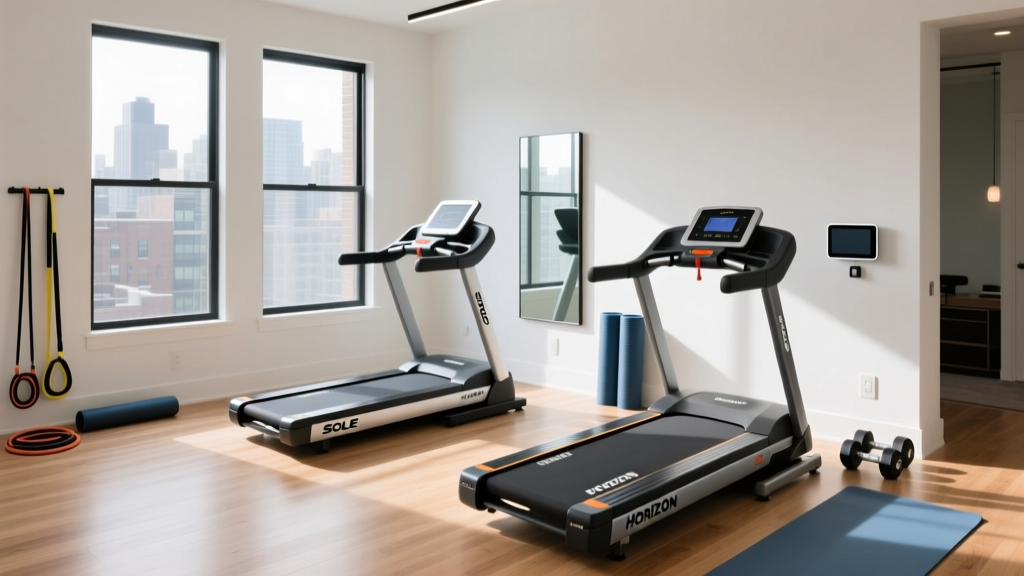
Sole vs Horizon Treadmill: Elliptical vs Treadmill Space Layouts
Optimize your home gym layout. We compare elliptical vs treadmill footprints, featuring a Sole vs Horizon treadmill space analysis for 2026.

The Spatial Dilemma: Elliptical vs Treadmill for Home Cardio
When designing a home gym in 2026, the battle for square footage is just as critical as the battle for personal records. Whether you are converting a 12x12 spare bedroom into a fitness studio or carving out a corner in a multi-use living space, choosing between an elliptical and a treadmill requires rigorous spatial planning. The decision extends far beyond joint impact and calorie burn; it dictates your room's traffic flow, ceiling clearance requirements, and structural vibration management.
According to the Mayo Clinic, both machines offer exceptional cardiovascular benefits, but their physical footprints demand entirely different architectural considerations. Treadmills require elongated floor space and strict rear safety margins, while ellipticals demand significant vertical clearance and lateral swing radii. To illustrate these spatial dynamics, we will use the highly debated Sole vs Horizon treadmill comparison as a framework to evaluate how leading treadmill brands engineer space-saving mechanisms, and how those dimensions stack up against premium compact ellipticals.
2026 Layout Warning: Never place a cardio machine flush against a wall. The American Council on Exercise (ACE) mandates a minimum 20-inch lateral clearance on both sides and a 30-inch rear drop-zone for treadmills to prevent severe friction burns and entrapment in the event of a fall.The Footprint Showdown: Unfolded vs. Folded Real Estate
The most common misconception in home gym design is relying solely on the manufacturer's 'folded dimensions' to plan a room. While folding mechanisms are excellent for daily storage, your primary layout must accommodate the machine in its fully deployed state, alongside the user's biomechanical envelope.
Treadmill Dimensions: The Length Penalty
Treadmills are inherently long. To accommodate a natural running stride without the user stepping on the rear motor cowling, the running belt must be at least 55 inches long, pushing the total machine length past 80 inches. When analyzing the Sole vs Horizon treadmill market from a spatial perspective, we see distinct approaches to minimizing this footprint.
- Sole F80 (2026 Model): Measures 82' L x 30' W x 56' H. Sole prioritizes a wider 22-inch running track, which pushes the overall width to 30 inches. Its hydraulic folding system reduces the floor footprint to roughly 38' L x 30' W, but the deck remains locked at an 8.5-inch height when folded.
- Horizon 7.0: Measures 76' L x 27' W x 55' H. Horizon achieves a more compact footprint by utilizing a slightly narrower 20-inch belt and a more aggressive feather-light folding hinge, yielding a stored footprint of 36' L x 27' W. This makes the Horizon 7.0 a superior choice for narrow galley-style home gyms.
Elliptical Dimensions: The Height and Depth Factor
Ellipticals cannot be folded due to their fixed crank-and-rail geometry. A premium machine like the Sole E95 Elliptical occupies a permanent 82' L x 31' W x 69' H footprint. While the length is similar to a treadmill, the spatial challenge shifts to the front-to-back stride ellipse. Users must account for an additional 10 inches of forward reach beyond the machine's physical nose when the pedals are at their maximum anterior extension.
2026 Compact Cardio Matrix: Specifications & Pricing
| Machine Model | Unfolded Footprint | Folded Footprint | Deck/Pedal Height | Est. Price (2026) |
|---|---|---|---|---|
| Sole F80 Treadmill | 82' x 30' | 38' x 30' | 8.5' Deck | $1,199 |
| Horizon 7.0 Treadmill | 76' x 27' | 36' x 27' | 8.0' Deck | $999 |
| Sole E95 Elliptical | 82' x 31' | N/A (Fixed) | 15' Pedal Apex | $1,499 |
| Horizon EX-59 Elliptical | 70' x 25' | N/A (Fixed) | 12' Pedal Apex | $799 |
Note: Pricing reflects direct-to-consumer MSRPs as of early 2026. Promotional discounts may apply during holiday sales events.
Vertical Real Estate: Ceiling Clearance Mathematics
The most frequently miscalculated variable in home gym layout design is vertical clearance. Hitting your head on a ceiling fan or drywall mid-stride is not just annoying; it is a severe safety hazard.
The Treadmill Clearance Formula
Treadmill decks elevate the user. The Sole F80 has an 8.5-inch step-up height. When running, a user's vertical bounce adds approximately 2 to 3 inches. Therefore, the formula for minimum ceiling height is:
User Height + Deck Height (8.5') + Bounce Margin (3') = Minimum Ceiling Height.
For a 6-foot (72') tall user, the math is 72 + 8.5 + 3 = 83.5 inches. A standard 8-foot (96') ceiling provides a comfortable 12.5-inch safety buffer.
The Elliptical Clearance Trap
Ellipticals are far more demanding vertically. The pedal apex (the highest point of the stride cycle) on a front-drive machine like the Sole E95 can reach 15 inches off the ground. Furthermore, users stand fully upright without the slight forward lean characteristic of treadmill running. For a 6-foot user on an elliptical, you must add the 15-inch pedal apex plus a 4-inch overhead safety margin, totaling 91 inches. If your home gym is located in a basement with dropped ceilings or exposed HVAC ducting, an elliptical may be physically unviable, making a low-deck Horizon treadmill the only logical choice.
Electrical Layout and Cable Management
Space optimization also means managing power delivery without creating tripping hazards. As highlighted in extensive home gym testing by Wirecutter, high-torque treadmill motors require robust electrical infrastructure.
- Circuit Requirements: The Sole F80 features a 3.5 CHP motor that can draw up to 15 amps under heavy load. It requires a dedicated 15-amp or 20-amp circuit. Sharing this circuit with a space heater or window AC unit will trip the breaker mid-run.
- Cord Length Constraints: Most premium cardio machines feature a maximum 6-foot power cord. Your spatial layout must place the machine within 5 feet of a grounded wall outlet. Avoid using extension cords, as they introduce voltage drop and fire risks.
- Ergonomic Outlet Placement: For optimal layout design, install outlets at waist height (36 inches) rather than baseboard level. This prevents severe bending to plug/unplug the machine and keeps the cord clear of the treadmill's folding hinge mechanism.
Floor Loading, Vibration, and Acoustic Mapping
When optimizing a layout, you must consider the Z-axis: what is happening beneath the floor. Treadmills generate repetitive impact forces (up to 3x body weight) that translate into structural vibration. Ellipticals are zero-impact, meaning they generate virtually no downward kinetic force.
Second-Floor Layouts
If your home gym is on the second floor or above a finished living space, the Sole vs Horizon treadmill debate shifts toward cushioning technology. Sole's proprietary Cushion Flex Whisper Deck system reduces impact by up to 40% compared to outdoor asphalt, significantly dampening low-frequency acoustic transfer through floor joists. However, spatial planning for any second-floor treadmill mandates the use of a 3/4-inch thick vulcanized rubber mat (such as those from SuperMats) that extends 12 inches beyond the machine's perimeter to absorb micro-vibrations.
Static Weight Distribution
While ellipticals lack impact vibration, they possess a higher static weight and concentrated center of gravity. The Sole E95 weighs 236 lbs. When a 200-lb user is at the extreme forward pedal position, the weight distribution shifts heavily to the front stabilizers. Ensure your flooring (especially luxury vinyl plank or engineered hardwood) is rated for point-loads exceeding 450 lbs to prevent long-term indentation.
Final Verdict: Designing Your Cardio Zone
Choosing between an elliptical and a treadmill for your home cardio layout ultimately comes down to your room's specific architectural constraints. If your space is constrained by narrow widths and low ceilings (under 8 feet), the compact, foldable Horizon 7.0 treadmill is the undisputed champion of spatial efficiency. Its 27-inch width allows it to slide into tight alcoves, and its low 8-inch deck height eliminates ceiling clearance anxieties.
Conversely, if you have ample square footage but require a zero-impact modality due to joint rehabilitation or multi-generational household use, the Sole E95 Elliptical justifies its permanent 82x31-inch footprint with superior biomechanical ergonomics and whisper-quiet operation. Just ensure your ceiling height exceeds 8.5 feet and you have mapped out the necessary 20-inch lateral safety wings.
By treating your home gym not just as a collection of equipment, but as an integrated architectural layout, you ensure that your 2026 fitness space remains safe, functional, and optimized for long-term consistency.
More gear to consider
All reviews
2026 Techno Treadmill Showdown: Myrun vs. Skillrun

Walking Pad Review: Setup for the 12 3 30 Treadmill Exercise
Does Nike Run Club Work on Treadmills? Setup & 2026 Buyer Guide

ProForm Cadence LT Treadmill Setup & Walking Pad Comparison

Goplus 2 in 1 Folding Treadmill Manual & Walking Pad Review
