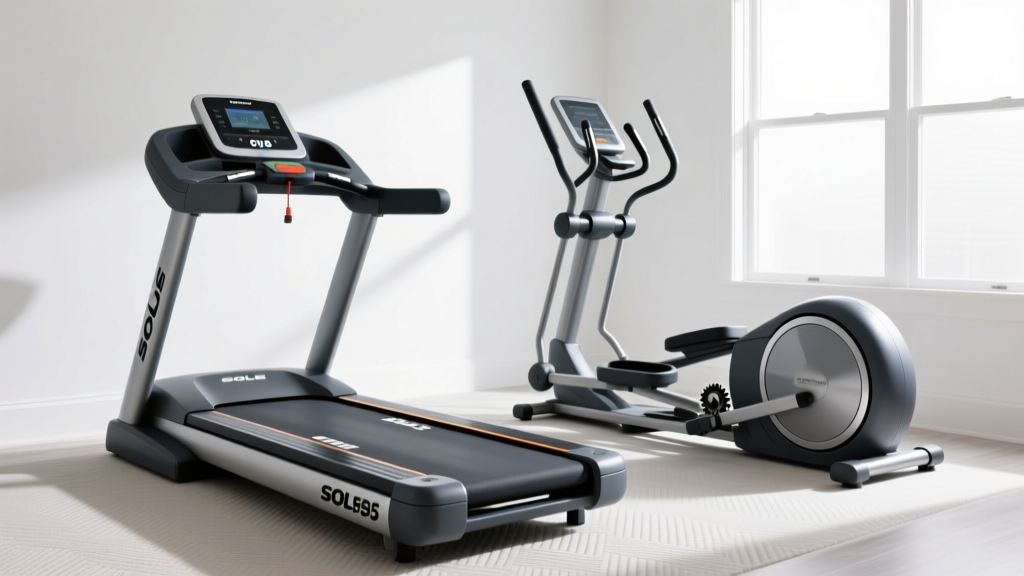
Sole F85 Treadmill vs Ellipticals: Home Cardio Budget Breakdown
Is the Sole F85 treadmill worth the investment over a premium elliptical? We break down long-term costs, maintenance, and ROI for home cardio.

The Upfront CapEx: Sole F85 Treadmill vs. Premium Ellipticals
When outfitting a home gym in 2026, the debate between a heavy-duty treadmill and a premium elliptical often centers on joint health and workout intensity. However, from a strict financial and value-analysis perspective, the decision requires a deeper look at capital expenditure (CapEx) and total cost of ownership. The Sole F85 treadmill has long been the gold standard for serious home runners, boasting a massive 4.0 CHP motor, a 22-inch by 60-inch running surface, and a 400-pound weight capacity. But how does its financial footprint compare to high-end ellipticals like the Sole E95 or the NordicTrack Commercial 14.9?
To understand the true value, we must first look at the street prices. While MSRP can be misleading in the fitness industry, actual transaction prices in 2026 tell a clearer story. The Sole F85 typically retails between $1,799 and $2,299 depending on seasonal promotions. Its direct elliptical counterpart, the Sole E95, hovers around $1,699, while the NordicTrack Commercial 14.9 elliptical sits at a similar $1,699 price point. On paper, the upfront costs are nearly identical. The divergence in value, however, begins the moment you plug the machines in.
| Machine Model | Type | 2026 Street Price | Drive System | Frame Warranty |
|---|---|---|---|---|
| Sole F85 | Treadmill | $1,799 - $2,299 | 4.0 CHP Motor | Lifetime |
| Sole E95 | Elliptical | $1,699 | Magnetic Resistance | Lifetime |
| NordicTrack Commercial 14.9 | Elliptical | $1,699 | Magnetic Resistance | 10 Years |
The Hidden OpEx: Electricity, Subscriptions, and Climate Control
Operating expenditure (OpEx) is where the elliptical vs treadmill for home cardio debate shifts dramatically. Treadmills are inherently power-hungry machines. The Sole F85's 4.0 CHP (Continuous Horsepower) motor is a beast, designed to maintain speeds up to 12 MPH and inclines up to 15% without bogging down. Under heavy load—such as a 220-pound user running at an incline—the motor can draw upwards of 1,800 watts. If you run for one hour daily, that equates to roughly 657 kWh per year. At the 2026 national average electricity rate of $0.16 per kWh, the F85 will cost you approximately $105 annually just in power.
Conversely, ellipticals utilize magnetic resistance and flywheel momentum. The console and magnetic brakes on a machine like the Sole E95 draw less than 100 watts. Your annual electricity cost for an elliptical? Less than $6. While $100 a year might not break the bank, it is a fixed operational cost that treadmills inherently carry.
Warning: The Subscription TrapThe most significant OpEx disparity in 2026 lies in software subscriptions. The Sole F85 includes access to the Sole+ app, which provides basic metrics and free world-map routing without a mandatory paywall. However, if you opt for a smart elliptical like the NordicTrack Commercial 14.9, the machine's HD touchscreen is effectively bricked without an iFIT membership. At $396 per year, a 5-year iFIT subscription adds a staggering $1,980 to your total cost of ownership, completely destroying the elliptical's perceived upfront value.
The HVAC Factor: Ambient Heat Generation
An often-overlooked budget factor is climate control. A 1,800-watt treadmill motor generates roughly 6,140 BTUs of heat per hour—the equivalent of running a medium-sized space heater. During summer months, your home's air conditioning system must work overtime to dissipate the heat generated by both the F85's motor and your own body. Ellipticals, lacking a high-friction drive belt and massive electric motor, generate significantly less ambient heat, keeping your summer cooling bills marginally lower.
Biomechanical ROI: Caloric Yield vs. Joint Depreciation
Financial value is meaningless if the machine does not deliver a return on your physiological investment. According to the American College of Sports Medicine (ACSM), both treadmills and ellipticals provide excellent cardiovascular conditioning, but their biomechanical ROI differs vastly.
- Treadmill (Sole F85): Running on a treadmill generates ground reaction forces (GRF) equivalent to 2.5 times your body weight. This high-impact loading is crucial for osteogenic stimulation (bone density maintenance) but accelerates joint cartilage wear over time, particularly in the knees and lumbar spine.
- Elliptical (Sole E95): Ellipticals eliminate the strike phase of the gait cycle, reducing GRF to near zero. This makes them the undisputed champions for active recovery, rehabilitation, and high-volume cardio for aging populations. However, they do not provide the bone-loading benefits of a treadmill.
From a pure caloric expenditure standpoint, the Sole F85 wins. Because you must support your own body weight and stabilize your core without the assistance of moving arm handles (unless you actively pump them on an elliptical), treadmill running burns approximately 10% to 15% more calories per hour than an equivalent perceived exertion level on an elliptical. If your primary metric for ROI is calories burned per minute, the treadmill is the superior asset.
Maintenance and Failure Modes: What Actually Breaks?
To accurately forecast long-term value, we must analyze the mechanical failure modes of both machine types. As noted in the Consumer Reports Treadmill Buying Guide, treadmills require strict adherence to maintenance schedules to avoid catastrophic motor failure.
Sole F85 Treadmill Failure Points
- Deck Delamination & Belt Friction: The F85 uses a phenolic-coated deck. If the user neglects to lubricate the belt with 100% silicone every 150 miles, friction increases exponentially. This forces the 4.0 CHP motor to draw excess amperage, which eventually fries the motor controller board—a $300+ replacement part.
- Drive Belt Stretching: The poly-V drive belt connecting the motor to the front roller will stretch over 3 to 5 years of heavy use, requiring tension adjustments or replacement.
Premium Elliptical Failure Points
- Pivot Bearing Seizure: Ellipticals have multiple pivot points (pedal arms, crank joints, handlebars). While they don't require belt lubrication, these sealed bearings can dry out or seize after 5,000+ miles. Replacing them requires a complete teardown of the machine's linkage system.
- Crank Arm Fatigue: The metal crank arms connecting the pedals to the central flywheel endure immense lateral torque. In cheaper models, these snap; in premium models like the E95, they are overbuilt but still represent a critical single-point-of-failure.
The 5-Year Total Cost of Ownership (TCO) Matrix
Let's synthesize the data into a 5-year financial projection. This matrix assumes 5 hours of use per week, standard US electricity rates, and no extended third-party warranties.
| Cost Category | Sole F85 Treadmill | Sole E95 Elliptical | NordicTrack 14.9 Elliptical |
|---|---|---|---|
| Upfront Purchase Price | $1,999 | $1,699 | $1,699 |
| Delivery & Assembly | $150 | $150 | $150 |
| 5-Year Electricity Cost | $525 | $30 | $30 |
| 5-Year Software Subscriptions | $0 (Sole+ is free) | $0 | $1,980 (iFIT) |
| Routine Maintenance Parts | $45 (Silicone lube) | $0 | $0 |
| 5-Year Total Cost | $2,719 | $1,879 | $3,859 |
As the matrix illustrates, the Sole E95 elliptical is the undisputed champion of pure financial efficiency over a 5-year horizon. However, the Sole F85 treadmill offers a vastly superior biomechanical experience for runners, and its TCO remains remarkably competitive when compared to smart-ecosystem ellipticals that lock you into subscription paywalls.
Final Verdict: Maximizing Your Home Cardio Investment
Choosing between the Sole F85 treadmill and a premium elliptical is not just about what fits your budget today; it is about what aligns with your physiological goals and long-term financial tolerance.
Buy the Sole F85 Treadmill if: You are training for outdoor road races, you require high-impact osteogenic loading for bone health, you want to maximize caloric burn per minute, and you refuse to pay monthly software subscriptions to unlock your machine's basic functionality. The F85's 4.0 CHP motor and lifetime warranty make it a legacy investment that can withstand a decade of heavy use.
Buy a Premium Elliptical (like the Sole E95) if: Your primary goal is joint preservation, you are recovering from lower-body injuries, you want to minimize your home's electrical and HVAC footprint, and you prefer a machine that requires virtually zero routine maintenance. Just be sure to avoid models that mandate expensive monthly software subscriptions to function.
Ultimately, the best financial decision is the one that keeps you consistent. A $1,800 elliptical gathering dust in your guest room has an infinite cost-per-use, while a heavily utilized Sole F85 treadmill pays daily dividends in cardiovascular health and longevity.
More gear to consider
All reviews
Gold Gym 450 Treadmill Troubleshooting: Curved Manual vs Motorized

Under-Desk Treadmill Belt Length Trends & 2026 Office Market Review

Beyond the Treadmill Cat: Upright vs Recumbent vs Spin Bikes
Are NordicTrack Treadmills Good? Curved vs Motorized Setup Guide

Walking Pad vs Treadmill 2026: Treadmill METs Calculator Breakdown
