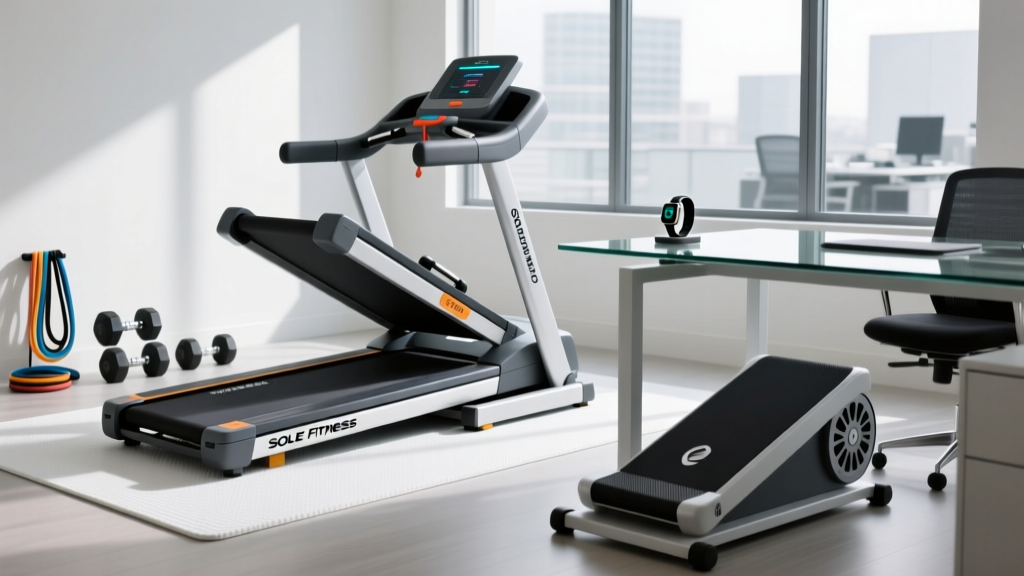
Sole Fitness F80 Folding Treadmill vs Under Desk Office Treadmills
We compare the heavy-duty Sole Fitness F80 folding treadmill against top under desk treadmills to find the best cardio setup for your home office.

The Heavy-Duty vs. Hybrid Work Dilemma
The transition from dedicated home gyms to integrated hybrid workspaces has fundamentally shifted how we evaluate cardio equipment in 2026. For years, my gold standard for at-home cardio has been the Sole Fitness F80 folding treadmill—a powerhouse with a 3.5 CHP motor, a 20" x 60" belt, and a $999 price tag that justifies its durability. However, when your office is also your living room, a 250-pound folding treadmill isn't always practical for mid-day movement. This brings us to the modern ergonomic dilemma: should you stick to a traditional folding machine, or pivot to an under-desk treadmill for daily office use? In this hands-on review, I break down the biomechanics, noise profiles, and real-world productivity impacts of swapping heavy-duty runners for ultra-compact walking pads.
Specification Matrix: Heavy-Duty vs. Ultra-Compact
Before diving into the ergonomics, we need to look at the raw hardware. The engineering compromises required to make a treadmill fit under a standing desk drastically change the performance envelope.
| Feature | Sole Fitness F80 | WalkingPad R2 | Urevo Strol 2E |
|---|---|---|---|
| Motor | 3.5 CHP Continuous | 2.5 HP Peak | 2.25 HP Peak |
| Belt Size | 20" x 60" | 17" x 43" | 16.5" x 41.3" |
| Top Speed | 12.0 mph | 7.5 mph (handle up) / 3.7 mph (flat) | 4.0 mph |
| Weight | 250 lbs | 65 lbs | 55 lbs |
| Price (2026) | $999 - $1,099 | $499 - $549 | $279 - $329 |
| Best Use Case | Dedicated HIIT & Distance Running | Active Recovery & Brisk Walking | Slow Typing & Casual Strolling |
The Biomechanics of Desk Treadmills: How Speed Affects Productivity
A common mistake first-time under-desk treadmill buyers make is assuming they can walk at 3.0 mph while drafting emails. Biomechanically, the lateral sway of your pelvis at speeds above 1.5 mph severely degrades fine motor control. According to ergonomic research published in the National Center for Biotechnology Information (NCBI), typing speed and accuracy drop by roughly 10% to 15% when walking at 1.5 mph compared to sitting, and the error rate compounds exponentially past 2.0 mph.
Expert Tip: For tasks requiring high cognitive load or precise mouse work, keep your under-desk treadmill between 0.8 and 1.2 mph. Save the 3.0+ mph speeds for video calls where you are primarily listening, or transition back to your Sole F80 after work for dedicated, high-intensity cardio.Hands-On Review: Top Under-Desk Contenders for 2026
1. WalkingPad R2 (The Premium Pivot)
If you are stepping down from a Sole Fitness F80 folding treadmill, the WalkingPad R2 is the least jarring transition. Its 180-degree foldable handrail allows it to function as a traditional mini-treadmill (up to 7.5 mph) or fold completely flat to slide under a 30-inch standing desk. The 17-inch belt width is narrow compared to the Sole's 20-inch deck, meaning you must maintain strict lateral discipline. However, the brushless motor operates at roughly 55 decibels—quiet enough that your microphone won't pick it up during Zoom calls.
2. Urevo Strol 2E (The Budget Workhorse)
Priced around $299, the Urevo Strol 2E sacrifices top speed for ultimate low-profile integration. It maxes out at 4.0 mph, which is perfectly adequate for NEAT (Non-Exercise Activity Thermogenesis) accumulation. The CDC recommends minimizing prolonged sedentary behavior, and the Strol 2E makes it effortless to log 10,000 steps without leaving your spreadsheet. Its primary failure mode? The belt requires manual silicone lubrication every 40 hours of use, unlike the waxed belts on premium Sole models.
Maintenance Realities: What the Spec Sheets Don't Tell You
One area where the Sole Fitness F80 folding treadmill completely outclasses the under-desk category is long-term maintenance and edge-case durability. The F80 features a phenolic-coated deck that requires zero manual lubrication for the first few years. Under-desk treadmills, constrained by their ultra-slim 4-inch profiles, use thinner decks and smaller rollers.
The Edge Case of Low-Speed Friction: When you walk at 1.0 mph on a compact treadmill, the belt spends more time in contact with the deck per revolution than it does when running at 6.0 mph. This creates localized heat buildup directly under the foot strike zone. If you do not lift the belt and apply 100% silicone lubricant every 40 to 60 hours, the increased friction will eventually trip the motor's thermal overload switch or fry the control board. I have seen budget under-desk models fail in under six months purely due to user neglect of this critical maintenance step.
Furthermore, the American Heart Association emphasizes that while breaking up sitting time is crucial for cardiovascular health, the equipment must be reliable enough to form a daily habit. A treadmill that constantly requires belt tensioning adjustments via an Allen wrench will quickly become an expensive clothes hanger.
Acoustic Footprints: Will Your Coworkers Hear You?
When testing the Sole Fitness F80 folding treadmill in a garage environment, the 65-decibel motor hum and footstrike impact are non-issues. In a shared home office or an apartment with downstairs neighbors, acoustic dampening is critical.
- Footstrike Impact: Under-desk treadmills lack the heavy flywheels and thick elastomer cushions of the Sole F80. To mitigate low-frequency vibration transfer to your floor, you must use a high-density EVA foam mat (at least 3/8-inch thick).
- Motor Whine: Cheaper under-desk models use brushed motors that emit a high-pitched whine at 2.0+ mph. Stick to brushless options like the WalkingPad or higher-end Urevo models to keep ambient noise below 60 dB.
The Final Verdict: Which Machine Owns Your Floor Space?
Choosing between a traditional heavy-duty machine and an under-desk model isn't necessarily an either/or proposition; it's about matching the tool to the daily routine.
Stick to the Sole F80 If:
- You run intervals or exceed 4.0 mph regularly.
- You have a dedicated room with at least 30 square feet of clearance.
- You require advanced incline training (up to 15% on the F80).
- You weigh over 220 lbs and need a 375+ lb user capacity.
Buy an Under-Desk Treadmill If:
- Your primary goal is combating sedentary fatigue during 8-hour shifts.
- You live in an apartment where storing a 250-lb machine is impossible.
- You want to accumulate NEAT calories without changing into gym clothes.
- You primarily work at a standing desk and value low-decibel operation.
Frequently Asked Questions
Can I use the Sole Fitness F80 folding treadmill with a standing desk?
Technically, no. The Sole F80's console height and 9-inch step-up deck clearance make it incompatible with standard standing desks. Furthermore, its 12-mph speed capability and lack of a dedicated "desk mode" safety tether make it dangerous for typing while moving.
Do under-desk treadmills burn as many calories as the Sole F80?
Per minute, no. Walking at 1.5 mph burns roughly 100-150 calories per hour. However, because you can use an under-desk treadmill for 3-4 hours continuously while working, your total daily caloric expenditure often exceeds what you'd burn during a 45-minute dedicated run on the Sole F80.
How often do under-desk treadmill belts need replacing?
Due to the smaller motor rollers and constant low-speed friction (which generates more heat than high-speed running), expect to replace an under-desk belt every 2 to 3 years with daily use, compared to 5 to 7 years on a well-maintained Sole F80.
More gear to consider
All reviews
Hitting 3.5 Speed on Treadmill Walking Pads: Budget & Value Guide
Maintaining Your AFG Sport 3.5 AT Treadmill & Compact Cardio Gear

Pad Setup: Calories Burned on Treadmill Calculator With Incline
Treadmill Motor Size Guide: Is the ProForm 385 Treadmill Enough?

Under Desk Treadmill Review: Garmin Treadmill Walk Value Analysis
