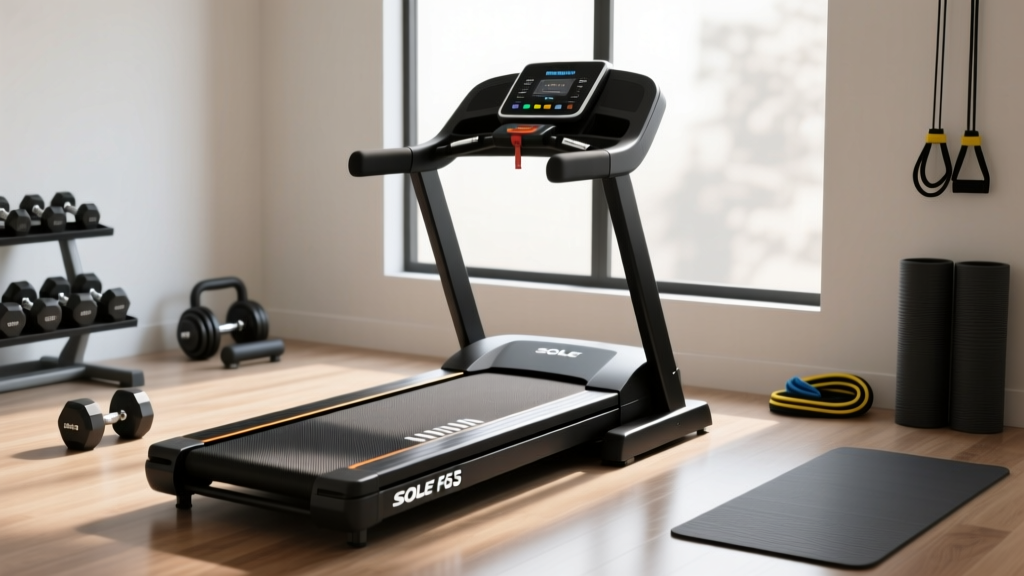
Sole F65 Treadmill Review: Layouts for Belt Maintenance
Read our Sole F65 treadmill review focusing on home gym layout design, spatial clearances, and step-by-step belt maintenance and lubrication protocols.

Motor: 3.25 HP Continuous Duty | Deck: 20" x 60" | Weight: 236 lbs | Belt Type: 2-ply, pre-waxed
Maintenance Interval: 100% Silicone Lubrication every 3 months or 150 miles.
Average Replacement Board Cost: $120 - $150 (Lower Control Board)
The Spatial Blind Spot in Treadmill Reviews
When evaluating cardio equipment for home use, most buyers focus on motor size, screen interactivity, and folding capabilities. However, a critical factor often ignored in standard product evaluations is the maintenance envelope—the physical space required to actually service the machine. In our comprehensive Sole F65 treadmill review, we are approaching the evaluation from a space optimization and layout design perspective. The Sole F65 is a powerhouse mid-range unit, but its 34-inch width and 236-pound footprint demand strategic room planning.
If you shove this treadmill into a tight alcove with only six inches of side clearance, you effectively block your own access to the deck. You cannot perform essential belt maintenance and lubrication without adequate spatial clearance. Neglecting this maintenance due to poor room layout leads directly to increased friction, motor overheating, and premature failure of the lower control board. Below, we break down exactly how to design your home gym layout to accommodate the Sole F65, followed by the precise protocol for belt lubrication.
Sole F65 Clearance Matrix: Operation vs. Maintenance
Safety guidelines dictate minimum clearances for emergency dismounts, but maintenance clearances require ergonomic space for you to crouch, reach, and apply lubricant beneath the belt edge. The Consumer Product Safety Commission (CPSC) recommends ample rear clearance for fall safety, but side clearance is where maintenance access lives.
| Zone | Minimum for Operation | Required for Maintenance Access | Design Strategy |
|---|---|---|---|
| Left Side (Control Panel Side) | 12 inches | 24 - 30 inches | Keep clear of walls/desks for crouching access. |
| Right Side | 12 inches | 18 - 24 inches | Allow space to lift belt edge and wipe excess silicone. |
| Rear Deck | 78 inches (Fall Zone) | 48 inches | Required to access rear roller tension bolts. |
| Front Motor Hood | 24 inches | 36 inches | Needed to remove hood cover for vacuuming/deep cleaning. |
The 15-Minute Belt Lubrication Protocol
The Sole F65 features a 2-ply, pre-waxed belt. While pre-waxed belts delay the need for immediate lubrication, the wax eventually degrades. According to industry experts featured in Consumer Reports, failing to re-lubricate a home treadmill belt is the number one cause of expensive motor and electronic failures. Here is the exact, step-by-step protocol for the Sole F65.
- Power Down and Unplug: Never lubricate a live machine. Unplug the Sole F65 from the wall and remove the safety magnetic key from the console.
- Locate the Application Zone: You will be applying 100% pure silicone (approx. $12 per bottle) between the walking belt and the wooden deck. Do not use petroleum-based sprays like WD-40, which will destroy the rubber.
- Lift the Left Edge: Crouch in your designated 24-inch left-side maintenance zone. Lift the left edge of the belt near the middle of the deck. You should be able to slide your hand about 8 to 10 inches toward the center.
- Apply the Silicone: Squeeze a zig-zag line of silicone (about 1/2 ounce) across the width of the deck, as close to the center as your arm can reach.
- Repeat on the Right Side: Move to the right side of the treadmill, lift the belt, and apply another 1/2 ounce zig-zag pattern.
- Distribute the Lubricant: Plug the machine back in. Start the treadmill at a slow walking pace (1.5 to 2.0 MPH). Let it run for 3 to 5 minutes. The friction will naturally spread the silicone evenly across the entire deck surface.
- Wipe the Edges: Power down again and use a microfiber cloth to wipe away any excess silicone that has seeped out onto the side rails to prevent slipping.
Space-Saving Layouts: The Slide-and-Pivot Strategy
What if your home gym is in a small spare bedroom and you simply cannot afford 30 inches of permanent clearance on the left side? In 2026, spatial optimization relies on dynamic movement rather than static footprints. We recommend the Slide-and-Pivot Layout for tight spaces.
Implementing the Slider System
Because the Sole F65 weighs 236 lbs, dragging it across hardwood or carpet can damage both the floor and the machine's leveling feet. Purchase a set of heavy-duty appliance sliders (rated for at least 300 lbs, costing roughly $25). Place the sliders under the front feet and the rear transport wheels. This reduces the friction coefficient so drastically that a single person can pull the treadmill 30 inches away from the wall with one hand, perform the 15-minute lubrication protocol, and slide it back into its tight operational footprint.
Expert Warning on Motor Amp-Draw: If spatial constraints prevent you from lubricating the Sole F65, the dry belt will cause massive friction. The 3.25 HP motor will compensate by drawing excess amperage. This routinely pushes the draw past 15 amps, which will either trip your home's circuit breaker or fry the Sole lower control board. Replacing the board costs between $120 and $150, plus the labor of recalibrating the motor.
Troubleshooting Maintenance-Related Failures
Even with a perfect layout, users sometimes encounter edge cases during or after maintenance. Here is a troubleshooting matrix for common Sole F65 belt issues:
- Belt Hesitation or Slipping After Lubrication: You likely applied too much silicone, or the belt tension is too loose. Use the rear roller hex bolts (usually 3/4") to tighten the belt by turning both sides exactly one-quarter turn clockwise. Test at 3 MPH.
- Belt Drifting to the Left: The left side is tighter than the right. Turn the left rear roller bolt counter-clockwise by one-eighth of a turn, or tighten the right side by one-eighth of a turn. Always make micro-adjustments and let the belt run for 30 seconds to track.
- Burning Smell from Motor Hood: This indicates severe friction or a failing drive motor. If you have just lubricated the belt and the smell persists, the deck itself may be worn through the phenolic coating. A replacement Sole F65 deck/belt combo kit typically costs around $180 to $220.
Final Thoughts on Gym Layout and Longevity
A treadmill is an investment in your cardiovascular health, but it is also a mechanical device that demands physical interaction. By integrating the maintenance envelope into your initial room design—whether through permanent clearance zones or dynamic slider systems—you ensure that the Sole F65 remains a reliable asset rather than a costly liability. Proper spatial planning is just as critical as the workout itself when it comes to maximizing the lifespan of your home cardio equipment.
More gear to consider
All reviews
Precor TRM 835 Treadmill: Step-by-Step Cardio Noise Comparison Guide

Cursor Fitness C70 Treadmill Review: Office Value & Budget Breakdown

Beyond 30 Minutes on Treadmill Everyday: Home Stair Climber Guide

Can a Plane Take Off on a Treadmill? Stair Climber Setup Guide

Sole F63 Treadmill Manual: Belt Care & Space Optimization
