Snowboard Treadmill Motor Size and Horsepower Buying Guide
Discover the exact motor size, continuous horsepower (CHP), and torque specs required for snowboard treadmills and endless slope simulators.

The Physics of Carving: Why Snowboard Treadmills Demand Extreme Torque
When most consumers think of cardio machines, they picture a standard flat-bed running treadmill. However, the snowboard treadmill—more accurately known in the industry as an endless slope or snowboarding simulator—operates on an entirely different mechanical paradigm. Unlike a traditional treadmill designed for forward linear motion on a 0% to 15% incline, a snowboard treadmill is engineered to support aggressive lateral carving, edge-loading, and high-friction synthetic snow mats on steep gradients ranging from 18% to 30%.
This extreme operational environment completely rewrites the rules for treadmill motor size and horsepower. If you attempt to use a standard 3.0 Continuous Horsepower (CHP) residential running motor on a 25-degree snowboard rig, the motor will overheat, trip its thermal breaker, or strip its internal gears within minutes. The friction coefficient of a snowboard edge digging into a synthetic belt (such as Neveplast or Sungrass) combined with the gravitational drag of a 180-pound rider on a steep incline requires massive low-end torque, not just top-end speed.
Continuous Horsepower (CHP) vs. Peak Horsepower: The Marketing Trap
The fitness equipment industry is notorious for inflating motor specifications using 'Peak Horsepower' metrics. Peak HP measures the absolute maximum output the motor can achieve for a fraction of a second before failing. For a snowboard treadmill, this number is entirely irrelevant.
⚠️ Buyer Beware: The Peak HP Illusion
Never purchase an endless slope simulator based on Peak HP. A motor advertised as '5.0 Peak HP' may only deliver 2.5 CHP. When you are heelside carving on a 22% grade, you need sustained, continuous power. According to the motor diagnostics experts at the Treadmill Doctor, continuous duty ratings are the only reliable metric for high-incline, high-load cardio equipment.
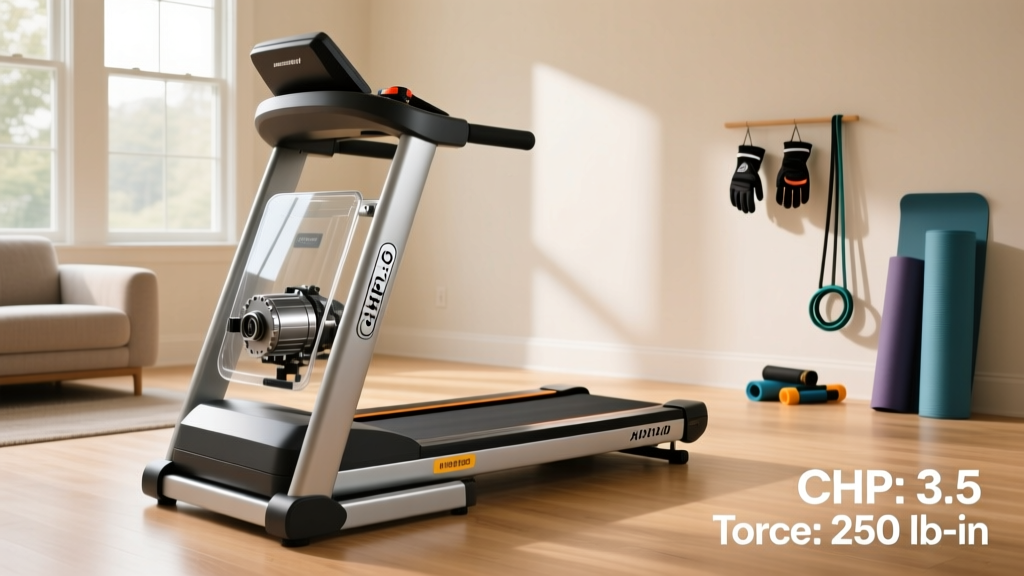
For a dedicated snowboard treadmill, you must look exclusively at Continuous Horsepower (CHP) or Continuous Duty ratings. A genuine residential snowboard simulator requires a minimum of 4.5 CHP, while commercial-grade endless slopes utilized in training facilities demand between 7.0 and 10.0 CHP.
Motor Size and Specification Comparison Matrix
To understand the sheer mechanical gap between standard cardio equipment and snowboarding simulators, review the comparative data below. This matrix highlights why standard treadmill components fail when adapted for snow sports training.
| Specification | Standard Home Running Treadmill | Snowboard Treadmill (Endless Slope) |
|---|---|---|
| Motor Type | Brushed DC (Direct Current) | Brushless 3-Phase AC (Alternating Current) |
| Continuous Horsepower (CHP) | 2.5 to 4.0 CHP | 4.5 to 10.0+ CHP |
| Torque Output | Low to Moderate (Speed-focused) | Extreme (Load and Incline-focused) |
| Drive System | Standard PWM Controller | VFD (Variable Frequency Drive) |
| Electrical Requirement | 110V / 15A Standard Outlet | 220V / 20A+ Dedicated Circuit |
| Cooling Mechanism | Internal Fan (RPM dependent) | Independent Forced-Air or Liquid Cooling |
The 220V Electrical Mandate for Snowboard Simulators
One of the most critical, yet frequently overlooked, aspects of buying a snowboard treadmill for home use is the electrical infrastructure. A true 5.0 CHP AC motor cannot operate on a standard North American 110V/15A household circuit. The mathematical limit of a 15A, 110V circuit is roughly 1,650 watts (about 2.2 Horsepower). When a rider aggressively carves and stalls the belt for a microsecond, the amp draw spikes. On a 110V circuit, this spike will instantly trip the breaker or, worse, melt the wiring inside your walls.
Premium snowboard treadmill manufacturers, such as SkyTech Sport, engineer their high-end residential and commercial simulators to run on 220V dedicated circuits. Before ordering an endless slope for your garage or basement, you must consult a licensed electrician to install a 220V/20A (or 30A) receptacle. Attempting to bypass this by using step-up transformers is a severe fire hazard and will void the manufacturer's warranty.
AC vs. DC Motors: Why Alternating Current Wins on the Slopes
Standard treadmills use DC (Direct Current) motors because they are cheap to manufacture, lightweight, and work well for the consistent, rhythmic impact of running. However, DC motors rely on carbon brushes that wear down over time and struggle to provide high torque at low RPMs.
Snowboard treadmills almost exclusively utilize 3-Phase AC (Alternating Current) motors paired with a Variable Frequency Drive (VFD). Here is why this configuration is non-negotiable for snowboarding:
- Massive Starting Torque: AC motors deliver maximum torque at zero RPM. When a rider catches an edge and abruptly stops the belt, the AC motor has the brute force to restart the belt instantly without stalling.
- Brushless Longevity: Without carbon brushes to replace, AC motors in commercial endless slopes can run for 20,000+ hours with zero internal maintenance.
- Regenerative Braking: Advanced VFDs on snowboard simulators can capture the kinetic energy generated when the rider pushes down the slope, feeding it back into the system to manage heat and improve efficiency.
Real-World Brand Analysis: What the Top Manufacturers Use
To provide actionable buying context, let us examine the motor architectures of the industry leaders in the snowboard treadmill space as of 2026.
SkyTech Sport (Premium Residential & Commercial)
SkyTech Sport is widely considered the gold standard for indoor snowboarding. Their premium models utilize heavy-duty, brushless AC motors ranging from 5.0 to 7.5 CHP. These motors are mated to industrial-grade VFDs that allow for micro-adjustments in belt speed (from 0.5 mph to 12 mph) while maintaining constant torque. Their synthetic belt tracking systems are reinforced with Kevlar weaves to prevent the lateral stretching that ruins standard treadmill belts during snowboard carving.
Pro Slopes (Commercial Endless Slopes)
UK-based Pro Slopes builds massive, wide-body endless slopes designed for ski schools and multi-rider training. Because their belts are significantly wider (often exceeding 35 inches) and must support the friction of two skiers or snowboarders simultaneously, they utilize 10.0+ CHP 3-phase AC motors. These units require 3-phase commercial power drops and feature liquid-cooled motor housings to dissipate the immense heat generated by continuous high-friction carving.
Troubleshooting Motor Burnout and Thermal Overload
Even with a correctly sized 5.0 CHP motor, snowboard treadmills operate in a high-stress environment. If your simulator frequently shuts down mid-session, it is likely triggering its thermal overload switch. Here is a step-by-step diagnostic framework to resolve motor strain:
- Inspect the Synthetic Mat Lubrication: Unlike rubber running belts that use liquid silicone, synthetic snow mats (like Neveplast) often require specialized dry PTFE (Teflon) sprays or specific paste waxes. A dry mat increases the friction coefficient by up to 40%, forcing the motor to draw excess amperage.
- Check Belt Tension and Tracking: If the snowboard belt is over-tensioned, the motor wastes up to 20% of its torque just overcoming the mechanical resistance of the rollers. Consult your manual for the exact deflection measurement (usually 1.5 to 2 inches of lift at the center of the deck).
- Verify Ambient Temperature and Airflow: AC motors on endless slopes generate significant heat. Ensure the motor housing vents are not blocked by drywall or gym mats. Many high-end simulators require a minimum of 12 inches of clearance behind the motor cowling for the independent cooling fan to draw ambient air.
- Calibrate the VFD: Over time, the Variable Frequency Drive may lose its calibration regarding the amp-limit threshold. A certified technician can recalibrate the VFD to ensure it delivers optimal voltage without prematurely tripping the thermal safeguard.
Final Verdict: Sizing Your Snowboard Treadmill Motor
Investing in a snowboard treadmill is a commitment to high-performance athletic training, with premium models ranging from $15,000 to over $60,000. Do not compromise on the drivetrain. When reviewing spec sheets, ignore peak horsepower and top speed. Instead, demand a minimum of 4.5 Continuous Horsepower (CHP), verify the presence of a brushless AC motor with a VFD, and ensure your facility has the 220V electrical infrastructure to support it. By prioritizing torque and continuous duty ratings, you will secure a machine capable of withstanding the brutal, high-friction realities of indoor snowboarding for years to come.
More gear to consider
All reviews
Best QVC Treadmills for Office Use: 2026 Under Desk Review

Why Is Running on a Treadmill Harder? A Feature Buying Guide

Horizon Fitness 7.0AT Studio Series Treadmill vs Walking Pads

Treadmill Motor Size Guide: NordicTrack Treadmill Summit 4500 HP

Curved vs Motorized: A Beginner's Guide to Sprint Exercise on Treadmill