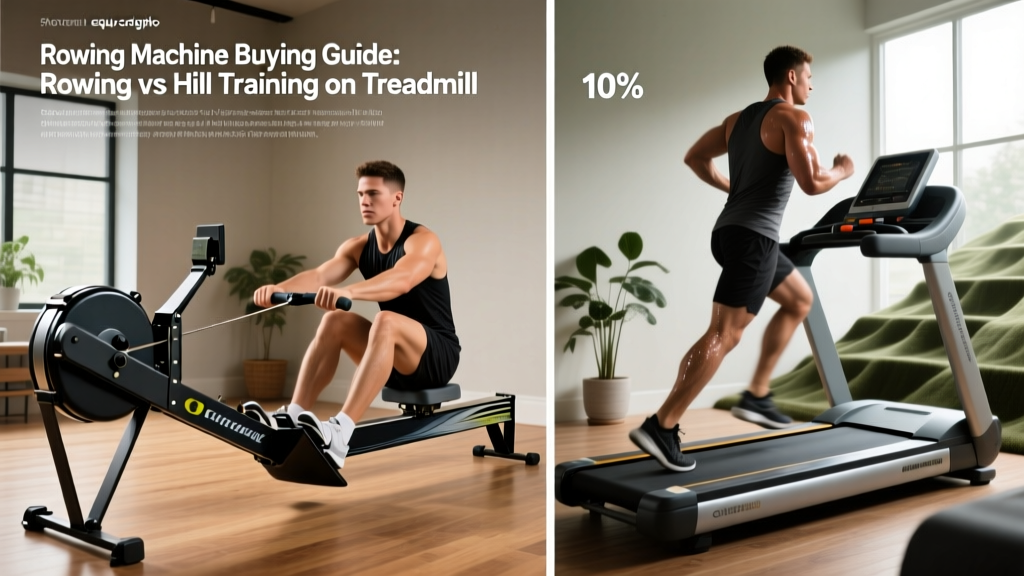
Rowing Machine Buying Guide: Rowing vs Hill Training on Treadmill
Compare rowing machines to hill training on treadmill cardio. Our buying guide covers top ergometer models, technique, and biomechanics for 2026.

The Great Cardio Debate: Ergometer vs. Incline Walking
When designing a home gym for cardiovascular conditioning and posterior chain development, buyers frequently debate between two powerhouse modalities: the rowing machine (ergometer) and incline treadmill walking. The viral popularity of protocols like the '12-3-30' method has made hill training on treadmill equipment a dominant trend for glute and hamstring targeting. However, as we navigate the fitness equipment market in 2026, the rowing machine remains an unparalleled tool for full-body metabolic conditioning. This comprehensive buying guide and technique breakdown will help you decide which machine deserves your floor space, budget, and daily effort.
Biomechanics & Caloric Expenditure: Rowing vs. Treadmill Incline
To make an informed purchasing decision, we must first look at the biomechanical demands of both machines. Hill training on a treadmill primarily isolates the lower body—specifically the gluteus maximus, hamstrings, calves, and Achilles tendon. While excellent for lower-body endurance and bone density, it entirely neglects the upper body and core stabilizers.
Conversely, rowing is a closed-kinetic-chain exercise that engages approximately 86% of the body's musculature. According to data from Harvard Health Publishing, a 155-pound individual burns roughly 252 calories in 30 minutes of moderate rowing, compared to 215 calories walking at a brisk 3.5 mph pace. When you introduce a steep incline to the treadmill, the caloric burn increases, but the joint compressive forces on the knees and lower back also scale up, whereas rowing remains a non-weight-bearing, low-impact alternative, as noted by Johns Hopkins Medicine.
| Feature | Rowing Machine (Ergometer) | Hill Training on Treadmill (12%+ Incline) |
|---|---|---|
| Muscle Engagement | 86% (Legs, Core, Back, Arms) | 60% (Lower Body Posterior Chain) |
| Joint Impact | Zero-impact (Seated, non-weight-bearing) | Moderate (Weight-bearing, high Achilles load) |
| Spatial Footprint | ~8 ft length (can be stored vertically) | ~6.5 ft length x 3 ft width (fixed footprint) |
| Primary Limiting Factor | Cardiovascular capacity & grip endurance | Local muscular fatigue (calves/glutes) |
| Average Cost (2026) | $995 - $2,500 | $1,200 - $3,500 |
2026 Rowing Machine Buying Guide: Top Models for Home Gyms
If you decide that the full-body stimulus of the ergometer outweighs the specific lower-body isolation of treadmill incline work, selecting the right model is critical. The market has bifurcated into traditional air-resistance workhorses and premium smart-rowers.
Concept2 RowErg (The Gold Standard)
Formerly known as the Model D, the Concept2 RowErg remains the undisputed king of competitive and home rowing. Priced at $995, it utilizes a pure air-resistance flywheel. The 'drag factor' automatically adjusts to your effort, meaning the harder you pull, the more resistance you feel. It is the only machine approved for official indoor rowing competitions. Its polycarbonate seat rollers glide flawlessly over the stainless steel track, and the PM5 monitor provides unmatched data accuracy. Best for: Serious athletes, CrossFitters, and data-driven users.
Hydrow Apollo (Premium Smart Rower)
Retailing at $2,295, the Hydrow Apollo combines air and magnetic resistance to simulate the exact feel of water drag. The standout feature is the 22-inch sweat-proof touchscreen that broadcasts live, on-the-water workouts with Olympic-level coaches. Unlike the Concept2, the Apollo uses a webbed strap instead of a metal chain, resulting in a whisper-quiet stroke perfect for apartment living. Best for: Tech enthusiasts, apartment dwellers, and users who need instructor-led motivation.
NordicTrack RW900 (Interactive Magnetic Resistance)
At $1,599, the RW900 offers 20 levels of silent magnetic resistance and a unique folding mechanism that allows it to stand upright on a remarkably small base. While it lacks the dynamic, infinite resistance curve of an air flywheel, its integration with iFIT allows the machine to automatically adjust resistance during global scenic rows. Best for: Multi-purpose home gyms with limited floor space and users who prefer quiet, steady-state cardio.
Expert Insight: The Drag Factor MythMany beginners mistakenly set the Concept2 damper to 10, assuming higher equals better. According to Concept2's official training guidelines, a damper setting of 10 is akin to rowing a heavy, slow wooden rowboat, while a setting of 3-5 simulates a sleek racing shell. For optimal aerobic conditioning and to prevent lower back fatigue, keep the drag factor between 100 and 130.
Mastering the Rowing Technique: The 4-Phase Stroke
Unlike hill training on a treadmill, which requires zero technical learning curve, rowing demands precise motor patterning. Poor technique on an ergometer is the leading cause of lumbar strain. The stroke is divided into four distinct phases, driven by a 60% legs, 20% core, 20% arms power distribution.
- The Catch: Slide forward until your shins are perfectly vertical. Do not compress past 90 degrees, as this forces the pelvis into a posterior tilt, rounding the lower back. Keep your arms straight and shoulders relaxed.
- The Drive: Initiate the movement by driving through the heels. Your arms must remain completely straight until your legs are nearly fully extended. Only then do you hinge the torso back to an 11 o'clock position and pull the handle to your lower ribs.
- The Finish: The handle should lightly brush your sternum/lower ribs. Your wrists must remain flat and neutral—never flexed. Your core should be braced, supporting the slight backward lean.
- The Recovery: This is the exact reverse of the drive. Extend the arms first, hinge the torso forward past the hips, and only then allow the knees to bend as you slide back to the catch. The recovery should take twice as long as the drive (a 1:2 ratio).
Common Failure Modes & Maintenance Edge Cases
Rowing machines are remarkably durable, but they are not maintenance-free. Understanding these edge cases will save you hundreds of dollars in repair costs over a decade of ownership.
- Chain Stretch and Corrosion: On air-resistance models like the Concept2, the nickel-plated steel chain requires lubrication every 50 hours of use. Use only 20-weight motor oil or purified 3-in-One oil. Never use WD-40, as it strips existing lubricants and attracts abrasive dust.
- Elastic Bungee Failure: The retraction mechanism relies on an internal elastic cord. After 3 to 5 years of heavy use, this cord loses elasticity, causing the handle to fail to return to the cage. This is a normal wear-and-tear item; a replacement kit costs under $20 and takes 15 minutes to install.
- Seat Roller Flat Spots: If sweat drips onto the monorail and is not wiped down, the salt crystallizes. When the seat rolls over these crystals, it pits the urethane rollers, eventually causing flat spots that result in a bumpy, noisy stroke. Wipe the rail with a rubbing alcohol solution weekly.
Final Verdict: Which Machine Deserves Your Floor Space?
If your primary goal is isolated lower-body hypertrophy, Achilles tendon rehabilitation, or replicating outdoor hiking conditions, hill training on treadmill equipment remains your best option. The ability to precisely dial in a 15% incline at a controlled walking pace is unmatched for posterior chain isolation.
However, if you are optimizing for time efficiency, maximum caloric expenditure, full-body muscular endurance, and joint longevity, the rowing machine is the superior investment. For the majority of home gym owners in 2026, a Concept2 RowErg offers the highest return on investment, delivering commercial-grade durability, infinite scalability, and a biomechanically sound movement pattern that translates to real-world functional fitness.
More gear to consider
All reviews
Head-to-Head Treadmill Motors: Matching HP to Workout Plan PDFs

Air Bike vs Assault Bike Maintenance & ProForm 545s Treadmill

Elliptical vs Treadmill Layouts: How Long to Walk for 10K Steps

Does the Nike Running App Work on Treadmills? Setup & Noise Guide

Rowing Machine Buying Guide & Technique: Ditch the Treadmill TV Mount