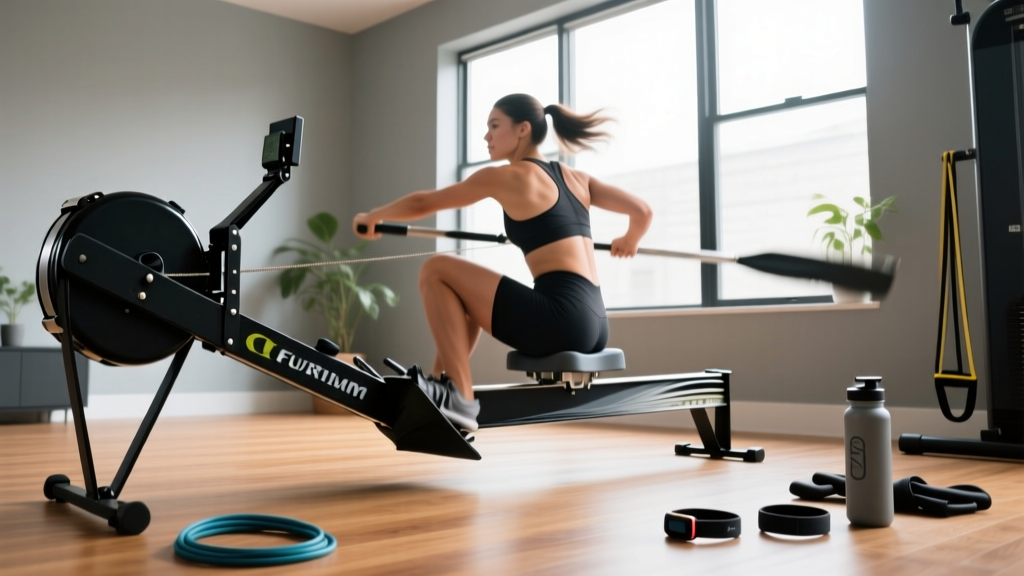
Rowing Guide: Technique & Fitness Exchange Display Assembly Tech
Master rowing machine technique and compare top 2026 models. Learn how rower monitors outlast treadmill display assemblies in our expert buying guide.

The Biomechanical Edge: Why Rowing Dominates Home Cardio
When outfitting a home gym in 2026, the debate often narrows down to the two heavyweights of cardiovascular conditioning: the treadmill and the indoor rower. While running is a staple, rowing offers a distinct biomechanical advantage. According to Harvard Health Publishing, rowing engages approximately 86% of the body's musculature per stroke, delivering a high-yield aerobic and anaerobic stimulus without the repetitive impact forces associated with running.
However, choosing the right rowing machine requires looking past the marketing gloss and evaluating drive mechanics, monitor ecosystems, and long-term maintenance. This head-to-head buying guide breaks down elite rower specifications, stroke technique, and the hidden tech realities of cardio equipment ownership.
Maintenance Reality Check: Console Tech & Repairability
Before diving into specific models, consider the lifecycle of your machine's "brain." Treadmill consoles are notoriously complex, integrating incline motor relays, belt speed telemetry, and heart rate sensors into a single printed circuit board. If the screen fails, sourcing a specific fitness exchange display assembly treadmill component often costs between $250 and $450, requiring a technician to dismantle the uprights and recalibrate the wiring harness.
Conversely, elite rowing machines utilize modular, plug-and-play performance monitors. If a Concept2 PM5 monitor fails, you simply unclip it from the bracket, disconnect the single RJ45 cable, and snap in a replacement ($160) in under thirty seconds. When evaluating total cost of ownership, the modular tech of rowers heavily outweighs the proprietary, high-failure-point console assemblies found on commercial treadmills.
Head-to-Head: 2026 Elite Rowing Machine Matrix
Not all resistance profiles are created equal. Below is a direct comparison of the three dominant resistance ecosystems currently defining the premium home fitness market.
| Feature | Concept2 RowErg | Hydrow (Gen 3) | Ergatta (WaterRower) |
|---|---|---|---|
| Resistance Type | Air (Flywheel) | Electromagnetic | Water (Polycarbonate Tank) |
| 2026 MSRP | $990 | $2,495 | $2,199 |
| Monitor / Display | PM5 (Modular LCD) | 22" HD Touchscreen | 17.3" Cherry Wood Bezel |
| Subscription Req. | None (Free App) | $44/mo (Required for full use) | $35/mo (Optional Gamification) |
| Maintenance Need | Chain oil every 50 hrs | Software updates, belt tension | Water purification tabs / 6 mos |
Analysis of the Contenders
The Purist's Choice (Concept2): The RowErg remains the undisputed gold standard for competitive athletes and CrossFit affiliates. Its air resistance is infinite and dynamically scales with your effort. The PM5 monitor, while visually dated compared to HD touchscreens, broadcasts via Bluetooth and ANT+ to any third-party app (like ErgData or Zwift) without a paywall.
The Immersive Experience (Hydrow): Hydrow's electromagnetic drag provides a whisper-quiet, glass-smooth catch that mimics water without the sloshing sound. However, it is essentially a hardware terminal for its software. If you lapse on the $44/month subscription, the machine reverts to a "Basic" mode, stripping away the live coaching and scenic rows.
The Aesthetic/Gamified Route (Ergatta): Built on the WaterRower chassis, Ergatta uses actual water displacement for resistance, yielding an authentic acoustic profile. The interface focuses on racing and interval games rather than follow-along video coaching, appealing to users who find traditional metric-tracking monotonous.
The 4-Phase Stroke: Technique Breakdown & Timing
Purchasing premium gear is useless if your biomechanics are flawed. Proper rowing technique is a sequential transfer of power, not a simultaneous full-body yank. According to the Concept2 Indoor Rower Technique Guide, the stroke is divided into four distinct phases. The American Council on Exercise (ACE Fitness Exercise Library) emphasizes that mastering this sequence is critical for lumbar spine safety.
- The Catch (0% of stroke): Shins are perfectly vertical (or as close as ankle mobility allows). The torso is hinged forward at roughly 11 o'clock. Arms are straight, shoulders relaxed, and lats engaged to connect the handle to the core.
- The Drive (Power Phase): This is a strict sequence: Legs, Core, Arms.
- 60% Legs: Push the footplate away explosively. The torso angle does not change until the legs are nearly extended.
- 30% Hips/Core: Once the knees are past the plane of the handle, swing the torso from 11 o'clock to 1 o'clock.
- 10% Arms: Finally, draw the handle to the lower sternum (just below the sports bra line), keeping elbows tucked past the ribcage.
- The Finish (100% of stroke): Legs are flat, core braced, torso slightly leaned back (1 o'clock), and the handle is hovering lightly at the sternum. Do not pull the handle to your neck or throat.
- The Recovery (Return Phase): The exact reverse of the drive: Arms, Core, Legs. Extend arms fully, hinge the torso forward past vertical, and only then allow the knees to bend. The recovery should take 2 to 3 times as long as the drive (a 2:1 or 3:1 ratio).
Expert Insight on Drag Factor: Novices often set the air damper to 10, assuming higher equals better. This is a critical error. On a Concept2, check the 'Drag Factor' menu. A setting of 10 often yields a drag factor of 200+, which mimics rowing a heavy, muddy wooden boat and places immense shear force on the L4-L5 vertebrae. Elite Olympic rowers train at a drag factor between 110 and 130 (usually damper setting 4 or 5), which perfectly simulates the hydrodynamics of a carbon-fiber racing shell.
Buying Framework: Sizing, Rail Length, and Footprint
When measuring your space and evaluating ergonomics, pay strict attention to the monorail length and the machine's "parked" footprint.
Rail Length & Inseam Limits
If you or anyone in your household is taller than 6'2", standard rail lengths will result in the seat carriage hitting the rear bumper before the catch phase is complete.
- Standard Rails: Accommodate up to a 38-inch inseam.
- Extended Rails: Concept2 and WaterRower offer extended tracks accommodating up to a 40-inch inseam. Always measure your actual inseam, not just your total height, as torso-to-leg ratios vary wildly.
Edge Cases & Failure Modes to Avoid
- Bungee Cord Degradation (Air Rowers): The handle retraction is powered by an internal elastic bungee. In high-UV environments (e.g., a sunroom), this bungee can dry rot and snap after 3-5 years. Replacement is a $15 part but requires partial disassembly of the flywheel cage.
- Polycarbonate Tank Leaks (Water Rowers): Dropping a heavy object on a water rower's tank can cause micro-fractures that slowly leak over weeks. Always keep water rowers away from high-traffic drop zones.
- Electromagnetic Calibration Drift: Smart rowers relying on magnetic resistance occasionally suffer from calibration drift after firmware updates, resulting in a "dead zone" at the catch. Ensure your machine's brand has a documented, user-accessible recalibration protocol in the settings menu.
Final Verdict: Aligning Tech with Your Training Goals
If your goal is pure performance tracking, competitive benchmarking, and zero mandatory subscription fees, the Concept2 RowErg is an indestructible asset. Its modular design ensures that you will never face the exorbitant repair bills associated with a proprietary fitness exchange display assembly treadmill repair or a bricked smart-screen.
However, if you require external motivation, cinematic immersion, and have the budget for ongoing software subscriptions, the Hydrow offers an unparalleled coaching experience that makes the high entry price justifiable for the right user. Evaluate your space, measure your inseam, and prioritize biomechanical safety over flashy touchscreens to make the right investment for your 2026 home gym.
More gear to consider
All reviews
Bowflex T6 Treadmill Review: Long-Term Belt Maintenance Tips

Curved vs Motorized: Best Treadmill Workout Apps Guide

Is It OK to Walk on a Treadmill Barefoot? Home Stair Climber Guide

Navigating the Walking Treadmill Bicycle Debate: 2026 Setup & Feature Guide

Elliptical vs Treadmill: Why Your Treadmill Trips Circuit Breaker
