Rowing Machine Buying Guide & Technique: Rower vs Circle Treadmill
Master rowing machine technique and explore our 2026 buying guide. Compare top rowers against the niche circle treadmill for your home gym setup.

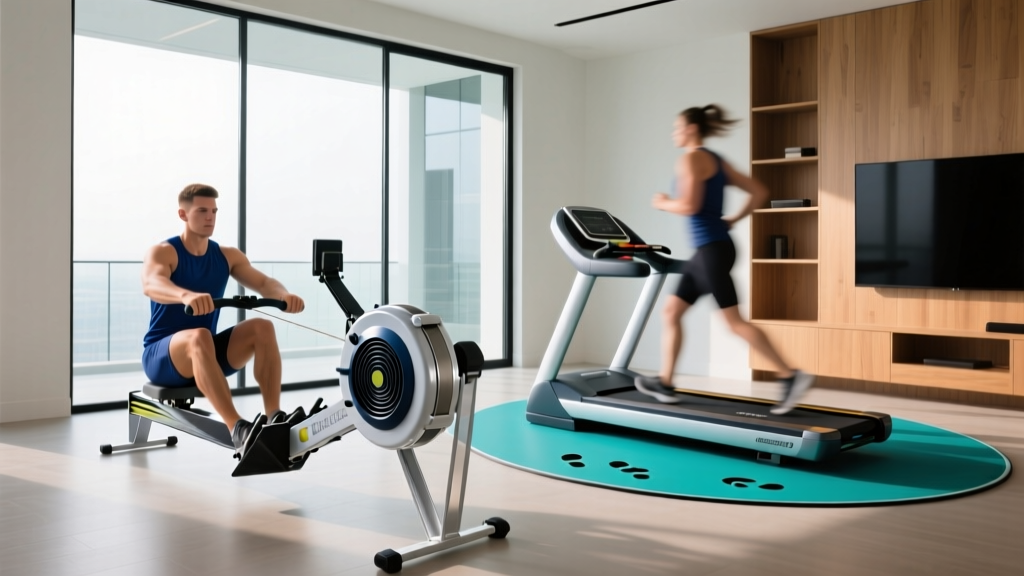
While the fitness tech world occasionally fixates on novelty equipment like the omnidirectional circle treadmill—often utilized in VR setups or specialized 360-degree curved tracks—the rowing machine remains the undisputed champion of efficient, full-body home cardio. A circle treadmill requires a dedicated 64-square-foot footprint, specialized slider footwear, and a steep learning curve just to walk naturally. In stark contrast, a high-quality rowing machine delivers a superior cardiovascular stimulus, engages 86% of your muscle mass, and stores vertically in a mere 2 square feet.
If you are designing a home gym in 2026 and debating between niche cardio gear and proven performance, this comprehensive rowing machine buying guide and technique breakdown will help you make an evidence-based decision.
The 86% Rule: According to biomechanical studies, proper rowing engages approximately 86% of the body's musculature. Unlike the circle treadmill, which primarily targets the lower body and stabilizers, the rower demands coordinated output from the calves, quads, glutes, core, lats, and biceps in every single stroke.The 2026 Rowing Machine Buying Matrix: Top Models Compared
Not all ergometers are created equal. The market has split into three distinct categories: purist air rowers, immersive electromagnetic rowers, and aesthetic water rowers. Below is a comparison of the top-tier models dominating the home fitness space this year.
| Model | Resistance Type | Price (2026) | Rail Length | Best For |
|---|---|---|---|---|
| Concept2 RowErg | Air | $1,100 | 108" (Standard) | Purists & CrossFitters |
| Hydrow | Electromagnetic | $2,495 | 115" | Tech & Class Lovers |
| NordicTrack RW900 | Magnetic/Air Hybrid | $1,699 | 110" | Interactive Training |
| WaterRower Natural | Water | $1,599 | 112" | Aesthetics & Quiet Zones |
Decoding Resistance: Air, Magnetic, or Water?
When transitioning from a traditional treadmill or a circle treadmill to a rower, the resistance mechanism will dictate your entire experience.
Air Resistance (The Gold Standard)
Air rowers use a flywheel with fan blades. The harder you pull, the more wind resistance is generated. This provides an infinite, dynamic resistance curve. Expert Tip: Do not leave the damper setting at 10. For most athletes, a damper setting between 3 and 5 yields a 'drag factor' of 100-130, which most accurately simulates the feel of a heavy racing shell on water.
Electromagnetic Resistance (The Silent Glide)
Machines like the Hydrow use electromagnets to brake a metal flywheel. The result is near-silent operation and the ability to digitally micro-adjust resistance mid-stroke. If you live in an apartment or share a room with a sleeping partner, magnetic is vastly superior to the 'whoosh' of an air rower.
Water Resistance (The Aesthetic Choice)
Water rowers feature a polycarbonate tank filled with actual water. The resistance scales with your effort, much like air, but the auditory feedback of splashing water is highly meditative. However, they require water purification tablets every 6 months and lack the digital telemetry required for competitive tracking.
The 4-Phase Rowing Technique: A Step-by-Step Breakdown
The most common reason beginners abandon rowing is lower back pain, which is almost universally caused by poor sequencing. Unlike walking on a circle treadmill where your body naturally finds a gait, rowing requires a learned, deliberate sequence: Legs, Core, Arms on the drive, and Arms, Core, Legs on the recovery.
"Rowing is not an upper-body pull; it is a lower-body push. Think of it as a deadlift performed horizontally. Your legs should generate 60% of the power, your core 30%, and your arms only 10%."
1. The Catch (The Setup)
- Shins: Vertical, or as close to vertical as your ankle mobility allows. Do not compress so far that your heels lift excessively or your lower back rounds.
- Arms: Completely straight, lats engaged, shoulders relaxed away from the ears.
- Torso: Hinged forward at roughly 11 o'clock.
2. The Drive (The Power Phase)
- Push: Drive through the mid-foot. Your arms and torso angle remain completely frozen while the legs extend.
- Swing: Once the legs are about 80% extended, swing the torso from 11 o'clock to 1 o'clock using the core.
- Pull: Finally, draw the handle to your sternum (just below the chest), keeping elbows tucked past the ribs.
3. The Finish (The Anchor)
Legs are fully extended (but not hyper-locked). The torso is slightly leaned back at 1 o'clock. The handle is resting lightly against the lower sternum. This position should feel stable and powerful.
4. The Recovery (The Reset)
The recovery must happen in the exact reverse order of the drive to avoid hitting your knees with the handle.
- Arms away: Extend arms fully over the knees.
- Hinge: Pivot from the hips, bringing the torso back to 11 o'clock.
- Slide: Only after the handle has cleared the knees should you bend the legs and slide back to the catch.
Sizing and Clearance: Avoiding the 'Tall User' Trap
One area where the rowing machine requires more foresight than a circle treadmill is rail length. If you are tall, a standard rail will cause you to 'bottom out' before reaching the proper catch position, forcing you to compromise your form.
The Inseam Test: If your inseam is 34 inches or greater, you must purchase a rower with an extended rail (115+ inches) or buy an aftermarket rail extension. For example, Concept2 offers an optional Tall Legs kit that adds 6 inches to the monorail, accommodating inseams up to 38 inches.Furthermore, consider the storage footprint. While a circle treadmill demands a permanent, dedicated 8x8 foot zone, the Concept2 RowErg separates into two pieces and stands upright in a 2x2 foot corner, and the Hydrow can be tilted vertically against a wall using a specialized wall-anchor kit.
Expert Troubleshooting: 3 Form Errors to Fix Today
Even experienced athletes develop bad habits. Review this checklist to optimize your stroke efficiency and protect your lumbar spine.
- Error 1: Shooting the Slide.
The Fix: Your hips are rising faster than your shoulders during the drive, meaning your legs are pushing but your back is taking the load. Focus on keeping your chest and hips connected, moving backward at the exact same speed during the first half of the drive. - Error 2: Early Arm Bend.
The Fix: Bending the elbows before the legs are nearly fully extended bleeds power and overtaxes the biceps. Wrap your thumbs over the handle and think of your arms as rigid hooks connecting your lats to the handle. - Error 3: Rushing the Recovery.
The Fix: The recovery should take twice as long as the drive (a 1:2 ratio). Rushing back to the catch ruins your cardiovascular rhythm and prevents the muscle from recovering. Use the slide forward to catch your breath.
Cardiovascular Health and Joint Longevity
Why choose a rower over high-impact alternatives? The American Heart Association recommends at least 150 minutes of moderate-intensity aerobic activity per week. Rowing fulfills this requirement while completely eliminating the ground-reaction forces associated with running or even the awkward sliding mechanics of a circle treadmill.
Furthermore, because the foot remains fixed to the pedal and there is no downward gravitational impact, the Mayo Clinic frequently highlights rowing-style movements as ideal for individuals managing osteoarthritis or recovering from lower-extremity joint surgeries. You achieve a massive VO2 max stimulus without the cartilage degradation.
Final Verdict: The Rower Wins the Home Gym
While the circle treadmill is an impressive piece of engineering for specific VR applications or niche gait-training facilities, it falls short as a primary home cardio solution due to its spatial demands, high cost, and isolated muscle engagement. The rowing machine, conversely, offers an unmatched combination of full-body conditioning, compact storage, and scalable resistance. By selecting the right resistance type for your living space and strictly adhering to the 'legs-core-arms' technique sequence, you are investing in the most time-efficient cardiovascular tool on the market.
For more technical breakdowns on drag factor calibration and advanced interval programming, consult the official Concept2 technique guide to refine your stroke before your next 2K test.
More gear to consider
All reviews
Curved Manual vs Motorized: FreeMotion 850 Treadmill Guide

Horizon T91 Treadmill & Air Bike Care: Assault Bike Comparison Guide

Equinox Treadmills vs Ellipticals: Home Cardio Maintenance Guide

Massage Equip Recovery Essentials: Science-Backed Tools for Athletes, Drivers, and Daily Commuters

Is the Calorie Count on a Treadmill Accurate? Belt Friction & Costs