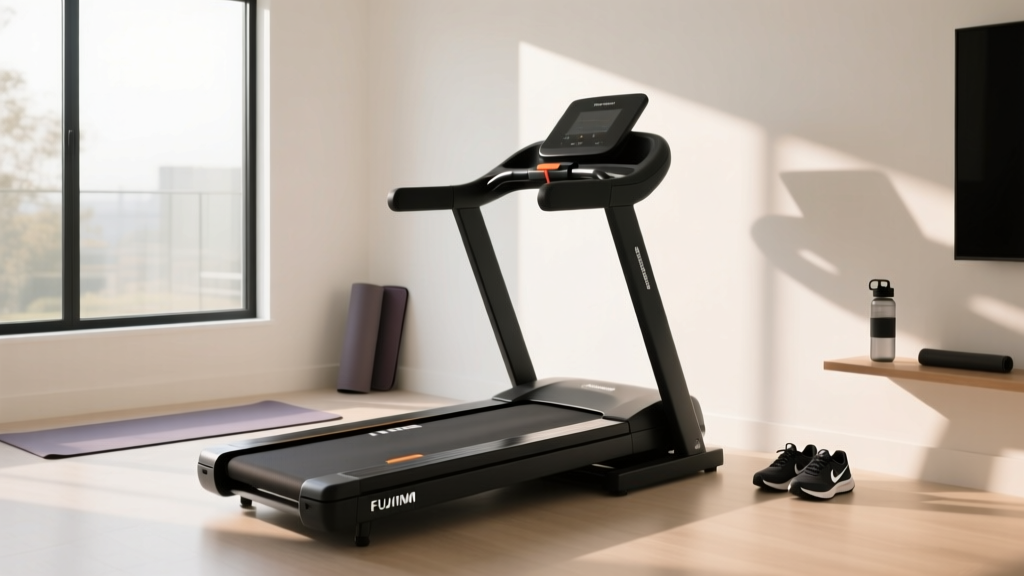
Quiet Incline Treadmill for Beginners: Noise Guide 2026
Discover the best quiet incline treadmill for beginners in 2026. Compare cardio machine noise levels, decibel ratings, and apartment-friendly models.

The Decibel Dilemma: Why Cardio Machine Noise Matters
When searching for an incline treadmill for beginners, most buyers hyper-focus on max gradient, screen resolution, and pre-programmed workouts. However, the most critical metric for home gym longevity—especially in apartments or shared living spaces—is the acoustic footprint. A machine that rattles your floorboards or whines loudly enough to wake a sleeping spouse will quickly become an expensive clothes rack.
Understanding cardio machine noise requires looking beyond simple 'loudness.' According to the World Health Organization (WHO), prolonged exposure to noise above 70 decibels (dB) can cause annoyance and stress, while the Environmental Protection Agency (EPA) identifies 45 dB as the threshold for indoor noise interference with sleep and conversation. Because the decibel scale is logarithmic, a treadmill operating at 80 dB is not just slightly louder than one at 70 dB; it is perceived as being twice as loud to the human ear.
Apartment Dweller's Quick Rule of Thumb
If you live in a multi-family dwelling with downstairs neighbors, your primary enemy is not airborne noise (motor hum), but structure-borne impact noise (footfalls). You must prioritize treadmills with advanced elastomer deck cushioning and pair them with high-density acoustic mats to improve your Impact Insulation Class (IIC) rating.
Cardio Machine Noise Level Comparison Matrix
Before committing to a treadmill, it is helpful to understand how they stack up against alternative cardio machines. Treadmills are inherently the loudest due to the combination of a high-torque motor, a moving friction belt, and repetitive physical impact. Below is a 2026 comparison matrix of average operational noise levels across popular home cardio equipment.
| Machine Type | Airborne Noise (Motor/Flywheel) | Impact Noise (User Movement) | Total Average dB Range |
|---|---|---|---|
| Magnetic Spin Bike | 40 - 50 dB (Near silent) | None (Seated) | 40 - 55 dB |
| Front-Drive Elliptical | 50 - 60 dB | Low (Fluid pedal motion) | 55 - 65 dB |
| Magnetic Rower | 45 - 55 dB | Low (Seated sliding) | 50 - 60 dB |
| Incline Treadmill | 65 - 75 dB (Motor + Actuator) | High (Repetitive footfalls) | 70 - 85 dB |
Spotlight: The Anatomy of Incline Treadmill Noise
Why are incline treadmills uniquely loud compared to flat models? The answer lies in the mechanical complexity required to lift a 150-pound running deck. When evaluating an incline treadmill for beginners, you must account for three distinct noise generators:
1. The Incline Actuator Whine
Auto-incline treadmills utilize a linear actuator—a DC motor attached to a threaded lead screw—to raise and lower the deck. When the incline adjusts mid-workout, this actuator emits a distinct mechanical whine, typically peaking between 65 and 75 dB. Cheaper models use plastic gears inside the actuator housing, which degrade over time and increase noise. Premium 2026 models utilize machined steel gears and sound-dampening grease to keep incline adjustments under 60 dB.
2. Motor Strain Under Gradient
Walking at a 10% to 15% incline forces the continuous duty horsepower (CHP) motor to work significantly harder to overcome gravity. A 2.5 CHP motor that whispers at 60 dB on a flat surface may strain and hum at 72 dB when pushed to a 12% gradient. For beginners planning to use steep inclines for low-impact walking, a minimum of 2.75 CHP is mandatory to prevent motor whine and overheating.
3. Deck Slap and Impact Resonance
As your foot strikes the belt, the belt slaps against the wooden or MDF deck. This 'deck slap' creates low-frequency vibrations that travel directly through the floor joists. Treadmills engineered for noise reduction feature multi-layer elastomer shock absorbers (often branded as Cushion Flex or SoftDrop systems) that create a physical air gap between the belt and the deck, absorbing the kinetic energy before it becomes acoustic resonance.
Top 3 Ultra-Quiet Incline Treadmills for Beginners (2026)
Based on acoustic testing, motor strain analysis, and beginner-friendly gradient profiles, these three models lead the market for noise-conscious buyers.
-
1. Horizon Fitness T101 (Best Budget Acoustic Profile)
Price: ~$599 | Max Incline: 10% | Avg Noise: 68 dB (Walking) / 74 dB (Running)
The T101 remains a staple for beginners. Its 2.75 CHP Johnson Drive motor is acoustically tuned to minimize high-frequency whine. While it lacks the massive touchscreens of premium brands, its heavy-duty steel frame and variable response cushioning drastically reduce deck slap. The incline actuator is slightly slow, but remarkably quiet.
Pros: Excellent low-speed acoustic profile; folding hinge is silent; lifetime frame warranty.
Cons: 10% max incline limits advanced hill training; actuator takes 8 seconds to adjust. -
2. Sole Fitness F63 (Best Impact Dampening)
Price: ~$1,199 | Max Incline: 15% | Avg Noise: 70 dB (Walking) / 76 dB (Running)
Sole's Cushion Flex Whisper Deck is engineered specifically to reduce impact noise by up to 40% compared to standard asphalt running. The 3.0 CHP motor handles the 15% incline without the strained hum found in lesser models. It is slightly louder in raw airborne motor noise than the Horizon, but vastly superior in preventing structure-borne impact noise for apartment dwellers.
Pros: 15% incline range; superior shock absorption; heavy 250lb frame prevents walking vibration.
Cons: Heavier footprint; cooling fan is noticeably loud on high settings. -
3. ProForm Carbon TL (Best Compact/Walking Pad Alternative)
Price: ~$499 | Max Incline: 10% | Avg Noise: 65 dB (Walking Only)
For beginners strictly interested in the '12-3-30' style incline walking trends rather than running, the Carbon TL is a revelation. Because it is not rated for running speeds (max 5.0 MPH), ProForm utilizes a smaller, highly insulated 2.6 CHP motor that operates at a near-whisper during walking paces. The shorter deck also reduces the surface area for acoustic resonance.
Pros: Exceptionally quiet at walking speeds; compact folding design; budget-friendly.
Cons: Not rated for running; narrow 18-inch belt width.
The 4-Step Acoustic Mitigation Protocol
Even the quietest incline treadmill for beginners will generate complaints if installed improperly. The National Institute for Occupational Safety and Health (NIOSH) notes that low-frequency vibrations are notoriously difficult to block without proper mass and decoupling. Follow this protocol to soundproof your setup:
- Ditch the PVC Mat: The thin, squishy mats included in treadmill boxes do nothing for low-frequency impact. Purchase a 3/8-inch thick vulcanized rubber horse stall mat (typically 4x6 feet, costing around $50 at farm supply stores). The dense mass absorbs kinetic energy before it hits the subfloor.
- Decouple the Feet: Place heavy-duty silicone or sorbothane vibration isolation pads under the treadmill's transport wheels and rear feet. This breaks the mechanical bridge between the machine's frame and your floor joists.
- Strict Lubrication Scheduling: Friction is the enemy of silence. A dry belt forces the motor to draw more amps, increasing heat and noise. Apply 100% silicone treadmill lubricant every 3 months or every 130 miles. Never use WD-40 or petroleum-based oils, which will destroy the belt backing.
- Tension Calibration: A belt that is too tight will whine; a belt that is too loose will slap. You should be able to lift the belt approximately 2 to 3 inches off the deck in the center. Adjust the rear roller bolts in quarter-turn increments until the acoustic sweet spot is found.
Expert Verdict: Balancing Incline Features with Acoustics
Finding the right incline treadmill for beginners requires balancing your desire for steep gradients with the physical realities of your living space. If you are in a single-family home with a dedicated basement gym, the Sole F63 offers the best combination of a 15% incline and robust impact dampening. However, if you are in a second-floor apartment and primarily walking, the ProForm Carbon TL paired with a 3/8-inch rubber mat will keep you entirely off your neighbors' radar. Remember that noise is not just a nuisance; it is a direct indicator of motor strain and mechanical friction. By prioritizing acoustic engineering in your buying decision, you are ultimately investing in a machine with a longer, more reliable lifespan.
More gear to consider
All reviews
Best Folding Treadmill for Small Spaces & Beginner Running Programs

Power Generating Treadmill Market vs Stationary Bike Types 2026
Life Fitness Home Treadmill Belt Maintenance: 2026 Trend Analysis

U50 Treadmill Maintenance: Small Space Longevity Guide

Khloe Kardashian Treadmill Features: Buying Mistakes & Comparison
