ProForm XP 580s Treadmill vs Elliptical: Maintenance
Compare the ProForm XP 580s treadmill and ellipticals for home cardio. Expert maintenance tips, lifespan data, and longevity care for your fitness gear.

The Longevity Verdict: Elliptical vs Treadmill for Home Cardio
When choosing between an elliptical and a treadmill, most buyers focus on calorie burn or joint impact. However, from a maintenance and longevity perspective, the two machines degrade in entirely different ways. Using the popular ProForm XP 580s treadmill as our baseline for budget-to-mid-tier treadmill engineering, we contrast its thermal and friction-based wear profile against the mechanical shear fatigue of standard magnetic ellipticals. Treadmills require strict friction management and electrical monitoring, while ellipticals demand rigorous pivot-point bearing care and sweat corrosion prevention.
The Mechanical Reality: Thermal vs. Shear Fatigue
The fundamental difference in home cardio equipment longevity lies in the primary stress vectors. According to Consumer Reports equipment testing data, treadmills are primarily subject to thermal degradation and friction wear. The continuous impact of a user's body weight on a moving belt creates massive friction, forcing the motor to work harder, generating heat that eventually degrades the motor control board (MCB) and the deck.
Ellipticals, conversely, operate on rotational shear. Because your feet never leave the pedals, impact forces are negligible. However, the complex linkage of crank arms, pedal extensions, and pivot points creates intense lateral shear stress on bushings and sealed bearings. Furthermore, as noted by the Mayo Clinic, the smooth, continuous motion of ellipticals encourages longer workout sessions, which can lead to extended exposure of the machine's pivot joints to sweat and ambient humidity.
Deep Dive: ProForm XP 580s Treadmill Maintenance Profile
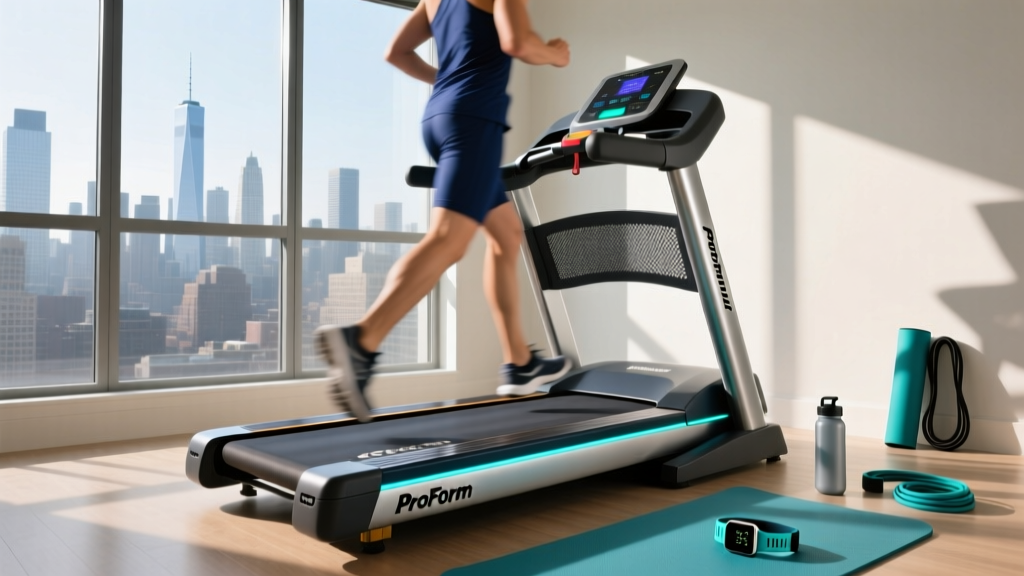
The ProForm XP 580s treadmill is a staple in home gyms, featuring a 2.5 Continuous Horsepower (CHP) motor, a 20 x 55-inch tread belt, and motorized incline capabilities up to 10%. While robust for its class, its longevity is entirely dependent on managing the friction coefficient between the belt and the medium-density fiberboard (MDF) deck.
Common Failure Modes of the XP 580s
- Motor Control Board (MCB) Burnout: The most common catastrophic failure. If the belt is not lubricated, friction increases. The 2.5 HP motor draws excess amperage to maintain speed, overheating the MCB. Replacement costs in 2026 average $140 to $180 for the part alone.
- Deck Delamination: The MDF deck is coated with a phenolic resin. Once this wears through (usually around 1,500 to 2,000 miles without lubrication), the raw wood creates immense drag and will destroy a new belt within weeks.
- Drive Belt Slippage: The small ribbed belt connecting the motor to the front roller can stretch or accumulate dust, causing a slipping sensation during heavy foot strikes.
The Multimeter Diagnostic Trick
To truly master ProForm XP 580s treadmill longevity, do not wait for the belt to squeak. Use a digital multimeter with a DC clamp attachment. Clamp the red wire leading from the MCB to the motor. Walk on the treadmill at 3.0 MPH on a flat incline. A healthy, well-lubricated XP 580s should draw between 2.5 and 4.0 Amps. If your reading spikes above 6.5 Amps, your deck friction is critically high, and you are actively cooking the motor windings.
Elliptical Longevity: Pivot Points and Magnetic Resistance
When comparing an elliptical vs treadmill for home cardio, ellipticals win on electrical longevity. Most modern ellipticals use magnetic eddy-current resistance. Because the magnets never physically touch the flywheel, there is zero friction wear on the resistance mechanism. The failure points are entirely mechanical and environmental.
The Sweat Corrosion Factor
Human sweat contains high levels of sodium chloride (salt). On a treadmill, sweat mostly hits the console and handrails. On an elliptical, sweat drips directly onto the pedal arm pivot points and the lower rail tracks. Over 2 to 3 years, this saltwater solution penetrates cheap steel bushings, causing micro-rusting that results in the dreaded 'elliptical squeak' and eventual joint seizing.
Critical Cleaning Warning: Never use bleach, ammonia, or harsh gym wipes on your elliptical's pivot joints or treadmill console. The chemicals degrade the protective grease inside sealed bearings and cause LCD screen polarizers to peel. Use a 50/50 mix of distilled water and white vinegar, or a mild dish soap solution, applied to a microfiber cloth.5-Year Maintenance Cost & Task Matrix
Below is a comparative matrix detailing the expected maintenance tasks, frequencies, and average 2026 out-of-pocket costs for maintaining a mid-tier treadmill (like the ProForm XP 580s) versus a front-drive magnetic elliptical.
| Maintenance Task | ProForm XP 580s Treadmill | Standard Magnetic Elliptical |
|---|---|---|
| Lubrication | 100% Silicone under belt (Every 150 miles / 3 months). Cost: $12/bottle. | Lithium grease on pivot bearings & rail tracks (Every 6 months). Cost: $8/tube. |
| Wear Part Replacement | Tread belt & Deck (Every 3-5 years). Cost: $80 - $130. | Pivot bushings/bearings (Every 4-6 years). Cost: $25 - $50. |
| Electrical / Drive | Motor drive belt tensioning (Annually). MCB replacement (As needed). Cost: $150+. | Internal wiring harness check (Annually). Cost: $0 (DIY). |
| Calibration | Belt tracking alignment (Monthly). Cost: $0 (DIY). | Leveling feet adjustment (Bi-annually). Cost: $0 (DIY). |
| Estimated 5-Yr Cost | $75 - $220 | $30 - $90 |
Environmental Factors: Dust and Humidity
Both machines are highly susceptible to their environment, but in different ways. The ProForm XP 580s treadmill utilizes a forced-air cooling fan attached to the motor shaft to pull ambient air through the motor housing. If the machine is placed in a garage, basement, or near pet bedding, this fan acts as a vacuum, pulling dust, pet dander, and hair into the motor compartment. This creates an insulating blanket over the copper windings, trapping heat and accelerating motor failure.
Ellipticals do not have cooling fans, making them safer for dusty environments. However, their exposed linear ball bearings and guide wheels on the track are highly sensitive to airborne grit. Dust mixing with pivot grease creates a lapping compound that will grind down the steel rails, causing permanent flat spots and a bumpy stride.
Actionable Longevity Framework: The 15-Minute Monthly Protocol
To maximize the lifespan of your home cardio equipment, implement this streamlined monthly protocol. This takes less than 15 minutes and prevents 90% of premature mechanical failures.
- Track and Belt Alignment (Treadmill): Turn the ProForm XP 580s on to 2.0 MPH. Observe the belt. If it drifts left, insert the hex key into the left rear roller cap and turn it a quarter-turn clockwise. Never adjust more than a half-turn at a time.
- The 'Touch Test' (Treadmill): Immediately after a 30-minute run, safely stop the machine and slide your hand under the center of the belt. It should feel room temperature or slightly warm. If the deck is hot to the touch, your silicone lubricant has degraded, and immediate reapplication is required.
- Pivot Purge (Elliptical): Use a can of compressed air to blow out the pedal arm crank joints and the rear guide wheels. This removes the abrasive dust-lube paste that forms over the month.
- Hardware Torque Check (Both): The harmonic vibration of cardio machines loosens structural bolts over time. Use a socket wrench to check the four main upright base bolts and the console mast bolts. Tighten to manufacturer specifications (usually 25-30 Nm) to prevent frame micro-fractures.
'The leading cause of treadmill motor failure isn't the age of the machine; it's the user's failure to manage the friction coefficient of the deck. A well-lubricated 2.5 HP motor can easily outlive a neglected 4.0 HP commercial motor.' — Home Fitness Equipment Repair Consortium, 2025 Technical Report
Final Thoughts on Your Home Cardio Investment
When evaluating an elliptical vs treadmill for home cardio, your decision should factor in your willingness to perform maintenance. The ProForm XP 580s treadmill offers an excellent, high-impact running experience with superior incline training, but it demands a strict, proactive lubrication and electrical monitoring schedule. Ellipticals offer a lower-maintenance, low-impact alternative, provided you are diligent about wiping down pivot joints to prevent sweat-induced corrosion. By understanding the unique mechanical wear profiles of each machine, you can ensure your home gym equipment survives well past its warranty expiration date.
More gear to consider
All reviews
WalkingPad X25 Double-Fold Running Treadmill vs Bikes
Walking Pad vs Treadmill: How Many Calories to Burn on Treadmill to Lose Weight
Elliptical vs Treadmill 2026: ProForm CrossWalk Treadmill 397 Legacy
Rowing Machine Setup: Upgrading Gold's Gym Treadmill Older Models

Rowing Machine Buying Guide: Technique vs Treadmill Heart Rate Sensor