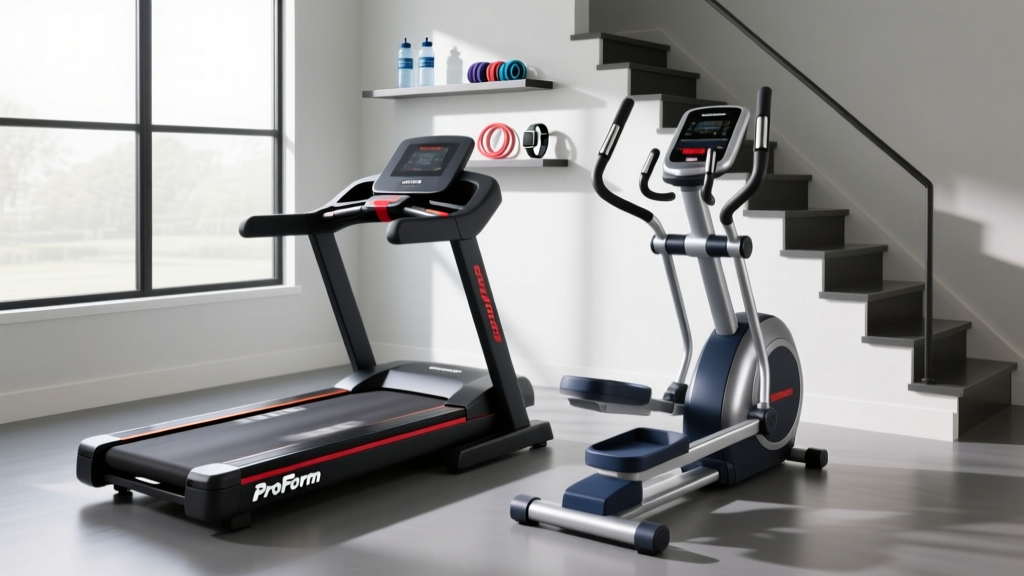
ProForm Sport 3.0 Treadmill vs Stair Climber: Home Use Guide
Deciding between the ProForm Sport 3.0 treadmill and a stair climber for home use? We compare specs, space, cost, and biomechanics to help you choose.

The Home Cardio Dilemma: Horizontal vs. Vertical Training
Building a home gym in 2026 requires making tough decisions about space, budget, and biomechanics. When outfitting a spare bedroom or garage, two distinct cardio philosophies often clash: the traditional horizontal locomotion of a treadmill versus the high-resistance vertical climb of a stair stepper. In this comprehensive stair climber machine for home use guide, we are putting a specific entry-level favorite—the ProForm Sport 3.0 Treadmill—head-to-head against the home stair climber category, specifically analyzing budget models like the Sunny Health & Fitness SF-S7805 and premium alternatives like the Bowflex Max Trainer SE.
Quick Decision Matrix
- Choose the ProForm Sport 3.0 if: You prefer walking/light jogging, have a longer room footprint (70+ inches), and want a familiar, low-learning-curve interface for under $400.
- Choose a Stair Climber if: You want maximum glute/quad activation, have limited floor space but high ceilings, and prefer high-intensity, low-impact interval training.
Contender 1: ProForm Sport 3.0 Treadmill Deep Dive
The ProForm Sport 3.0 is a staple in the budget treadmill market, typically retailing between $349 and $399. It is engineered for walkers and light joggers, not marathon trainees. Let us break down the exact specifications and real-world limitations of this machine.
Core Specifications & Performance
- Motor: 2.0 Continuous Horsepower (CHP). This is the critical metric, not peak horsepower. A 2.0 CHP motor is sufficient for walking up to 4.0 MPH and light jogging up to 6.0 MPH for users under 200 lbs.
- Belt Dimensions: 16 inches wide by 50 inches long. This is relatively compact. Users over 5'10" will find the 50-inch length restrictive for running, as it forces a shortened stride.
- Speed & Incline: 0 to 10 MPH top speed. The incline is manual, requiring you to step off the machine and adjust the rear deck pins to 3 different height levels.
- Weight Capacity: 275 lbs.
Real-World Failure Modes
As a budget treadmill, the Sport 3.0 has specific edge cases you must manage. The most common failure mode is motor control board overheating. If a 220 lb user runs at 8 MPH on the highest manual incline setting for more than 30 minutes, the thermal shutoff will trip to protect the 2.0 CHP motor. Additionally, the 1-ply belt requires strict adherence to a 100% silicone lubrication schedule every 150 miles; neglecting this increases friction, which directly degrades the motor lifespan.
Contender 2: The Home Stair Climber Category
Unlike the singular focus of the ProForm Sport 3.0, the "stair climber" category for home use is bifurcated into two distinct types: hydraulic mini-steppers and motorized vertical climbers.
Budget Pick: Sunny Health & Fitness SF-S7805 Stair Stepper
Retailing around $159, this hydraulic mini-stepper is a massive seller for compact homes. It uses dual hydraulic cylinders to provide resistance. The Catch: Hydraulic cylinders generate immense heat. The manufacturer explicitly limits use to 15-minute sessions. Exceeding this will blow the cylinder seals, resulting in a total loss of resistance. It is strictly for short-burst interval training, not steady-state cardio.
Premium Pick: Bowflex Max Trainer SE
At the opposite end of the spectrum ($1,999), the Max Trainer SE combines a stair-climbing motion with elliptical arm levers. It uses a magnetic eddy current resistance system, meaning there are no hydraulic seals to blow and no motorized belts to snap. It supports 300 lbs and is engineered for the "Max Interval" protocol (20 seconds max effort, 10 seconds rest).
Head-to-Head Comparison Matrix
How do these machines actually compare when placed side-by-side in a home environment? Review the data below to understand the physical and financial footprint.
| Feature | ProForm Sport 3.0 Treadmill | Sunny SF-S7805 (Budget Stepper) | Bowflex Max Trainer SE (Premium) |
|---|---|---|---|
| Approximate Price | $349 - $399 | $150 - $170 | $1,999 |
| Footprint (L x W) | 63" x 28" (Folded: 28" x 28") | 22" x 19" | 46" x 30" |
| Required Ceiling Clearance | User Height + 5 inches | User Height + 15 inches | User Height + 15 inches |
| Acoustic Output | 65-75 dB (Motor + footfall impact) | 40-50 dB (Quiet hydraulic hiss) | 50-60 dB (Magnetic flywheel hum) |
| Primary Muscle Focus | Calves, Hamstrings, Cardiovascular | Glutes, Quads, Hip Flexors | Full Body (Upper/Lower integration) |
| Maintenance Need | High (Belt lube, tensioning) | Low (Pivot point greasing) | Low (Dusting, bolt tightening) |
Biomechanics & Joint Impact: What the Science Says
When choosing between a treadmill and a stair climber, joint loading is often the deciding factor. According to biomechanical analyses referenced by the American Council on Exercise (ACE), walking on a flat treadmill generates an impact force of approximately 1.2 to 1.5 times your body weight on the knee and hip joints. While this is lower than outdoor running on concrete, it still involves repetitive heel-strike deceleration.
Conversely, stair climbing is a closed-chain kinetic exercise. Your foot remains planted on the pedal, eliminating the heel-strike impact entirely. However, stair climbing places a significantly higher shear force on the patellofemoral joint (the kneecap). If you suffer from patellar tendinopathy or chondromalacia, the deep flexion required by a stair stepper may aggravate the condition. For general joint preservation and caloric expenditure, the Centers for Disease Control and Prevention (CDC) recommends incorporating both low-impact resistance cardio and moderate walking to ensure balanced musculoskeletal health.
Expert Insight: "Treadmills allow for passive stride manipulation—you can zone out and let the belt pull your leg back. Stair climbers demand active, concentric muscle contraction for every single step. You cannot 'coast' on a stair climber, which is why the perceived exertion and caloric burn per minute are universally higher."
Space Planning: The Ceiling Height Trap
The most common mistake homeowners make when buying a stair climber is ignoring vertical clearance.
- Measure your ceiling: Standard home ceilings are 8 feet (96 inches).
- Calculate the step-up height: On machines like the Bowflex Max series, the pedal reaches its peak height about 10 to 14 inches off the ground.
- Add your height: If you are 6'0" (72 inches), and the pedal adds 12 inches, your total height while exercising is 84 inches.
- The Safety Margin: You need at least 6 to 8 inches of clearance to avoid clipping ceiling fans or light fixtures. In our example, 84 + 8 = 92 inches. You will have only 4 inches of clearance on an 8-foot ceiling, which feels claustrophobic and dangerous during high-intensity intervals.
The ProForm Sport 3.0 Treadmill bypasses this issue entirely. Because you remain on a flat plane, you only need 3 to 5 inches of clearance above your head, making it the superior choice for basements or rooms with low-hanging ductwork.
Long-Term Maintenance & Cost of Ownership
Beyond the initial purchase price, cardio machines require upkeep. The ProForm Sport 3.0 demands a strict maintenance schedule. You must purchase 100% silicone treadmill lubricant (approximately $12 per bottle) and apply it under the belt every 3 months or 150 miles. Furthermore, the deck will eventually warp or wear through the phenolic coating after 3 to 5 years of heavy use, requiring a $100+ deck replacement.
Stair climbers, particularly magnetic or premium hydraulic models, are largely maintenance-free. The primary upkeep involves wiping down the rails to prevent sweat corrosion and applying white lithium grease to the pedal pivot arms once a year to prevent squeaking. Over a 5-year lifespan, the total cost of ownership for a stair climber is significantly lower than that of a motorized treadmill.
Final Verdict: Which Machine Wins for Your Home?
There is no universal "best" machine; there is only the right machine for your specific architectural and physiological constraints.
Buy the ProForm Sport 3.0 Treadmill if: You are setting up a gym in a basement with low ceilings, you prefer steady-state Zone 2 cardio while watching television, and you are committed to performing routine belt maintenance. It remains an unbeatable value at $349 for casual walkers.
Buy a Stair Climber if: You have standard or vaulted ceilings, you want to maximize glute and hamstring hypertrophy, and you only have 15 to 20 minutes a day to train. If your budget is tight, the Sunny SF-S7805 is a great introductory tool (just respect the 15-minute time limit). If you have the capital, the Bowflex Max Trainer SE offers a commercial-grade, low-impact vertical climb that will outlast the ProForm's motor by a decade.
More gear to consider
All reviews
Stair Climber Guide: 12-3-30 Treadmill Before and After Results

ProForm 320x Treadmill vs Stair Climber: Home Cardio Guide

Sloped Treadmill Buying Guide: A Step-by-Step Beginner Plan

NordicTrack 900 Treadmill Belt Maintenance Trends 2026
Stationary Bike Types Budget Breakdown & Treadmill Turns On But Won't Start Fixes
