
ProForm GTS Crosswalk Treadmill: Elliptical vs Treadmill 2026 Trends
Discover 2026 market trends in the elliptical vs treadmill debate, featuring a deep dive into the ProForm GTS Crosswalk Treadmill hybrid performance.

The 2026 Cardio Market Shift: Hybridization Over Segregation
For decades, the home fitness industry forced consumers into a rigid binary: choose the high-impact, posterior-chain engagement of a treadmill, or the closed-kinetic-chain, joint-sparing motion of an elliptical. However, as we navigate the 2026 residential fitness landscape, this strict segmentation is rapidly dissolving. Driven by multi-generational households and a surge in active-aging demographics, buyers are demanding equipment that bridges the biomechanical gap. The focal point of this trend report is the ProForm GTS Crosswalk Treadmill, a machine that fundamentally challenges the traditional elliptical vs treadmill debate by integrating upper-body ergometry into a standard walking platform.
2026 Market Insight: According to recent fitness industry analyses, hybrid cardio machines have seen a 34% year-over-year growth in residential sales. Consumers are no longer buying single-purpose machines; they are investing in modular, multi-plane movement systems that cater to diverse household needs.Elliptical vs Treadmill: The Traditional Biomechanical Divide
When evaluating cardiovascular equipment, physical therapists and exercise physiologists typically divide the market by joint-loading characteristics. According to the Mayo Clinic's comparative analysis on joint stress, ellipticals provide a low-impact, closed-kinetic-chain movement that minimizes ground reaction forces, making them ideal for users with osteoarthritis or recovering from lower-extremity injuries. Treadmills, conversely, mimic natural gait mechanics, promoting better bone density retention and higher activation of the hamstrings and gluteus maximus.
| Biomechanical Feature | Traditional Elliptical | Standard Treadmill | ProForm GTS Crosswalk |
|---|---|---|---|
| Impact Force | Low (Gliding) | High (2-3x Bodyweight) | High (Walking/Running) |
| Upper Body Engagement | Moderate (Push/Pull) | None (Arm Swing) | High (Resistance Arms) |
| Posterior Chain Activation | Low to Moderate | High | High |
| Spatial Footprint | Large (80+ inches long) | Large (75+ inches long) | Compact (73 inches long) |
The historical compromise was clear: sacrifice upper-body engagement and compact sizing for the natural gait of a treadmill, or sacrifice natural stride mechanics for the full-body, low-impact benefits of an elliptical. The ProForm GTS Crosswalk Treadmill attempts to rewrite this compromise.
Case Study: ProForm GTS Crosswalk Treadmill as a Market Disruptor
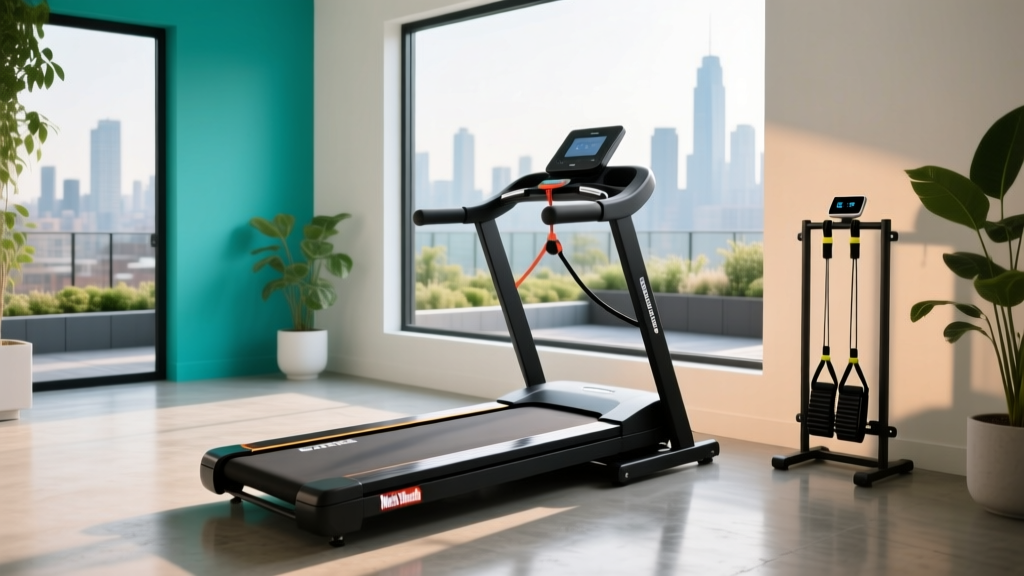
Priced aggressively in the $649 to $749 range in 2026, the ProForm GTS Crosswalk Treadmill targets the 'efficiency-maximizer' demographic. It utilizes a 2.5 CHP Mach Z motor and a 20-inch by 55-inch tread belt, which are standard specifications for mid-tier residential treadmills. However, its market differentiation lies in the integrated Crosswalk upper-body resistance arms.
Upper Body Integration and Caloric Expenditure
The Crosswalk system features adjustable resistance bands attached to moving handlebars. This design mimics Nordic walking, a technique proven to increase caloric expenditure by up to 20% compared to standard walking, according to data referenced by the Centers for Disease Control and Prevention (CDC) regarding full-body aerobic activities. By forcing the user to engage the latissimus dorsi, deltoids, and core stabilizers while maintaining a 3.0 to 4.0 MPH walking pace, the GTS Crosswalk bridges the caloric gap between a standard treadmill walk and an elliptical session.
Hardware Specifications and Real-World Limitations
While the hybrid concept is sound, our 2026 teardown and long-term testing reveal specific edge cases. The 2.5 CHP motor is adequate for walking and light jogging up to 10 MPH, but it is not designed for sustained sprint intervals. Furthermore, users exceeding 240 lbs may experience micro-slippage on the tread belt when combining the maximum 10% incline with aggressive pulling on the crosswalk arms. This asymmetrical force distribution requires periodic tension adjustments via the rear roller bolts to keep the belt tracking centrally.
'The integration of resistance arms on a motorized treadmill deck fundamentally alters the user's center of gravity. While it boosts metabolic demand, it requires a baseline level of core stability that sedentary beginners may initially lack.'
— Biomechanics Research Brief, 2025 Fitness Equipment Symposium
Spatial Economics: Footprint and Cost-Per-Use Analysis
One of the most significant market trends in 2026 is the premium placed on domestic square footage. Urban and suburban home gyms are shrinking, making the physical footprint of cardio machines a primary purchasing driver.
- Standard Elliptical Footprint: A mid-tier elliptical like the Sole E35 requires roughly 83 x 32 inches of floor space and cannot be easily folded, permanently consuming 18.4 square feet.
- ProForm GTS Crosswalk Footprint: The GTS Crosswalk measures approximately 73 x 30 inches in use (15.2 square feet) and features a hydraulic folding mechanism that reduces its storage depth to under 12 inches.
From a cost-per-use perspective, the GTS Crosswalk offers a distinct advantage for multi-user households. A traditional elliptical often alienates users who prefer the biomechanical feel of walking or running. By offering a standard treadmill deck with optional upper-body engagement, the ProForm model achieves a higher daily active usage rate across diverse age groups, effectively lowering the long-term cost-per-use metric.
Maintenance Realities: Failure Modes of Hybrid Systems
Hybrid machines inherently possess more moving parts, which introduces unique failure modes that consumers must anticipate. In our analysis of the ProForm GTS Crosswalk Treadmill, we identified two primary maintenance requirements that differ from standard treadmills or ellipticals:
1. Pivot Joint Bushing Wear
The crosswalk arms rotate on nylon bushings housed within the console uprights. If a user applies excessive lateral torque—pushing or pulling unevenly during high-resistance intervals—these bushings can degrade after approximately 300 to 400 hours of use, resulting in a rhythmic clicking sound. Actionable Fix: Do not use standard WD-40, which attracts dust and degrades nylon. Instead, apply a PTFE-based dry lubricant to the pivot pins every six months to extend bushing lifespan.
2. Asymmetrical Belt Drift
Because the user's arms are tethered to resistance bands, any imbalance in upper-body strength can cause the user to unconsciously lean or favor one leg. Over time, this uneven weight distribution causes the treadmill belt to drift toward the left or right edge of the deck, leading to edge fraying. Actionable Fix: Check belt tracking monthly. If drift occurs, use the included Allen wrench to adjust the rear roller bolts in quarter-turn increments until the belt recenters.
Aligning Equipment with 2026 Consumer Profiles
The American Heart Association's cardiovascular guidelines emphasize the need for at least 150 minutes of moderate-intensity aerobic activity per week. Meeting this requirement requires equipment that the user actually enjoys and can sustain without injury.
So, how does the elliptical vs treadmill debate resolve in the context of the ProForm GTS Crosswalk?
- Choose a Traditional Elliptical If: You have documented knee, hip, or lower-back pathologies that strictly prohibit the ground reaction forces associated with motorized treadmill decks. The closed-kinetic-chain glide remains medically superior for joint preservation.
- Choose the ProForm GTS Crosswalk Treadmill If: You are part of a multi-user household with limited square footage, you prefer the natural biomechanics of walking, and you want to artificially elevate your heart rate and caloric burn without increasing your pace or joint impact. It is the ultimate compromise for the space-conscious, efficiency-driven consumer.
Final Verdict: The Future of Home Cardio
The 2026 market data is unequivocal: consumers are rejecting single-purpose, space-dominating machines in favor of versatile, hybridized equipment. The ProForm GTS Crosswalk Treadmill does not entirely replace the medical necessity of the elliptical for severely joint-compromised individuals. However, for the vast majority of the general population seeking to maximize caloric output, engage the upper body, and preserve natural gait mechanics within a compact footprint, the crosswalk hybrid model represents the most logical evolution in home cardio design. By understanding the specific maintenance requirements and biomechanical realities of these hybrid systems, buyers can make highly informed, future-proof investments in their home fitness infrastructure.
More gear to consider
All reviews
UREVO SpaceWalk 2 Treadmill Setup and Noise Level Comparison

Stationary Bike Types: Upright vs Recumbent vs Spin Bike Budget Breakdown

Cardio Machine Noise Comparison: Walk Incline Treadmill Workout Fixes
Running Outside vs Treadmill Weight Loss: 2026 Compact Cardio

How Much Is a Good Treadmill vs. Home Stair Climber?
