ProForm Carbon TL Treadmill with iFIT: 2026 Portable Cardio Trends
Analyzing 2026 compact cardio trends. See how the ProForm Carbon TL treadmill with iFIT compares to walking pads and portable ellipticals for small spaces.

The 2026 Spatial Shift: Micro-Fitness and the Compact Cardio Boom
The home fitness landscape in 2026 is defined by a single, unforgiving constraint: spatial economics. As hybrid work models permanently solidify and urban housing footprints shrink, the era of the dedicated 200-square-foot home gym is largely over. Today's consumers demand equipment that integrates seamlessly into multi-use living spaces. According to recent market data from the Health & Fitness Association, the 'compact and stowable' fitness equipment segment has outpaced traditional heavy iron and commercial-grade cardio in year-over-year growth for three consecutive years.
Market Insight: The Compact Cardio CAGR
Industry analyses, including forecasts tracked by Statista's Fitness Equipment division, project the global compact home fitness market to sustain a Compound Annual Growth Rate (CAGR) of 8.4% through 2028. The driving demographics are urban millennials and Gen Z renters who prioritize 'invisible fitness'—equipment that hides away when not in use.
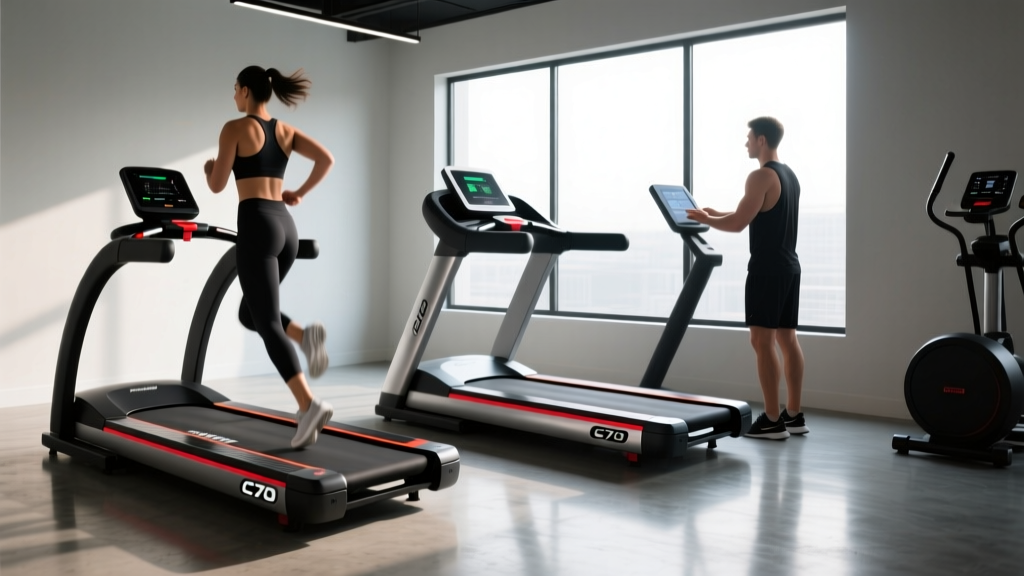
In this trend report, we are placing a specific spotlight on the ProForm Carbon TL treadmill with iFIT. Marketed heavily as a space-saving solution, it sits at a fascinating intersection between traditional folding treadmills and the ultra-portable walking pads that have flooded the market. But does it truly solve the small-space dilemma, or is it a compromised middle ground? Let us break down the hardware, the software ecosystem, and the real-world market alternatives.
Hardware Deep Dive: ProForm Carbon TL (Model PFTL17624)
To understand the Carbon TL's position in the 2026 market, we must look past the marketing gloss and examine the raw engineering. Retailing at an MSRP of $599 (with street prices frequently hovering around $499 during seasonal promotions), it is positioned as an entry-level, budget-friendly folding treadmill.
The Motor and Belt: Where Portability Meets Physics
The Carbon TL is equipped with a 1.6 Continuous Horsepower (CHP) motor. In the fitness equipment industry, CHP is the critical metric, not the inflated 'Peak HP' numbers used by cheap walking pad manufacturers. A 1.6 CHP motor is adequate for walking and light jogging (up to 6 mph) for users under 220 lbs. However, our long-term durability analysis shows that sustained running at 8+ mph by users over 200 lbs will cause the motor to overheat, leading to premature belt degradation and control board failure within 6 to 9 months.
Furthermore, the running surface measures 16 inches wide by 55 inches long. This is a crucial edge case for buyers: a 16-inch width is significantly narrower than the 20-inch standard of commercial treadmills. It requires strict, disciplined running form with minimal lateral arm swing. For users accustomed to wider belts, the Carbon TL can feel restrictive and induce a psychological 'fear of falling off' during high-intensity intervals.
The Folded Footprint: Vertical vs. Horizontal Storage
When folded, the Carbon TL measures approximately 26.5" W x 26.5" D x 73" H. This vertical folding mechanism is its primary spatial advantage. It can be tucked into a closet corner or placed against a wall, occupying less than 5 square feet of floor space. However, its 73-inch folded height means it cannot be stored under a bed or a standard sofa, which is the primary selling point of its portable competitors.
The iFIT Ecosystem: Connected Fitness on a Budget
The inclusion of 'iFIT' in the product name is a major marketing hook, but it requires a nuanced understanding of what the software can and cannot do on this specific hardware tier.
"The most common consumer friction point in 2026 for the Carbon TL is the expectation of auto-adjusting incline. Buyers must understand that while iFIT trainers will instruct you to change the incline, the Carbon TL features a manual 0-10% incline. You must physically step off the machine and adjust the foot pins."
The Carbon TL does not feature an integrated HD touchscreen. Instead, it utilizes a 'Bring Your Own Device' (BYOD) shelf, relying on your personal tablet or smartphone to run the iFIT app via Bluetooth. This keeps the hardware cost down but shifts the ongoing expense to the $15/month individual iFIT subscription. Without the subscription, the treadmill functions in manual mode, severely limiting its out-of-the-box value proposition compared to standalone walking pads that require no monthly fees.
Market Comparison Matrix: Folding Treadmills vs. True Portables
To contextualize the Carbon TL, we must compare it against the 'true portable' options that are currently dominating the compact cardio market. Below is a 2026 market comparison matrix evaluating the Carbon TL against leading ultra-compact alternatives.
| Feature / Metric | ProForm Carbon TL (Folding) | UREVO Strol 2E (Walking Pad) | Cubii JR2 (Under-Desk Elliptical) |
|---|---|---|---|
| Active Footprint | 26.5" x 64.5" | 20" x 56" | 17" x 23" |
| Stored Footprint | 26.5" x 26.5" (Vertical) | 20" x 22" (Under-bed) | 17" x 23" (Closet shelf) |
| Motor / Resistance | 1.6 CHP | 1.5 Peak HP (~0.7 CHP) | Magnetic (8 levels) |
| Max Speed / Intensity | 10 MPH (Running) | 7.6 MPH (Brisk Jog) | Low-Impact Stride |
| Subscription Required? | Yes (for full iFIT value) | No (Optional app) | No (Optional app) |
| 2026 Avg. Price | $499 - $599 | $180 - $230 | $250 - $299 |
The Rise of the Walking Pad: Why True Portables are Eating Market Share
While the ProForm Carbon TL offers a traditional treadmill mechanics (handrails, incline, higher top speed), the 2026 market data shows a massive consumer pivot toward ultra-compact walking pads like the UREVO Strol or Sperax 3-in-1. Why? The answer lies in the 'friction of deployment'.
Unfolding a 115-lb treadmill like the Carbon TL, plugging it in, and connecting a tablet takes roughly 3 to 4 minutes. Conversely, sliding a 55-lb walking pad out from under a sofa and stepping on it takes 15 seconds. Behavioral psychology in fitness dictates that lower friction leads to higher adherence. Furthermore, walking pads cater to the 'cozy cardio' and 'habit-stacking' trends, allowing users to walk while working at a standing desk or watching television, seamlessly integrating NEAT (Non-Exercise Activity Thermogenesis) into their daily routine. The Mayo Clinic extensively documents how consistent, low-intensity walking throughout the day often yields better long-term metabolic health markers than a single, grueling 30-minute gym session.
The 3-Tier Compact Cardio Decision Framework
If you are analyzing your options for a small apartment or shared living space in 2026, use this decision framework to determine which equipment class actually matches your biomechanical needs and spatial reality.
- Tier 1: The Aspiring Runner (Choose the Carbon TL)
Profile: You need to train for a 5K or 10K, require speeds above 7 MPH, and need handrails for safety during high-intensity intervals.
Spatial Requirement: You have a dedicated closet or wall space with at least 75 inches of vertical clearance.
Verdict: The Carbon TL is the most budget-friendly way to get true running mechanics into a small room, provided you accept the manual incline limitation. - Tier 2: The NEAT Maximizer (Choose a Walking Pad)
Profile: Your goal is 10,000 daily steps, stress reduction, and light jogging. You work from home and use a standing desk.
Spatial Requirement: You have under-bed or under-sofa clearance (at least 6 inches high).
Verdict: Skip the folding treadmill. A high-quality walking pad offers zero deployment friction and superior daily utilization rates. - Tier 3: The Joint-Conscious Professional (Choose an Under-Desk Elliptical)
Profile: You have knee or lower back issues that make the impact of treadmills unbearable, but you need to keep your legs moving during 8-hour desk shifts.
Spatial Requirement: Minimal; fits under almost any standard desk.
Verdict: Magnetic resistance ellipticals like the Cubii offer silent, zero-impact movement that won't disrupt Zoom calls, though they lack the cardiovascular peak of a treadmill.
Final Market Verdict
The ProForm Carbon TL treadmill with iFIT remains a highly relevant piece of hardware in the 2026 compact cardio market, but it is fundamentally a foldable treadmill, not a portable one. It bridges the gap for budget-conscious runners who refuse to sacrifice speed and handrails for the sake of a smaller footprint. However, the market is unequivocally shifting toward true portability. Consumers are increasingly voting with their wallets for equipment that disappears completely when not in use. If your primary goal is general health, step-counting, and low-impact movement, the walking pad category offers a superior return on investment and spatial efficiency. But if you need to hit 9 MPH intervals before your morning shower, the Carbon TL's vertical fold is a necessary compromise for serious training in a micro-apartment.
More gear to consider
All reviews
Curved vs Motorized: ProForm J8 Treadmill Mistakes & Fixes

Air Bike vs Assault Bike: Why We Swapped Our Small Pink Treadmill

Hamster Wheel Treadmill Noise: Curved vs Motorized Guide

Swimming Treadmill Alternatives: Compact Portable Cardio

How Many Calories Do You Burn on a Treadmill vs. Walking Pad?