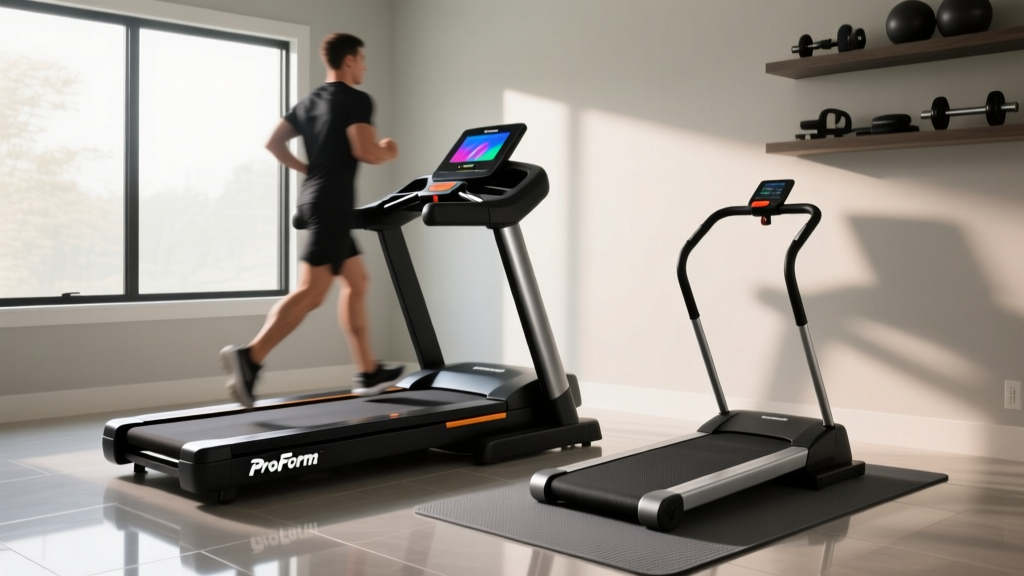
ProForm Trainer 420 Treadmill vs Walking Pads: 2026 Review
Is the ProForm Trainer 420 treadmill better than a walking pad? We compare specs, pricing, and real-world desk use to help you choose the right fit.

The Compact Cardio Dilemma: Folding Treadmill vs. Under-Desk Pad
The home fitness landscape in 2026 has been entirely reshaped by the demand for compact, low-profile cardio equipment. As remote work remains a permanent fixture for millions, the quest to integrate movement into the workday has sparked a fierce debate: should you invest in a budget-friendly folding model like the ProForm Trainer 420 treadmill, or opt for a dedicated ultra-slim under-desk walking pad?
While both categories promise to increase your daily step count without dominating your living room, their mechanical realities, ergonomic footprints, and long-term durability differ vastly. In this head-to-head comparison, we dissect the ProForm Trainer 420 against the leading walking pads on the market to determine which machine actually delivers on the promise of seamless home-office integration.
Anatomy of the ProForm Trainer 420 Treadmill
Positioned at the intersection of budget fitness and space-saving design, the ProForm Trainer 420 treadmill is technically a "compact folding treadmill" rather than a true walking pad. Retailing between $299 and $349 in 2026, it offers a traditional treadmill experience shrunken down to a smaller footprint.
Key Specifications and Real-World Performance
- Motor: 2.0 Continuous Horsepower (CHP). This is sufficient for walking and light jogging (up to 8.0 MPH), but it will strain under continuous running loads.
- Belt Dimensions: 50 inches long by 18 inches wide. This provides a forgiving stride for walking, though taller users (over 6'1") may feel the deck is slightly short for a full running gait.
- Weight Capacity: 275 lbs, supported by a relatively sturdy steel frame compared to aluminum walking pads.
- Incline: Fixed at 0%. There is no manual or automatic incline adjustment on this model.
The primary advantage of the ProForm Trainer 420 treadmill is the inclusion of a fixed handrail and an elevated console. For users who struggle with balance or prefer to track their heart rate via built-in grip sensors, this traditional silhouette offers a psychological and physical safety net that handlebar-less walking pads lack.
The Walking Pad Benchmark: UREVO Strol 2E & KingSmith R2
To properly evaluate the ProForm, we must compare it against the gold standards of the walking pad category: the UREVO Strol 2E (approx. $259) and the KingSmith WalkingPad R2 (approx. $399).
True walking pads prioritize a minimalist deck, typically lacking an upright console. They utilize peak horsepower ratings (often 2.5 HP Peak, which translates to roughly 1.25 to 1.5 CHP) and feature belts that are noticeably shorter and narrower—usually around 41" x 16". The trade-off for this ultra-compact size is a strict speed limit (usually capped at 4.0 to 6.0 MPH for under-desk use) and a complete absence of handrails, forcing the user to rely on core stability or a standing desk crossbar for balance.
Head-to-Head Spec Matrix
| Feature | ProForm Trainer 420 | UREVO Strol 2E (Pad) | KingSmith WalkingPad R2 |
|---|---|---|---|
| Price (2026) | $299 - $349 | $259 | $399 |
| Motor Output | 2.0 CHP | 2.5 HP (Peak) | 2.5 HP (Peak) |
| Top Speed | 8.0 MPH | 6.0 MPH | 6.2 MPH |
| Running Surface | 50" x 18" | 41.3" x 15.7" | 47.2" x 17.3" |
| Machine Weight | 85 lbs | 55 lbs | 62 lbs |
| Desk Friendly? | No (Console obstructs) | Yes (4.7" profile) | Yes (Foldable handrail) |
The "Under-Desk" Reality Check: Ergonomics and Clearance
⚠️ The Desk Clearance Trap
Many buyers mistakenly assume any "compact" treadmill will slide under their standing desk. This is where the ProForm Trainer 420 treadmill fails the walking pad test.
A standard standing desk rests at 29 to 30 inches high. A true walking pad adds about 4.5 inches of deck height, bringing your total standing elevation to roughly 34 inches—an ideal ergonomic height for typing.
The ProForm 420, even when folded flat for storage, has a deck thickness of nearly 8.5 inches, and its non-removable console arm extends upward at a 45-degree angle. If you attempt to use the ProForm while unfolded, the console sits at roughly 42 inches high, which will violently collide with the underside of a desk set to standard typing height. Verdict: The ProForm is a "small room" treadmill, not an "under-desk" treadmill.
Motor Thermals and Belt Slippage: Real-World Failure Modes
When comparing sub-$400 cardio machines, understanding failure modes is critical for long-term satisfaction. Budget motors and narrow rollers are the primary culprits for early equipment death.
The Thermal Throttling Issue
Because walking pads use "Peak" HP ratings rather than "Continuous" HP, they are highly susceptible to thermal throttling. If a 200 lb user walks at 4.0 MPH on a UREVO pad for more than 60 continuous minutes, the internal thermal sensor will often trip, forcing the machine to shut down to prevent the motor from melting. The ProForm Trainer 420 treadmill, boasting a true 2.0 CHP motor, handles continuous 90-minute walking sessions with significantly less heat buildup, making it vastly superior for users who plan to walk through entire feature-length movies or long work blocks.
Belt Tension and Maintenance
Walking pads utilize smaller, tighter rollers, which increases friction and accelerates belt wear. The ProForm 420 features standard rear-roller adjustment bolts. Expect to perform a 1/4-turn hex key adjustment on the ProForm belt every 3 to 4 months to prevent lateral drifting. Walking pads, due to their low-profile nature, often require complete belt replacement after 12 to 18 months of heavy daily use, as the thin lubricant layer between the belt and the low-friction deck dries out rapidly.
The NEAT Factor: Why This Comparison Matters
The driving force behind both of these machines is the pursuit of NEAT (Non-Exercise Activity Thermogenesis). According to the Mayo Clinic, prolonged sitting is linked to a host of metabolic issues, and integrating low-intensity movement into your workday can significantly offset these risks. Furthermore, the American Heart Association highlights that consistent, moderate walking is one of the most effective ways to manage blood pressure and improve cardiovascular baseline health.
However, the consistency of that movement depends entirely on removing friction. If your machine is too loud, too tall, or too cumbersome to use while answering emails, your NEAT levels will drop back to zero.
Final Verdict: Which Compact Cardio Machine Wins?
There is no universal winner; the correct choice depends entirely on your spatial constraints and biomechanical needs. Use this decision framework to make your final purchase:
Buy the ProForm Trainer 420 Treadmill If:
- You want to jog: You need speeds above 6.0 MPH and a 50-inch belt to safely accommodate a running stride.
- You need stability: You have balance concerns or prefer holding onto a fixed handrail while watching TV in the living room.
- You walk for hours: You require a continuous-duty motor that won't overheat during 90+ minute daily sessions.
- Space is flexible: You have a dedicated 5x3 foot corner for the machine and don't need to roll it under a low bed or desk.
Buy a Dedicated Walking Pad (UREVO / KingSmith) If:
- You work at a standing desk: You need a deck height under 5 inches to maintain proper ergonomic typing posture.
- You only walk: Your cardio goals are strictly limited to 2.0 to 4.0 MPH strolls while reading or taking calls.
- Storage is a priority: You need to slide the machine under a sofa or into a closet when not in use.
- Noise is a concern: Walking pads generally produce lower decibel foot-strike noise due to their thinner decks and lack of upright rattling components.
Frequently Asked Questions
Can I remove the handrails on the ProForm Trainer 420 to use it under a desk?
No. The handrails and console mast are structurally integrated into the frame's base. Attempting to remove them will void your warranty, compromise the structural integrity of the machine, and leave exposed wiring and sharp metal brackets.
Do I need to lubricate the ProForm 420 belt?
Yes. Like all budget treadmills, the ProForm 420 requires 100% silicone treadmill lubricant applied under the belt every 3 months or every 130 miles of use to prevent the motor from overworking and the deck from warping.
Which machine is quieter for apartment living?
Walking pads are generally quieter. The ProForm 420's larger motor and upright console create more ambient vibration and acoustic resonance, which can transfer through the floorboards to downstairs neighbors if you do not use a high-density EVA foam equipment mat.
More gear to consider
All reviews
Hitting 10 000 Steps on Treadmill: Compact Space Guide
Space Treadmill vs Rower: Setup, Buying & Technique Guide

Chasing a 7 Minute Mile Pace on Treadmill Desks: Budget Analysis

Air Bike vs Assault Bike: Space Layout & Treadmill Arms Compared
Maintain Compact Portable Cardio Equipment and Gold's Gym Treadmills
