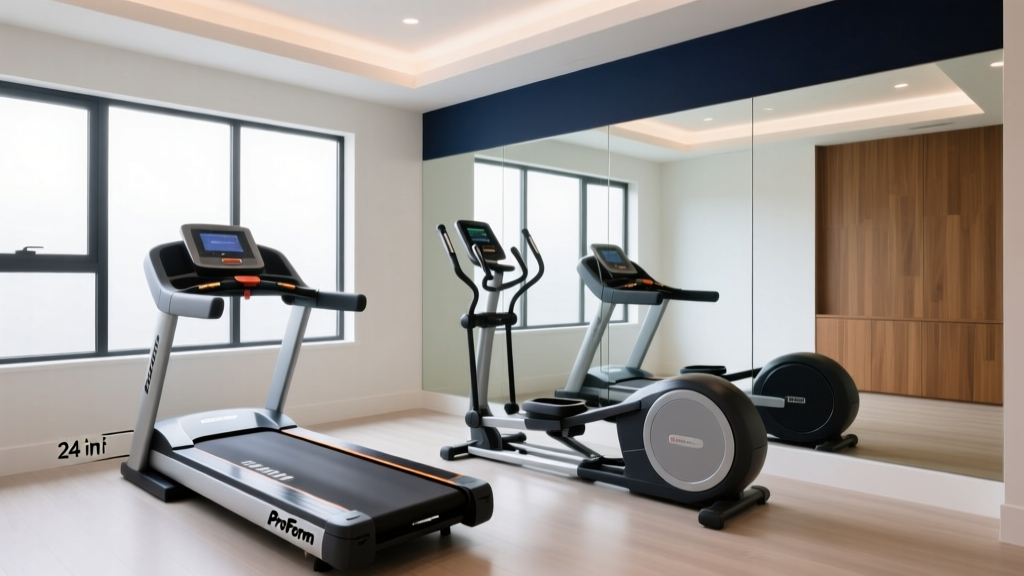
ProForm 14.0 Treadmill vs Ellipticals: Home Space Layout Guide
Compare the ProForm 14.0 treadmill and ellipticals for home cardio. Expert space optimization, layout dimensions, and clearance rules for small rooms.

The Spatial Dilemma: Treadmill vs. Elliptical in the Modern Home
Designing a home cardio zone in 2026 requires a ruthless approach to space optimization. When square footage is limited, the debate between purchasing an elliptical or a treadmill transcends mere biomechanics; it becomes an architectural challenge. While both machines deliver exceptional cardiovascular benefits, their spatial footprints, vertical clearances, and safety zones dictate entirely different room layouts. In this guide, we break down the spatial realities of standard ellipticals versus folding treadmills, using the highly popular ProForm 14.0 treadmill as our benchmark for modern, space-conscious engineering.
According to the American Council on Exercise (ACE), the most common mistake home gym owners make is ignoring the 'dynamic envelope'—the total space required not just for the machine, but for the user's movement and emergency dismounts. Let us examine how these two cardio giants compare when floor space is at a premium.
Footprint Face-Off: Raw Dimensions & Clearance Zones
To understand layout optimization, we must first look at the raw numbers. Below is a comparative matrix detailing the spatial requirements of a premium folding treadmill versus a standard front-drive elliptical.
| Specification | ProForm 14.0 Treadmill | Standard Front-Drive Elliptical (e.g., Sole E95) |
|---|---|---|
| Unfolded Footprint | 80' L x 32' W (17.7 sq ft) | 82' L x 31' W (17.6 sq ft) |
| Folded Footprint | 42' L x 32' W (9.3 sq ft) | N/A (Does not fold) |
| Deck / Pedal Height | 8' deck height | 12' - 18' pedal height |
| Rear Safety Clearance | 48' minimum | 12' minimum |
| Average 2026 Price | $1,299 - $1,499 | $1,799 - $2,199 |
At first glance, the unfolded footprints are nearly identical. However, the spatial divergence occurs in the rear safety clearance and the folding capability. The ProForm 14.0 treadmill demands a massive 48-inch void behind the belt, while the elliptical requires minimal rear space but dominates the room's permanent visual and physical volume.
The Treadmill Safety Mandate: Why the 48-Inch Rule Matters
When integrating a treadmill into a multi-use room, you cannot cheat the rear clearance zone. The U.S. Consumer Product Safety Commission (CPSC) strictly advises maintaining a clear fall zone behind all motorized treadmills to prevent severe friction burns and impact injuries in the event of a slip.
CRITICAL LAYOUT RULE: Never place a treadmill flush against a wall, a glass window, or a heavy piece of furniture. The 48-inch rear buffer is non-negotiable for household safety.This safety mandate means the ProForm 14.0 treadmill actually commands a 'dynamic footprint' of roughly 128 inches in length (80 inches for the machine + 48 inches for the fall zone) during use. If your room is only 10 feet long, placing the treadmill at the far end will block the primary traffic pathway while in operation. Space optimization here relies entirely on the machine's ability to reclaim that footprint when not in use.
Elliptical Spatial Realities: The Vertical and Width Problem
Ellipticals are often mistakenly marketed as 'space-saving' because they lack the massive rear clearance requirement of a treadmill. However, they introduce two severe spatial constraints: permanent volume and vertical clearance.
1. The Permanent Volume Issue
Unlike the ProForm 14.0 treadmill, which utilizes a hydraulic SpaceSaver lift to fold the deck vertically, 95% of home ellipticals do not fold. An elliptical is a permanent fixture. Once placed, it permanently consumes 18 square feet of floor space and creates a large, unyielding visual barrier in the room.
2. The Vertical Clearance Trap
Because elliptical pedals elevate the user 12 to 18 inches off the ground, ceiling height becomes a critical limiting factor. If you are 6 feet tall and using an elliptical with a 15-inch pedal height, your peak head clearance reaches 7 feet 3 inches. In rooms with standard 8-foot ceilings, this leaves less than 9 inches of overhead buffer, creating a claustrophobic and potentially dangerous environment if you bounce during high-resistance intervals.
Deep Dive: ProForm 14.0 Treadmill SpaceSaver Mechanics
Let us look closely at why the ProForm 14.0 treadmill is a favorite among interior designers and fitness enthusiasts optimizing small spaces. The machine features a proprietary hydraulic folding mechanism that allows the 80-inch deck to pivot upward, locking securely into the console uprights.
- Folded Depth: Shrinks from 80 inches to just 42 inches, instantly returning 38 inches of walkway space to the room.
- Transport Wheels: Once folded, the center of gravity shifts onto integrated transport wheels, allowing a single user to roll the 160-pound machine into a closet or corner.
- Visual Weight: When folded, the machine's profile is significantly reduced, preventing the room from feeling 'cluttered' during non-workout hours.
This folding capability is the ultimate trump card for space optimization. A room can serve as a home office or yoga studio during the day, and seamlessly transition into a high-performance cardio zone in the evening.
Designing Your 2026 Home Cardio Zone: Layout Frameworks
Choosing between the ProForm 14.0 treadmill and an elliptical should be dictated by your room's specific geometry. Here are two practical layout frameworks to help you decide.
Framework A: The 'Galley' Layout (Best for Treadmills)
If your room is long and narrow (like a converted hallway or a rectangular spare bedroom), a folding treadmill is ideal. Place the ProForm 14.0 treadmill at the far narrow end, facing into the room. When in use, the 48-inch fall zone extends down the 'galley' of the room. When finished, fold it up to reclaim the walkway. This layout leverages the room's length for safety clearance without sacrificing width.
Framework B: The 'Anchor' Layout (Best for Ellipticals)
If your room is square and features high ceilings (9 feet or more), an elliptical can serve as a permanent architectural anchor. Place it in a corner at a 45-degree angle. This softens the harsh lines of the machine, improves sightlines across the room, and allows for adequate lateral arm-swing clearance (at least 20 inches on each side). As Harvard Health Publishing notes, creating an inviting, uncluttered visual environment is crucial for maintaining long-term exercise adherence.
Design is not just what it looks like and feels like. In the context of home fitness, design is how the space functions when your heart rate is at 160 BPM. Prioritize airflow, safety buffers, and natural light over cramming in extra equipment.
HVAC and Environmental Considerations
Space optimization is not limited to floor plans; it includes environmental control. Treadmills generate significant kinetic heat and require robust cross-ventilation. If you choose the ProForm 14.0 treadmill, ensure your layout does not trap the machine in a dead-air corner. Position it near a doorway or a window to allow for passive cooling, or install a wall-mounted oscillating fan directly in the primary sightline. Ellipticals, generating slightly less ambient heat due to the lack of a high-friction motorized belt, are more forgiving in enclosed, poorly ventilated nooks.
The Final Verdict: Which Machine Wins the Space War?
If your primary constraint is multi-use functionality and daily floor space reclamation, the ProForm 14.0 treadmill is the undisputed champion. Its ability to fold and hide away allows a single room to serve multiple purposes without feeling like a permanent gym. However, if you have a dedicated, high-ceilinged room where the equipment will never need to be moved, and you prefer a low-impact biomechanical profile, an elliptical provides a stable, permanent fixture that requires less rigorous rear-clearance planning.
Ultimately, successful home cardio design in 2026 is about respecting the dynamic envelope. Measure your ceilings, map your fall zones, and choose the machine that harmonizes with your architecture rather than fighting against it.
More gear to consider
All reviews
Beyond the ProForm Treadmill User Manual: 2026 Compact Cardio Trends

ProForm 755 Crosstrainer Treadmill & Curved vs Motorized Setup
Daeyegim Treadmill Review: Walking Pad Mistakes & Fixes

Gold Gym 430i Treadmill Review: Small Space Layouts

Treadmill Running and Knee Pain? Air Bike vs Assault Bike Guide
