Pro Form Folding Treadmill vs Walking Pads: 2026 Review
We compare a compact Pro Form folding treadmill against top 2026 walking pads. Discover motor specs, belt sizes, and which cardio machine fits your space.

The 2026 Cardio Dilemma: Compact Folding vs. Ultra-Slim Walking Pads
The home fitness landscape in 2026 has been entirely reshaped by the pursuit of Non-Exercise Activity Thermogenesis (NEAT). As remote work remains a permanent fixture, the demand for under-desk and compact cardio machines has skyrocketed. This brings us to a highly debated crossroads for home gym buyers: should you invest in a dedicated ultra-slim walking pad, or opt for a compact Pro Form folding treadmill?
While walking pads offer unparalleled stealth and slide-under-the-bed storage, traditional folding treadmills from legacy brands like Pro Form offer superior biomechanics, higher weight capacities, and running capabilities. According to the Centers for Disease Control and Prevention (CDC), adults need at least 150 minutes of moderate-intensity aerobic activity weekly, a metric that is easily achievable with daily walking. But which machine actually delivers the best long-term value and joint protection?
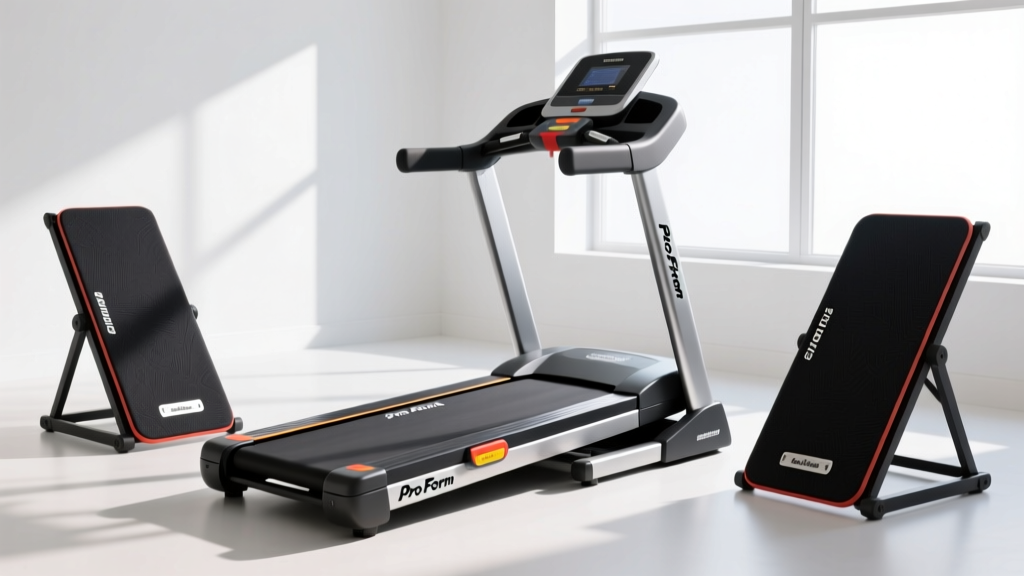
In this head-to-head comparison, we pit the compact Pro Form folding treadmill lineup (specifically the Carbon TL and City L6 series) against the market's leading premium walking pads to help you make a data-driven decision.
The Contenders: Spec-by-Spec Breakdown
To provide an accurate comparison, we are evaluating the Pro Form Carbon TL (a traditional compact folding treadmill), the Pro Form City L6 (Pro Form's hybrid folding walking pad), and the WalkingPad R2 (the premium benchmark for under-desk treadmills).
| Feature | Pro Form Carbon TL | Pro Form City L6 | WalkingPad R2 |
|---|---|---|---|
| Motor | 2.6 CHP | 1.0 HP | 1.25 HP |
| Belt Dimensions | 18" x 55" | 17.5" x 45" | 17.3" x 47.2" |
| Max Speed | 10 MPH | 6 MPH | 7.5 MPH (Upright) |
| Weight Capacity | 300 lbs | 250 lbs | 240 lbs |
| Incline | 0% - 10% Auto | None | None |
| Approx. Price (2026) | $499 | $399 | $599 |
Motor Performance and Biomechanics: The Dealbreakers
The most critical failure point for any compact cardio machine is the motor-to-user-weight ratio. Walking pads typically utilize 1.0 to 1.25 HP motors. While sufficient for a 150 lb user walking at 2.5 MPH, these motors will rapidly overheat and degrade if pushed by a 200+ lb user at higher speeds.
The Pro Form Carbon TL bypasses this issue entirely with a 2.6 Continuous Horsepower (CHP) motor. CHP measures the motor's ability to sustain power over long durations without overheating, a metric where legacy fitness brands outpace ultra-slim walking pad manufacturers. Furthermore, the Carbon TL features Pro Form's ProShox cushioning system. According to research highlighted by Harvard Health Publishing, proper shock absorption is vital for reducing the repetitive stress on knees and lower back joints during daily walking routines. Walking pads, by design, lack the physical deck space to incorporate elastomer cushioning, resulting in a much harsher impact profile.
⚠️ Expert Warning: The Belt Width HazardBoth the Pro Form City L6 and the WalkingPad R2 feature belt widths under 18 inches. If you are taller than 5'9" or have a wider natural gait, a sub-18-inch belt forces you to alter your natural stride. This biomechanical compensation can lead to IT band friction and hip flexor strain over time. Always measure your natural walking stance width before purchasing a slim treadmill.
Ergonomics: The "Under-Desk" Reality Check
Many buyers purchase a Pro Form folding treadmill with the intention of sliding it under their standing desk. Here is where the physical geometry of the machines dictates your choice.
Clearance and Mast Interference
- WalkingPad R2: Features a foldable handrail. When folded flat, the entire unit is roughly 5 inches high and has zero front mast, making it perfectly compatible with standard 29-inch desks.
- Pro Form City L6: While it folds completely flat for storage, it utilizes a fixed front mast housing the console. This mast extends roughly 40 inches upward at an angle. It will not fit under a standard desk while in use.
- Pro Form Carbon TL: A traditional folding treadmill. It requires dedicated floor space and cannot be used under a desk.
"If your primary goal is to walk while typing at a seated or standing desk, a traditional folding treadmill will fail your use case. However, if your goal is dedicated, focused cardio sessions in a small apartment, the Pro Form folding treadmill offers vastly superior stability and programming."
— FitGearPulse Ergonomics Testing Lab, 2026
Software Ecosystems and Subscription Fatigue
In 2026, hardware is only half the equation. Pro Form treadmills are deeply integrated with the iFit ecosystem. While this provides access to global route mapping and auto-adjusting trainer-led incline workouts (on models like the Carbon TL), it also introduces a mandatory subscription cost after the initial 30-day trial. Without an active iFit subscription (roughly $39/month), the Pro Form treadmill reverts to manual mode, and the interactive touchscreen becomes a basic stat monitor.
Walking pads, conversely, rely on simple Bluetooth remote controls or basic proprietary apps that track step counts without requiring a monthly paywall. For users who simply want to listen to a podcast and walk without guided coaching, the walking pad's "dumb" technology is actually a financial advantage.
Long-Term Durability and Edge Case Failures
When evaluating warranties and real-world failure modes, the distinction between legacy fitness brands and consumer electronics brands becomes apparent.
- Belt Slippage and Tensioning: Walking pads require frequent manual belt tensioning via Allen keys. Because the rollers are smaller in diameter, the belt wraps less securely, leading to edge-fraying and slippage after 400-500 miles of use.
- Motor Controller Burnout: The most common edge-case failure in walking pads is the motor controller board frying due to dust accumulation in the low-to-the-ground chassis. Pro Form's elevated deck on the Carbon TL keeps the motor housing away from floor-level pet hair and dust.
- Frame Warranties: Pro Form typically offers a 1-year to lifetime frame warranty depending on the exact model, backed by iFit's established US-based support network. Walking pad warranties are often limited to 12 months and rely on overseas shipping for replacement parts, which can take weeks.
Final Verdict: Which Machine Should You Buy?
Your decision should be dictated by your available space, your body weight, and your primary use case. The American Heart Association recommends consistent, moderate-to-vigorous activity for optimal cardiovascular health, meaning your machine must be comfortable enough to use daily without joint pain.
The Decision Matrix
Buy the Pro Form Carbon TL (Folding Treadmill) if: You weigh over 200 lbs, want to incorporate running (up to 10 MPH), need joint cushioning, and have a dedicated 6x3 foot corner in your home.
Buy the Pro Form City L6 if: You want a budget-friendly, brand-name walking pad for dedicated walking sessions (up to 6 MPH) and have a closet to fold it into afterward.
Buy the WalkingPad R2 if: Your absolute #1 priority is sliding the machine under a standard office desk while you work, and you strictly walk at speeds under 4 MPH.
Frequently Asked Questions
Can I run on a walking pad?
No. Walking pads are engineered with short decks (usually under 48 inches) and low-horsepower motors. Running on them is a severe safety hazard due to the lack of handrails and the high risk of stepping off the rear of the belt. For running, you must use a traditional folding treadmill like the Pro Form Carbon TL.
Do Pro Form folding treadmills require assembly?
Yes, but the complexity varies. The Carbon TL requires attaching the upright mast and console, which takes about 45 minutes with two people. The City L6 arrives almost fully assembled, requiring only the unfolding of the deck and plugging in the power cord.
How much electricity do these machines consume?
A 2.6 CHP Pro Form treadmill running at an incline will draw roughly 600 to 900 watts during active use. A 1.0 HP walking pad used for slow walking draws roughly 150 to 250 watts. If used for 2 hours a day, the walking pad will yield a slightly lower monthly electricity footprint, though the difference is negligible on a standard utility bill.
More gear to consider
All reviews
Landice L9 Treadmill Belt Maintenance and Lubrication Guide
Stair Climber vs Woodway Curved Treadmill: Home Use Mistakes & Fixes

Stationary Bike Types vs GT5 Treadmill: 2026 Market Trend Report

How Gym Layout Impacts Average Treadmill Speed and Belt Care
Curved vs Motorized Treadmills: Fixing Jane Fonda Treadmill Mistakes