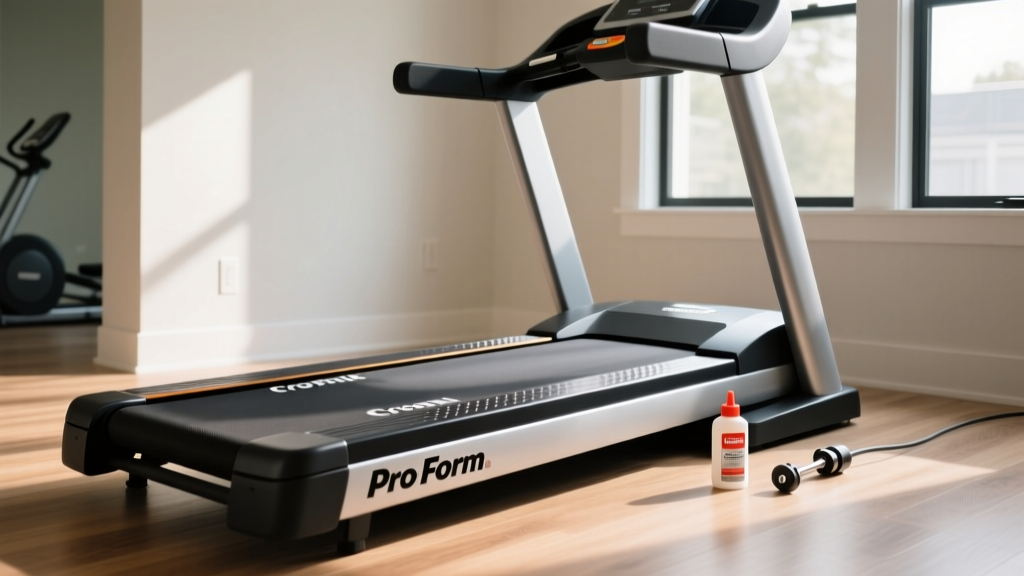
Pro Form Crosswalk Treadmill Belt Maintenance & Care Guide
Master Pro Form Crosswalk treadmill belt maintenance. Learn exact tension adjustments, silicone lubrication steps, and deck care to extend motor life.

Maintaining a Pro Form Crosswalk treadmill requires a slightly different approach than servicing heavy-duty commercial club models. The Crosswalk series—including popular models like the Crosswalk 390, 490, and 5.5—are engineered for space efficiency, featuring folding frames and compact motor housings. While this design is excellent for home gyms, it means the machine's 1.5 to 2.25 Continuous Horsepower (CHP) motors are highly susceptible to heat buildup and strain if the walking belt is neglected. Proper belt maintenance and lubrication are not just optional upkeep; they are critical interventions that prevent motor controller burnout and deck warping.
The Unique Engineering of the Crosswalk Series
Unlike high-end commercial treadmills that utilize thick, multi-ply belts and massive 4.0 HP motors, the Pro Form Crosswalk line relies on a delicate balance of friction management. The walking deck is typically constructed from medium-density fiberboard (MDF) coated with a phenolic resin. When the belt dries out, friction between the belt and this resin coating spikes exponentially. According to equipment repair specialists at the Treadmill Doctor, a dry treadmill belt can increase motor amp draw by up to 40%, generating enough heat to permanently demagnetize the drive motor or fry the lower control board.
⚠️ Warning: The Static Shock IndicatorIf you experience static shocks when touching the handrails of your Crosswalk treadmill, this is not just a humidity issue. It is a primary symptom of severe belt dryness and excessive friction. Stop using the machine immediately and lubricate the deck to prevent electronic component failure.
Belt Tension and Alignment Protocol
Before applying any lubricant, you must verify that the belt is properly tensioned and centered. A misaligned belt on a folding treadmill will quickly fray against the side rails, destroying the belt edge and exposing the MDF deck to moisture.
The Lift Test
Turn off and unplug the machine. Reach under the center of the walking belt and lift it away from the deck. For a Pro Form Crosswalk model, the optimal tension allows you to lift the belt exactly 2 to 3 inches off the deck. If it lifts higher than 3 inches, it is too loose and will slip during heavy foot strikes. If you cannot lift it 2 inches, it is over-tensioned and is actively crushing the deck bearings.
Adjusting the Rear Roller
- Locate the two rear roller adjustment bolts at the very back of the treadmill frame.
- Using a 3/16-inch hex wrench (standard for most ProForm models), turn both bolts exactly one-quarter (1/4) turn clockwise to tighten, or counter-clockwise to loosen.
- Never adjust one side more than the other, or the belt will track off-center.
- Plug the machine in, start it at 3.0 MPH, and observe the belt tracking for 60 seconds.
Lubrication: Choosing the Right Chemistry
The most common mistake owners make is using the wrong chemical compound on their Crosswalk deck. Using petroleum-based products or WD-40 will dissolve the phenolic resin coating on the MDF deck, turning it into a sticky, gummy mess that requires a total deck and belt replacement.
| Lubricant Type | Chemical Base | Compatibility with Crosswalk | Verdict |
|---|---|---|---|
| 100% Silicone Liquid | Polydimethylsiloxane | Optimal. Preserves phenolic coating. | APPROVED |
| Silicone Spray Aerosol | Silicone + Propellants | Poor. Propellants degrade rubber belt. | REJECT |
| Treadmill Wax | Paraffin/Beeswax blend | Fair. Clumps in compact folding frames. | CONDITIONAL |
| WD-40 / 3-in-One Oil | Petroleum Distillates | Catastrophic. Melts deck and belt. | DANGEROUS |
Step-by-Step Silicone Application
To properly lubricate your machine, you will need a bottle of 100% liquid silicone treadmill lube (typically costing between $10 and $15). Follow the official guidelines recommended by ProForm Customer Support for folding models:
- Step 1: Loosen the belt tension using the hex wrench until you can easily slide your hand underneath.
- Step 2: Insert the applicator wand of the silicone bottle under the belt, aiming toward the center of the deck.
- Step 3: Squeeze exactly 0.5 ounces (15 ml) of silicone onto the deck. Do not over-apply; excess silicone will leak out the sides and coat your drive motor pulley, causing the belt to slip.
- Step 4: Retighten the belt to the 2-3 inch lift specification.
- Step 5: Run the treadmill at 2.0 MPH for 5 minutes without walking on it to evenly distribute the silicone across the phenolic coating.
Advanced Diagnostics: Amp Draw Testing
For technicians and advanced DIYers, visual inspection is not enough. The true test of belt and deck health on a Pro Form Crosswalk treadmill is the amp draw test. Using a standard multimeter with an amp clamp, or a plug-in power meter (like a Kill A Watt), you can measure how hard the motor is working to pull the belt.
Baseline Metrics for Crosswalk Models (1.5 - 2.25 CHP):
• No-Load (Belt running empty at 3.0 MPH): 2.0 to 4.0 Amps
• Loaded (150 lb user walking at 3.0 MPH): 6.0 to 9.0 Amps
• Danger Zone: If loaded amp draw consistently exceeds 12.0 Amps, your deck is worn through the phenolic coating and the MDF is creating raw wood friction. Lubrication will no longer fix this; the deck and belt must be replaced.
Replacement Costs and Part Numbers
Even with meticulous care, walking belts eventually wear out. The Pro Form Crosswalk series generally uses a 14-inch by 120-inch or 16-inch by 120-inch 1-ply belt, depending on the exact model year. When sourcing replacement parts, avoid cheap, unbranded Amazon alternatives that lack proper seam welding. A high-quality aftermarket replacement belt will cost between $40 and $65. If your deck is scored or warped, a replacement MDF deck with pre-applied phenolic resin costs between $75 and $110. Always replace the belt and deck simultaneously; putting a new belt on a worn deck will destroy the new belt in under 30 days.
Routine Maintenance Schedule
To maximize the lifespan of your Crosswalk machine, adhere to this strict maintenance calendar:
- Monthly: Vacuum under the treadmill and behind the motor cover. Dust acts as an insulator, trapping heat inside the compact Crosswalk motor housing.
- Every 90 Days (or 150 miles): Perform the 0.5 oz silicone lubrication protocol and check rear roller tension.
- Bi-Annually: Inspect the drive belt (the ribbed belt connecting the motor to the front roller). Look for micro-cracks or fraying edges.
- Annually: Perform an amp draw test to evaluate the microscopic wear on the walking deck.
Frequently Asked Questions
Can I use a silicone spray from an auto parts store?
No. Automotive silicone sprays contain petroleum distillates and aerosol propellants designed to penetrate rust. These chemicals will break down the rubber compounds in your Crosswalk walking belt, causing it to stretch and snap. Always use 100% pure liquid silicone formulated specifically for fitness equipment.
Why does my Crosswalk belt slip when I sprint, even after lubricating?
Over-lubrication is a common culprit. If you applied more than the recommended 0.5 oz, the excess silicone has likely migrated to the front roller. To fix this, loosen the belt, wipe the front roller and the underside of the belt with a lint-free cloth and a mild degreaser, let it dry completely, and re-tension.
Does the folding mechanism affect belt wear?
Yes. When you fold a Pro Form Crosswalk treadmill, the walking belt rests against the frame and gravity pulls it downward. Over years of folding and unfolding, this can cause slight edge stretching. Always store the machine in the upright position in a climate-controlled room to prevent the belt rubber from drying out and cracking at the fold points.
More gear to consider
All reviews
12 Incline Treadmill vs Elliptical: 2026 Home Cardio Review

Elliptical vs Treadmill: 2026 Trends & Treadmill Static Electricity

Stair Climber Setup & Gold's Gym Air Stride Plus Treadmill Prep

Walking Pad vs Treadmill: A Beginner Guide to Treadmill Gradient
Faith Hill Queen of the Treadmill? Stationary Bike Budget Breakdown
