Prevent Shin Splints From Treadmill: Rowing Machine Guide
Suffering from shin splints from treadmill running? Discover the best rowing machines for zero-impact cross-training, plus expert technique tips.

For dedicated runners, the indoor treadmill is a sanctuary during harsh weather or late nights. However, the repetitive, high-impact nature of belt-driven running frequently leads to a common and frustrating injury. If you are battling shin splints from treadmill workouts, you are not alone. The biomechanics of a treadmill belt—which actively pulls your foot backward—force the tibialis anterior muscle to work overtime to dorsiflex the ankle before the next foot strike. Over thousands of strides, this overworks the lower leg, leading to micro-trauma along the tibia.
According to the Mayo Clinic, shin splints (medial tibial stress syndrome) are primarily caused by repetitive stress on the shinbone and the connective tissues that attach muscles to the bone. To maintain your VO2 max and cardiovascular base without pounding your joints, sports medicine physicians universally recommend cross-training. The rowing machine, or ergometer, is the undisputed king of zero-impact cardio. It engages 86% of the body's musculature, spares the lower legs from ground reaction forces, and builds posterior chain strength that actually bulletproofs your running stride.
The 2026 Rowing Machine Buying Guide for Runners
Not all rowing machines are created equal. When shopping for an ergometer to supplement your running, you must consider rail length (crucial for tall runners with long strides), resistance smoothness, and monitor accuracy. Below is our curated comparison matrix of the top rowing machines on the market for cross-training athletes.
| Model | Resistance Type | Est. Price | Max User Weight | Inseam Capacity | Best For |
|---|---|---|---|---|---|
| Concept2 RowErg | Air | $990 | 500 lbs | Up to 38' | Data nerds & competitive athletes |
| Hydrow | Electromagnetic | $2,495 | 375 lbs | Up to 36' | Immersive, guided studio classes |
| NordicTrack RW900 | Magnetic | $1,699 | 260 lbs | Up to 35' | Interactive iFIT programming |
| Echelon Row | Magnetic | $599 | 300 lbs | Up to 34' | Budget-conscious home gyms |
Why the Concept2 RowErg Remains the Gold Standard
For runners transitioning to the erg, the Concept2 RowErg (formerly the Model D) is the undisputed champion. Priced around $990, it utilizes air resistance, meaning the harder you pull, the more resistance it generates. This perfectly mimics the effort-based pacing of outdoor running. Furthermore, the PM5 monitor is the global standard for tracking split times (your 500m pace), allowing you to accurately measure your cardiovascular output and map it to your running heart rate zones. The standard rail accommodates inseams up to 38 inches, making it ideal for tall marathoners.
The Case for Magnetic Resistance: Hydrow and NordicTrack
If you share a small living space and need a whisper-quiet machine, magnetic resistance models like the Hydrow ($2,495) or NordicTrack RW900 ($1,699) are superior. They use magnets to create drag against a flywheel, resulting in near-silent operation. The Hydrow offers an incredibly smooth, 'on-water' feel and features a 22-inch HD screen with live, on-water workouts led by Olympic rowers. However, magnetic machines generally have a lower max user weight capacity and slightly shorter rails, which can be a limiting factor for runners with a stride-heavy build.
Crucial Specs: Demystifying the Damper Setting
One of the most common mistakes runners make when first using a rowing machine is cranking the damper setting up to 10. This is a critical error that can lead to lower back fatigue and poor mechanics.
Expert Insight: Think of the damper setting like the gears on a bicycle. A setting of 10 is the heaviest gear—great for short, explosive power strokes, but exhausting for a 30-minute cardio session. A setting of 3 to 5 yields a 'drag factor' between 100 and 130, which accurately simulates the sleek drag of a racing shell on water. For aerobic cross-training, keep the damper at 4.
According to the Concept2 official training guides, adjusting the damper to a moderate setting allows for a faster, more fluid stroke rate (measured in strokes per minute, or SPM), which translates much better to the high-cadence turnover required in distance running.
Step-by-Step Rowing Technique for Runners
Runners are naturally quad-dominant and accustomed to an upright posture. Rowing requires a powerful posterior chain drive (glutes, hamstrings, and lats). Mastering the four phases of the stroke is essential to avoid injury and maximize cardiovascular output.
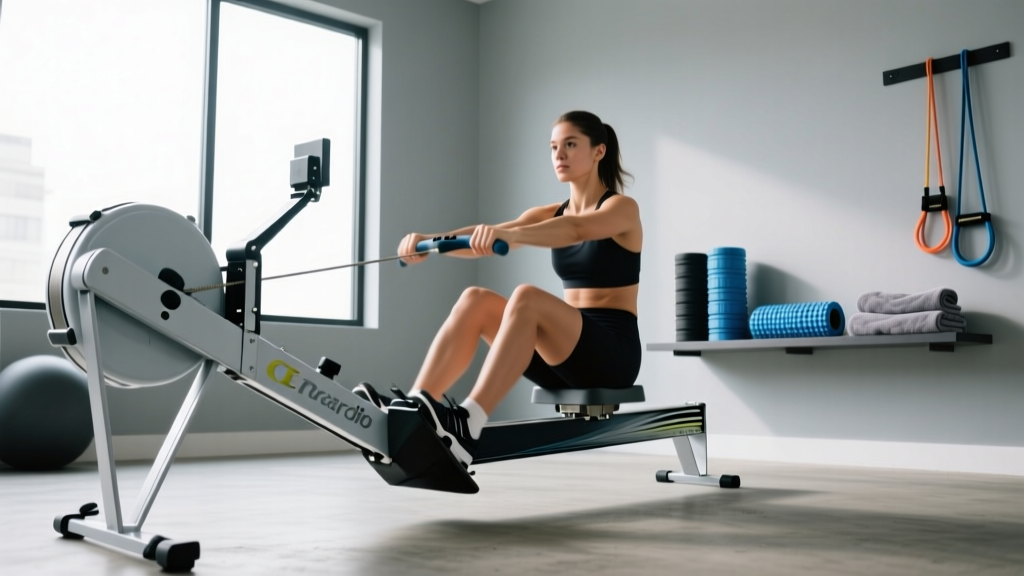
- The Catch: This is the starting position. Shins should be perfectly vertical (do not compress past vertical, as this strains the knees and lower back). Arms are straight, shoulders are relaxed, and your torso is hinged forward at roughly 11 o'clock. Engage your lats as if you are squeezing oranges in your armpits.
- The Drive: The power phase. The sequence is strictly legs, hips, arms. Push explosively through your heels (mimicking a leg press). Your arms remain completely straight until your legs are nearly extended. Only then do you hinge the hips open, followed by pulling the handle to your lower ribs.
- The Finish: Legs are fully extended but not hyperextended. The torso is leaned back slightly to 11 o'clock. The handle is resting lightly against your lower sternum, and your elbows are drawn past your torso. This position heavily engages the rhomboids and core, counteracting the forward-slouching posture many runners develop over long miles.
- The Recovery: The return to the Catch. The sequence reverses: arms, hips, legs. Extend the arms fully, hinge the torso forward past your knees, and finally allow the knees to bend and slide up the rail. The recovery should take twice as long as the drive, acting as your active rest phase.
Programming: Swapping Treadmill Miles for Erg Meters
How do you translate your running plan to the rowing machine? You cannot directly map miles to meters. Instead, map by time and heart rate.
- Easy Recovery Days: If your plan calls for a 45-minute easy zone 2 run, row for 45 minutes at 18-22 SPM, keeping your heart rate in the exact same zone. Focus on long, fluid strokes.
- Track Intervals: Swap 400m track repeats for 500m rowing sprints. Rest for the exact same amount of time it took you to complete the 500m piece (a 1:1 work-to-rest ratio).
- Tempo Runs: A 4-mile tempo run translates beautifully to a 20-minute steady-state row at 24-26 SPM, holding a challenging but sustainable 500m split.
By integrating the rowing machine into your weekly rotation, you not only give your tibiae a much-needed break from the repetitive strike of treadmill running, but you also build a stronger core, glutes, and back. This holistic strength translates directly to better running economy and a significantly reduced risk of future impact injuries when you finally return to the pavement or the treadmill belt.
Frequently Asked Questions
Will rowing make my running muscles bulky?
No. Rowing is primarily an endurance and cardiovascular exercise when performed at aerobic intensities (18-24 SPM). It builds lean, dense muscle in the posterior chain without adding the hypertrophic bulk associated with heavy weightlifting.
Can I row if I currently have active shin splints?
Yes, rowing is highly recommended for active recovery from MTSS. Because your feet are strapped into a fixed footplate and there is zero ground-reaction impact, the tibialis anterior is not subjected to the eccentric loading that causes treadmill-induced shin pain. However, ensure your foot straps are placed across the ball of the foot, not the toes, to prevent unnecessary calf and shin tension.
How often should I swap my runs for rows?
For injury prevention, sports physiotherapists recommend replacing 1 to 2 of your weekly easy runs with a rowing session. If you are actively recovering from severe shin splints, you may need to transition to 100% zero-impact cardio (rowing, cycling, or swimming) for 2 to 4 weeks until the periosteal inflammation subsides, as advised by the American Academy of Orthopaedic Surgeons.
More gear to consider
All reviews
Compact Bikes: Layouts & Does Oura Ring Track Steps on Treadmill?
Elliptical vs Treadmill Care: Why Does Running on a Treadmill Feel Harder

Rowing Machine Buying Guide and Technique vs Mobvoi Home Treadmill

Elliptical vs Treadmill: Calories Burned Walking Incline Treadmill
Stair Climber Machine Home Guide vs LiveStrong Treadmill LS 10.0 T
