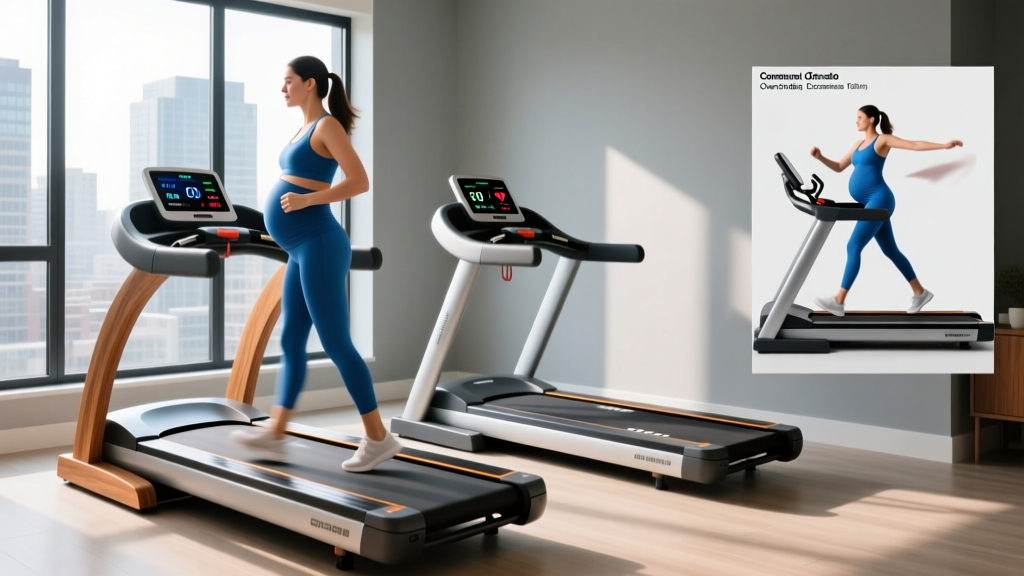
Troubleshooting Your Pregnancy Treadmill Workout: Curved vs Motorized Mistakes
Troubleshoot common form and machine-selection mistakes in your pregnancy treadmill workout. Compare curved manual vs motorized treadmills for prenatal safety.

The Biomechanical Shift: Why Your Pre-Pregnancy Stride Fails
Maintaining a consistent pregnancy treadmill workout is one of the most effective ways to manage gestational weight gain, improve cardiovascular endurance for labor, and reduce postpartum recovery time. However, as your body adapts to accommodate a growing fetus, your biomechanics fundamentally change. The hormone relaxin increases joint laxity by up to 30%, and your center of gravity shifts anteriorly by 2 to 3 inches by the third trimester.
When you step onto a treadmill, the machine's mechanics interact directly with these physiological shifts. A routine that felt effortless on a motorized treadmill in your first trimester can suddenly trigger Symphysis Pubis Dysfunction (SPD) or severe lumbar strain by week 24. In this troubleshooting guide, we dissect the most common mistakes pregnant women make when choosing between curved manual treadmills and traditional motorized models, providing actionable fixes to keep your prenatal cardio safe and effective.
⚠️ Medical Disclaimer: Always consult your OB-GYN or midwife before continuing or modifying your exercise routine. According to the American College of Obstetricians and Gynecologists (ACOG), while 150 minutes of moderate-intensity aerobic activity per week is recommended, individual contraindications like placenta previa or preeclampsia require immediate cessation of treadmill workouts.Mistake #1: Forcing a High-Incline Motorized Pace in the Second Trimester
Motorized treadmills, such as the popular Sole F80 ($999) or NordicTrack Commercial 1750 ($1,999), operate on a continuous loop belt driven by a rear motor. The defining characteristic of a motorized belt is that it pulls your foot backward, forcing your hip into extension.
The Failure Mode: Lumbar Compression and Anterior Pelvic Tilt
During pregnancy, the weight of the uterus pulls your pelvis into an anterior tilt, exacerbating the natural curve of your lower back (lordosis). When you increase the incline on a motorized treadmill to simulate hill climbing, the belt pulls your trailing leg back even further. This over-extends the hip flexors and compresses the lumbar spine. Many pregnant users report sharp lower back pain after just 10 minutes of incline walking, mistakenly blaming their core weakness rather than the machine's forced hip extension.
The Troubleshooting Fix
- Cap the Incline: Limit motorized treadmill inclines to a maximum of 4-5% during the second and third trimesters.
- Shorten Your Stride: Focus on a higher cadence (steps per minute) rather than a longer stride. A shorter stride reduces the degree of hip extension required when the belt pulls your foot back.
- Engage the Glutes: Actively squeeze your glutes upon foot strike to counteract the anterior pelvic tilt and stabilize the sacroiliac (SI) joint.
Mistake #2: Using a Curved Manual Treadmill Without Adjusting Posture
Curved, non-motorized treadmills like the AssaultRunner Pro ($3,299) or TrueForm Runner ($4,895) have surged in popularity due to their 30% higher caloric burn and self-paced speed control. Because there is no motor, the user must drive the slat belt backward using the ball of the foot and a slight forward lean.
The Failure Mode: The 'Counter-Lean' and Hamstring Overreach
To drive a curved treadmill effectively, you must lean forward from the ankles. However, the pregnant belly shifts your center of mass forward and down. To avoid feeling like you are falling over the front console, pregnant users instinctively lean backward (the counter-lean), hanging onto the side rails and reaching their legs out in front of them to push the heavy slat belt. This creates a massive braking force, overloading the hamstrings and placing dangerous shear stress on the pubic symphysis.
The Troubleshooting Fix
- Abandon the 'No-Hands' Rule: During pregnancy, it is entirely acceptable—and recommended—to maintain a light grip on the curved treadmill's front handles. This allows you to safely manage your shifted center of gravity without compromising your spinal alignment.
- Drive from the Hips, Not the Knees: Focus on pushing the belt down and back using your glutes and hamstrings, keeping your footstrike directly under your hips, not in front of them.
- Monitor the Slat Belt Resistance: Curved treadmills require more force to start the belt. If you experience pelvic floor heaviness or 'coning' in your abdomen when initiating the push, switch to a motorized treadmill for the duration of your pregnancy.
Curved vs. Motorized: Which is Safer for a Pregnancy Treadmill Workout?
Choosing the right machine depends heavily on your trimester and specific prenatal symptoms. Below is a diagnostic comparison matrix to help you decide which treadmill type best supports your current physiological state.
| Feature | Motorized Treadmill (e.g., Sole F80) | Curved Manual Treadmill (e.g., AssaultRunner Pro) | Pregnancy Verdict |
|---|---|---|---|
| Belt Mechanics | Pulls foot backward (assists hip extension) | Requires user to push backward (active hip drive) | Motorized is safer for women with pelvic girdle pain (PGP). |
| Speed Control | Set by console; requires manual adjustment | Self-paced; stops instantly when user stops | Curved is superior for preventing dizziness and allowing instant fatigue stops. |
| Fall Risk | Moderate; belt continues if user stumbles | Low; belt stops without forward momentum | Curved is significantly safer for third-trimester balance issues. |
| Energy Expenditure | Standard baseline | Up to 30% higher caloric burn | Motorized is better for keeping heart rate in the moderate ACOG-recommended zone without overexertion. |
Troubleshooting Common Pregnancy Treadmill Symptoms
If you are experiencing pain during or after your pregnancy treadmill workout, use this symptom-based troubleshooting guide to identify the mechanical error and adjust your machine settings accordingly.
Symptom: Sharp, Shooting Groin Pain (Round Ligament Pain)
The Cause: Over-striding on a motorized treadmill at speeds above 3.5 mph. The rapid deceleration of the leading leg stretches the round ligaments that support the uterus.
The Fix: Drop your speed to a brisk walk (2.5 - 3.0 mph). Increase your cadence to 110-120 steps per minute. Avoid sudden speed changes; use the console to ramp up speed in 0.1 mph increments over 30 seconds.
Symptom: Symphysis Pubis Dysfunction (SPD) / Pelvic Grinding
The Cause: Lateral sway and wide stances on a curved manual treadmill. The heavy slat belt requires significant unilateral force, causing the left and right pubic bones to shear against each other.
The Fix: Switch to a motorized treadmill immediately. Narrow your stance so your feet are directly under your hip bones (ASIS). Avoid lateral movements or side-shuffles on the treadmill deck.
Symptom: Dizziness or Lightheadedness Upon Stopping
The Cause: Venous pooling. During pregnancy, blood volume increases by up to 50%. Stopping abruptly on a manual treadmill, or hitting the emergency stop on a motorized one, causes blood to pool in the lower extremities, reducing cerebral perfusion.
The Fix: Implement a mandatory 3-to-5-minute active cooldown. Reduce your motorized treadmill speed by 0.5 mph every 60 seconds until you reach 1.5 mph. Never step off a moving belt.
Expert Insight: 'The outdated rule of keeping your heart rate under 140 BPM has been debunked. The Cleveland Clinic and ACOG now recommend using the Rate of Perceived Exertion (RPE) or the 'Talk Test.' If you cannot hold a conversation while on the treadmill, the intensity is too high for safe prenatal vascular adaptation.'
Advanced Machine Adjustments for the Third Trimester
As you enter weeks 28 through 40, your biomechanical limitations peak. The pelvic floor is under maximum load, and the diaphragm is compressed by the fundus of the uterus, reducing lung capacity. Here is how to optimize your treadmill environment for the final stretch:
- Console Height and Visual Focus: Looking down at a low console exacerbates cervical strain and restricts the airway. If using a motorized treadmill with a low-profile console (like the Peloton Tread), place a tablet riser at eye level to maintain a neutral cervical spine and open airway.
- Deck Cushioning: Joint laxity means your cartilage and ligaments are absorbing more impact. Prioritize treadmills with advanced elastomer cushioning systems (e.g., Sole's Cushion Flex or NordicTrack's Runners Flex) over rigid curved slat belts, which offer minimal vertical shock absorption.
- Incline for Reflux Management: Acid reflux is a common third-trimester complaint. Walking on a flat or declined surface can exacerbate gastric acid migration. Maintain a permanent 2% to 3% incline on your motorized treadmill to use gravity to keep stomach acid in place during your workout.
Final Thoughts: Listening to the Load
A successful pregnancy treadmill workout is not about maintaining your pre-pregnancy PRs; it is about managing the physiological load on your changing body. Curved manual treadmills offer excellent self-paced safety features but demand a forward lean and hip drive that can aggravate pelvic and lumbar pain. Motorized treadmills provide a predictable, cushioned surface but require strict discipline regarding stride length and incline limits to protect lax joints. By troubleshooting your form and selecting the right machine mechanics for your specific trimester symptoms, you can safely leverage treadmill cardio to build the stamina required for labor and beyond.
More gear to consider
All reviews
12 3 30 Treadmill Before and After: 2026 Under Desk Office Review
Rowing Machine Setup: No NordicTrack T 6.5 S Treadmill Manual Needed

Is It Bad to Hold Onto the Treadmill While Walking in Small Spaces?

Air Bike vs Assault Bike: Beyond Woodway Treadmills in LA Hotel Gyms

Escaping treadmill.murder: Stationary Bike Budget Breakdown
