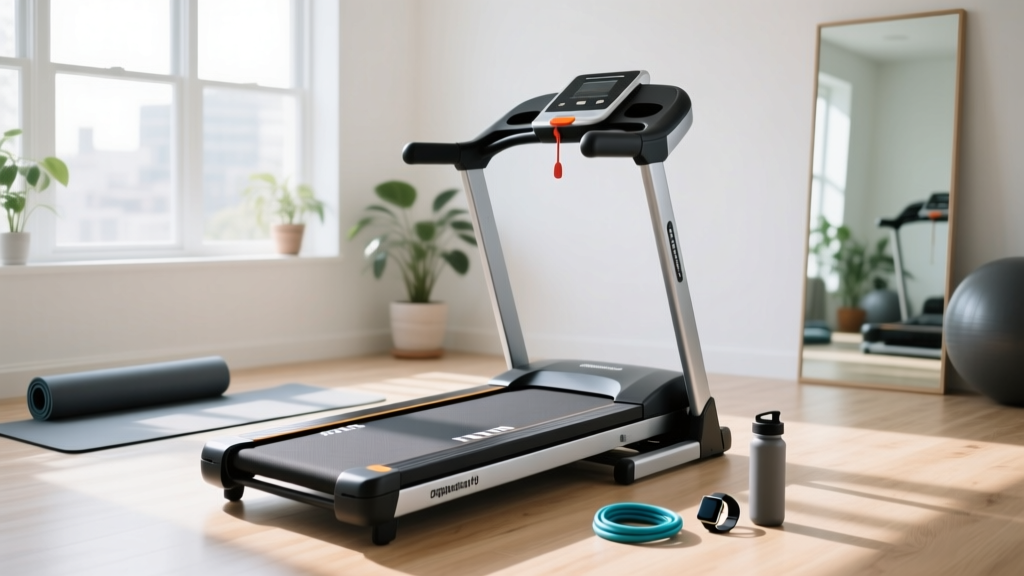
Maintaining Portable Cardio for a 10 Minute Mile on Treadmill
Learn essential maintenance tips for compact portable cardio equipment to safely sustain a 10 minute mile on treadmill without motor burnout or belt slip.

The Space-Saving Compromise: Pushing Compact Cardio to 6.0 MPH
The explosion of compact, foldable, and portable cardio equipment has revolutionized home fitness for apartment dwellers and minimalists. However, there is a distinct mechanical gap between a leisurely 3.0 mph walk and a moderate-intensity jog. Sustaining a 10 minute mile on treadmill equipment that folds into a closet requires a continuous pace of 6.0 mph. At this speed, the biomechanical forces and thermal loads on a portable machine increase exponentially compared to slower walking speeds.
According to the Mayo Clinic's guidelines on exercise intensity, a 10-minute mile elevates most users into a vigorous cardiovascular zone. While commercial gym treadmills are built with 4.0 CHP (Continuous Horsepower) motors and massive cooling systems to handle this daily, portable units typically rely on 1.5 to 2.5 CHP motors housed in restricted, low-clearance chassis. If you are using a compact treadmill to train for or maintain a 10-minute mile pace, rigorous, hyper-specific maintenance is not optional—it is the only way to prevent catastrophic motor burnout, belt delamination, and deck warping.
The 6.0 MPH Stress Test: Understanding Motor and Belt Physics
When you set your portable treadmill to 6.0 mph, the belt travels 176 yards per minute. Running mechanics experts at Runner's World note that a 6.0 mph pace requires a longer stride and greater ground reaction force than walking. On a compact treadmill with a shorter belt (typically 46 to 50 inches, compared to the standard 55 or 60 inches), your foot strikes the deck with higher frequency and localized impact.
This localized impact creates intense friction between the walking belt and the deck. Friction is the primary enemy of compact treadmill longevity. As friction increases, the motor must draw more amperage to maintain the 6.0 mph speed. If the amperage exceeds the motor controller's threshold, the machine will stutter, shut down, or permanently fry the PWM (Pulse Width Modulation) circuit board—a repair that often costs between $120 and $250, effectively totaling a budget portable unit.
⚠️ The Peak HP Trap: Never confuse 'Peak HP' with 'CHP' (Continuous Horsepower). A portable treadmill advertising a '3.0 Peak HP' motor may only sustain 1.5 CHP. At a 10-minute mile pace, a 1.5 CHP motor will overheat within 25 minutes if the belt is not perfectly lubricated.Advanced Belt Friction Mitigation for 6.0 MPH Runners
Standard manufacturer manuals recommend lubricating your treadmill belt every 90 days or 150 miles. If you are running at 6.0 mph on a compact deck, you must cut this interval in half. The higher rotational speed and increased foot-strike force degrade the lubricant layer much faster.
The 40-Hour Silicone Protocol
- Lubricant Type: Use only 100% silicone treadmill lubricant (brands like Spot On or Impresa). Never use WD-40, lithium grease, or petroleum-based oils, which will instantly melt the PVC backing of the walking belt.
- Application Frequency: Every 40 hours of use at speeds above 5.0 mph.
- Application Method: Loosen the belt, lift the edge, and apply exactly 15ml (one standard bottle) of silicone in a zig-zag pattern from the center to the edges. Run the machine at 2.0 mph for 5 minutes to distribute the fluid evenly.
The Quarter-Turn Tension Rule
Belt slip is common when attempting a 10 minute mile on treadmill units with smaller rear rollers. If the belt hesitates when your foot strikes, the tension is too loose. However, over-tightening will destroy the motor bearings. Use an Allen wrench to turn the rear roller adjustment bolts exactly one quarter-turn clockwise on each side. Test the belt at 6.0 mph. You should be able to lift the edge of the belt exactly 2 to 3 inches off the deck at the midpoint. Any tighter, and you risk stripping the drive belt.
Thermal Management in Foldable Chassis
Compact treadmills lack the cavernous motor hoods of full-size machines. The electronics and motor are packed tightly, often directly beneath the deck where heat radiates upward. When running at 6.0 mph, the motor generates significant thermal output.
- Elevate the Airflow: Never place a portable treadmill directly on thick carpet. The carpet fibers block the underside intake vents and trap heat. Always use a high-density PVC equipment mat (at least 3/16-inch thick) to create a flat, heat-dissipating barrier.
- Monthly Hood Vacuuming: Dust acts as an insulator on the motor windings and the PWM board. Every 30 days, unplug the machine, remove the 4 to 6 screws securing the front motor hood, and use a vacuum with a brush attachment to clear dust from the motor fins and the drive belt teeth.
- The 45-Minute Cool Down: If your training requires more than 45 minutes of continuous 6.0 mph running, stop and let the machine cool for 15 minutes. Most sub-$800 portable treadmills do not have active thermal shutdown protection; the motor will simply melt its internal wiring.
Compact Treadmill Viability Matrix
Not all portable cardio equipment is engineered to handle the sustained load of a 10-minute mile. Below is a breakdown of popular compact models, their true continuous horsepower, and their maintenance viability for 6.0 mph runners.
| Model | Motor (CHP) | Belt Size | 6.0 MPH Viability & Maintenance Focus | Approx. Price |
|---|---|---|---|---|
| Horizon T101 | 2.5 CHP | 20' x 55' | High. Excellent for 10-min miles. Focus on deck waxing every 60 days. | $699 |
| ProForm City L6 | 1.6 CHP | 18' x 46' | Borderline. Requires strict 30-day lube cycles; monitor motor heat closely. | $599 |
| WalkingPad R2 | 1.25 HP (Peak) | 17.3' x 47' | Low. Not recommended for sustained 6.0 mph; high risk of PWM failure. | $499 |
| Sunny Health SF-T723016 | 1.5 CHP | 20' x 48' | Moderate. Drive belt tension requires monthly checks at 6.0 mph. | $349 |
For a comprehensive look at how motor sizing affects longevity, Consumer Reports' treadmill buying guide heavily emphasizes matching the machine's continuous horsepower to the user's weight and intended speed, noting that underpowered motors are the number one cause of premature treadmill failure.
Deck Strike Zones and Footwear Impact
On a 55-inch commercial belt, your foot strikes slightly different areas of the deck as you naturally drift forward and backward. On a 46-inch portable belt, you are locked into a tight 'strike zone.' This concentrated impact can cause the phenolic resin coating on the underside of the deck to wear through to the bare MDF (Medium-Density Fiberboard) wood in as little as six months.
Proactive Deck Care: Every 90 days, remove the walking belt and inspect the deck. If you see a smooth, shiny trench worn into the center, the deck is failing. If the wood is exposed, the friction will skyrocket, and the deck must be replaced (typically a $60-$90 part). Furthermore, avoid running in heavily lugged trail shoes on a portable treadmill; the aggressive rubber tread grips the belt texture and accelerates the delamination of the belt's top layer.
Troubleshooting Mid-Run Stutters at 6.0 MPH
If your compact treadmill hesitates or 'stutters' precisely when your foot lands during a 10-minute mile pace, follow this diagnostic flow:
- Check the Walking Belt First: Stand on the side rails. Start the machine at 3.0 mph. If the belt moves smoothly but stutters when you step on, the walking belt is either too dry (needs silicone) or too tight (needs a quarter-turn counter-clockwise on the rear bolts).
- Inspect the Drive Belt: If the motor spins smoothly but the front roller hesitates, the internal drive belt (connecting the motor to the roller) is glazed or loose. Unplug the machine, remove the motor hood, and check the drive belt for rubber dust. Replace the drive belt if it shows cracking (a $15 part).
- Test the Speed Sensor: If the machine stutters and the console display fluctuates (e.g., jumping from 6.0 to 5.4 mph), the optical speed sensor near the motor flywheel is likely clogged with dust or misaligned. Wipe the sensor eye with a microfiber cloth and ensure it sits exactly 1/8-inch from the flywheel target.
Achieving and maintaining a 10 minute mile on treadmill equipment designed for small spaces is entirely possible, provided you respect the mechanical limitations of the machine. By adhering to an accelerated lubrication schedule, managing thermal buildup, and monitoring deck wear, you can extend the lifespan of your portable cardio gear from a single season to several years of reliable, high-intensity training.
More gear to consider
All reviews
Spirit XT485 Treadmill vs Sole F85: 2026 Heavy-Duty Comparison

Elliptical vs Treadmill: The 2026 Arch Treadmill Market Shift

7 Minute Mile on Treadmill: Belt Maintenance and Lubrication Guide

Nordic Track 2450 Treadmill vs Under Desk Office Pads: 2026 Review

Rowing Machine Setup & Technique: Smarter Than a bdsm treadmill?
