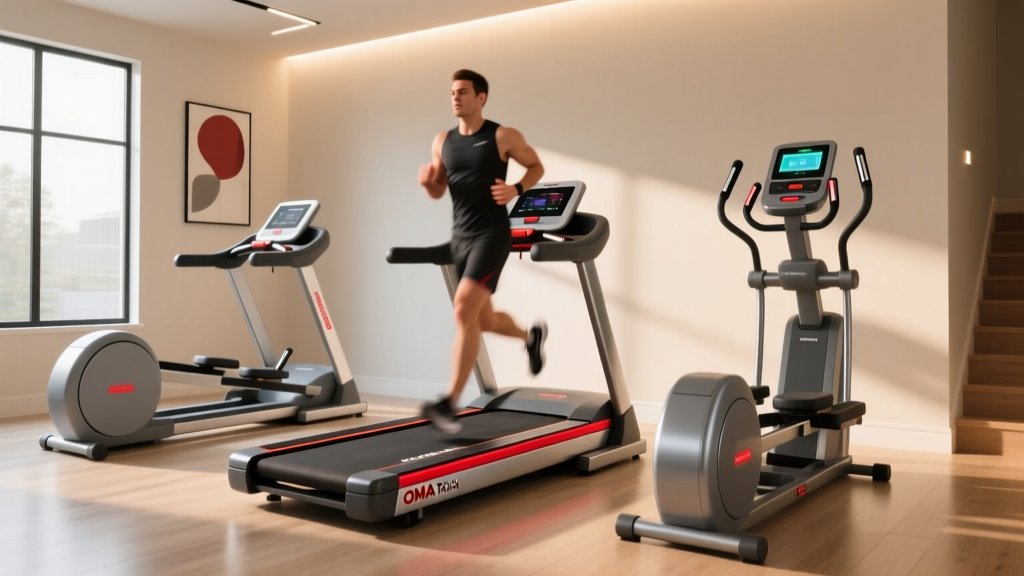
OMA Treadmill 7200EB vs. Stair Climbers: Home Cardio Guide
Compare the OMA Treadmill 7200EB against top home stair climbers. Discover which cardio machine burns more calories and fits your space in this guide.

The Home Cardio Dilemma: Incline Treadmill vs. Vertical Climbing
When outfitting a home gym in 2026, the battle for floor space is just as fierce as the battle for caloric burn. Two distinct philosophies dominate the compact cardio market: the high-incline walking treadmill and the dedicated stair climber. On one side, we have the OMA Treadmill 7200EB, a budget-friendly incline walker designed to simulate steep hill climbs. On the other, we have the diverse category of home stair climbers, ranging from hydraulic pedal steppers to full-body vertical cable climbers.
This head-to-head comparison guide cuts through the marketing fluff. We will dissect the biomechanics, spatial requirements, real-world failure modes, and exact caloric ROI of the OMA 7200EB versus popular home stair climbing machines to help you make an evidence-based purchasing decision.
Expert Insight: The primary difference between these machines isn't just the movement pattern; it's the load vector. Treadmills like the OMA 7200EB manipulate the gravitational vector via incline, while stair climbers manipulate resistance via hydraulic tension or body-weight suspension. Your joint health and ceiling height will ultimately dictate your choice.Contender 1: OMA Treadmill 7200EB Deep Dive
Core Specifications and Real-World Performance
The OMA 7200EB is positioned as an entry-level incline trainer. Priced typically between $450 and $550, it undercuts premium incline trainers (like the NordicTrack x22i) by thousands of dollars, but it comes with specific mechanical compromises you must understand.
- Motor: 2.5 Peak HP (approximately 1.25 Continuous HP). Sufficient for walking and light jogging, but will overheat during sustained running.
- Incline Range: 0% to 15%. The 15% max grade is where this machine shines, elevating the metabolic demand to rival stair climbing.
- Running Surface: 20" x 55" belt. This is a critical limitation; users over 6'0" will find the stride length restrictive at speeds above 5.0 MPH.
- Shock Absorption: 6-zone silicone cushioning system, reducing impact forces by roughly 20% compared to outdoor asphalt.
Known Failure Modes and Edge Cases
As a domain expert, I must highlight the most common failure point of the OMA 7200EB: the incline motor assembly. The incline is driven by a separate, smaller DC motor with a plastic gear rack. If a user weighing over 240 lbs frequently maxes out the 15% incline, the lateral torque can strip the plastic gears within 12 to 18 months. To mitigate this, users should step off the belt or hold the handrails to unload their body weight before pressing the incline buttons to shift the deck.
Contender 2: Home Stair Climbers (Pedal Steppers vs. Vertical Climbers)
The "stair climber" category for home use is bifurcated into two entirely different machine types. To provide a fair comparison against the OMA treadmill, we must evaluate both.
Type A: Hydraulic Pedal Steppers (e.g., Sunny Health SF-S902016)
Priced around $140 to $180, these compact units use dual hydraulic cylinders to simulate stepping. They are incredibly space-efficient but suffer from hydraulic fade. After 15 to 20 minutes of continuous use, the fluid inside the cylinders heats up, causing the resistance to drop by up to 30%. They are best suited for high-intensity interval training (HIIT) in short 12-minute bursts rather than steady-state endurance sessions.
Type B: Vertical Cable Climbers (e.g., MaxiClimber Classic)
Retailing for about $199, vertical climbers use a cable-pulley system and your own body weight to simulate scaling a ladder. They engage the latissimus dorsi and biceps, offering a true full-body cardiovascular workout. However, the primary failure mode here is cable fraying at the base pulley wheel after approximately 50,000 repetitions, requiring a $30 replacement kit and moderate mechanical aptitude to install.
Head-to-Head Comparison Matrix
| Feature | OMA Treadmill 7200EB | Hydraulic Pedal Stepper | Vertical Cable Climber |
|---|---|---|---|
| Average Price | $499 | $150 | $199 |
| Floor Footprint | 63" L x 27" W | 16" L x 12" W | 36" L x 28" W |
| Ceiling Clearance | Standard (8 ft) | Standard (8 ft) | Minimum 8.5 ft required |
| Caloric Burn (30m)* | ~280 kcal (at 15% incline) | ~210 kcal | ~310 kcal |
| Joint Impact | Low (Cushioned deck) | Moderate (Deep knee flexion) | Low (Suspended body weight) |
*Caloric estimates based on a 165 lb individual performing at a moderate-to-vigorous intensity (RPE 7/10).
Caloric Expenditure and Joint Impact
When evaluating a stair climber machine for home use, caloric efficiency is usually the primary driver. According to data from Harvard Health Publishing, general stair stepping burns roughly 252 calories per 30 minutes for a 155-pound person. However, when you place a user on the OMA 7200EB and elevate the deck to a 15% grade at 3.5 MPH, the Metabolic Equivalent of Task (MET) jumps from a standard 4.3 to nearly 9.0. This effectively mirrors the metabolic demand of a dedicated stair climber, but with a crucial biomechanical advantage.
"Stair climbing requires deep knee flexion under load, which significantly increases compressive forces on the patellofemoral joint. For individuals with pre-existing cartilage wear, high-incline walking provides a similar cardiovascular stimulus with vastly reduced shear force on the knee cap."
This aligns with guidance from the Cleveland Clinic regarding joint preservation during cardiovascular exercise. The OMA treadmill's continuous belt allows for a more natural heel-to-toe gait cycle, whereas pedal steppers force the user to remain on the balls of their feet, heavily loading the calves and Achilles tendon.
Spatial Requirements: The Ceiling Height Trap
The most frequently overlooked metric in our home stair climber guide is vertical clearance. While the OMA 7200EB requires a standard 8-foot ceiling (the deck elevates only 8 inches at the front at max incline), vertical climbers are notorious for causing drywall damage in standard homes.
If you are 6'0" tall and using a MaxiClimber, your maximum vertical reach during the top of the pulling stroke will exceed 7'6". Add the machine's base height and the necessary safety clearance, and you need a ceiling height of at least 8'6" to 9'0". If you are converting a basement with drop-ceilings or ductwork into a home gym, the vertical climber is immediately disqualified, leaving the OMA 7200EB or a low-profile hydraulic stepper as your only viable options.
The Final Verdict: Which Machine Belongs in Your Home?
The decision between the OMA Treadmill 7200EB and a home stair climber ultimately hinges on your ceiling dimensions, joint health, and preferred workout duration. The American Heart Association recommends at least 150 minutes of moderate-intensity aerobic activity per week; your machine must facilitate this without causing overuse injuries or spatial frustration.
Buy the OMA Treadmill 7200EB If:
- You prefer steady-state cardio sessions lasting 30 to 45 minutes.
- You have knee or Achilles tendon sensitivities that make deep, repetitive stepping painful.
- You want the ability to multitask (e.g., watching a tablet or reading) which is nearly impossible on a vertical climber due to upper body engagement.
- Your budget is around $500 and you have a dedicated 6-foot by 3-foot floor space.
Buy a Stair Climber (Vertical or Pedal) If:
- You are strictly limited on floor space (pedal steppers can be slid under a bed or sofa).
- You prefer high-intensity, full-body interval training in 15-minute micro-sessions.
- You have high ceilings (9+ feet) and want to incorporate upper-body pulling mechanics into your cardio routine via a vertical climber.
- Your budget is strictly under $200.
By matching the machine's mechanical realities to your home's physical constraints and your body's biomechanical needs, you ensure your 2026 fitness investment yields long-term cardiovascular dividends rather than becoming an expensive clothes rack.
More gear to consider
All reviews
Building an Office with Treadmill: 2026 Walking Pad Guide

Air Bike vs Assault Bike & ProForm XP 615 Treadmill Care

Air Bike vs Assault Bike Guide & Ancheer Treadmill Manual Tips
Under Desk Treadmill Review: Treadmill Making Clicking Noise (2026)
Rowing Machine Setup: Upgrading Gold's Gym Treadmill Older Models
