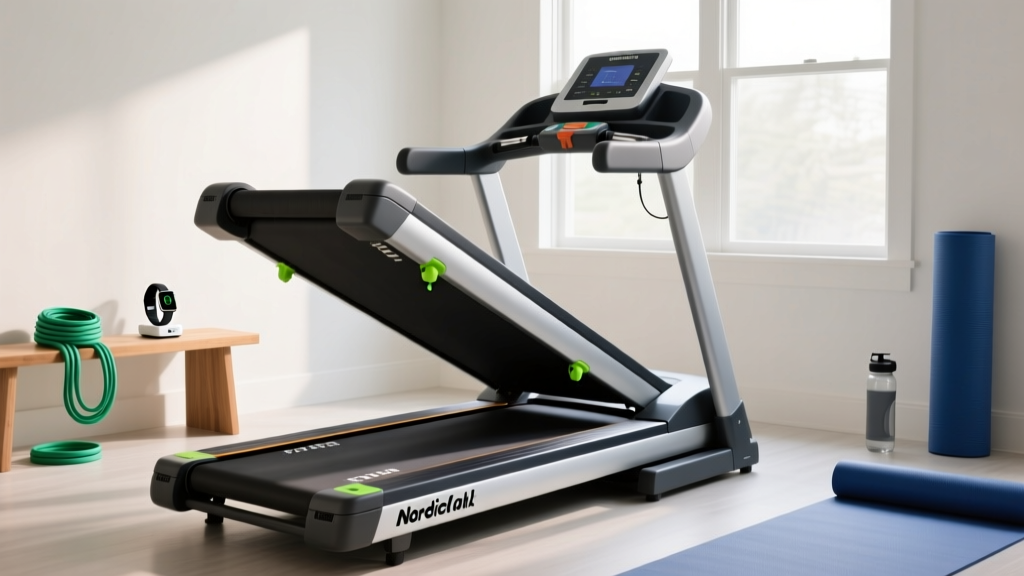
NordicTrack Treadmill T6.3 Belt Maintenance & 2026 Market Trends
Analyze 2026 market trends in treadmill maintenance with our NordicTrack Treadmill T6.3 belt lubrication guide, featuring DIY costs and failure modes.

The 2026 Secondary Market and Maintenance Economy
As we navigate the home fitness equipment landscape in 2026, macroeconomic factors and a growing emphasis on sustainability have fundamentally shifted consumer behavior. Rather than discarding legacy cardio machines, a significant portion of the market is pivoting toward rigorous maintenance and restoration. According to industry data tracked by the International Health, Racquet & Sportsclub Association (IHRSA), the secondary market for home fitness equipment has seen a sustained year-over-year growth, driven by inflation and the rising cost of premium smart-treadmill subscriptions.
Within this circular economy, entry-level and mid-tier legacy models have become highly sought after. The NordicTrack Treadmill T6.3, a staple of the early-to-mid 2010s budget fitness market, remains heavily circulated on platforms like Facebook Marketplace and Craigslist. However, acquiring a used T6.3 for $200 to $350 is only the first step. The true cost of ownership lies in the drive system's upkeep. In 2026, professional treadmill servicing averages $145 just for a diagnostic trip fee, making DIY treadmill belt maintenance and lubrication not just a hobbyist pursuit, but an economic necessity for legacy machine owners.
Anatomy of the NordicTrack Treadmill T6.3 Drive System
To properly maintain this specific model, one must understand its mechanical limitations and design parameters. The T6.3 is built around a 1.25 Continuous Horsepower (CHP) motor. While adequate for walking and light jogging, a 1.25 CHP motor operates with very little torque redundancy. This makes the system hyper-sensitive to belt friction.
Critical Specifications for Maintenance
- Belt Dimensions: 18 inches by 55 inches (Compact footprint requires precise tracking)
- Deck Material: Medium-Density Fiberboard (MDF) with a phenolic resin wear coating
- Motor Rating: 1.25 CHP (Peak output roughly 2.5 HP)
- Normal Amp Draw: 2.0 to 4.5 Amps (Walking to light jogging)
- Danger Zone Amp Draw: 10.0+ Amps (Indicates severe belt-to-deck friction)
When the walking belt dries out, the coefficient of friction between the polyester belt backing and the phenolic deck spikes. The motor must draw excess amperage to maintain the pulse-width modulation (PWM) signal required to keep the belt moving at the user's selected speed. This excess heat and electrical load are the primary culprits behind Motor Control Board (MCB) failures in the T6.3 lineage.
Step-by-Step T6.3 Belt Lubrication Protocol
Consumer testing standards from organizations like Consumer Reports consistently emphasize that using the wrong lubricant is worse than using no lubricant at all. You must use a 100% silicone-based liquid treadmill lubricant. Never use WD-40, petroleum distillates, or silicone sprays containing propellants, as these will dissolve the phenolic deck coating and destroy the belt backing.
- Preparation and Safety: Unplug the treadmill from the wall outlet. Remove the safety key from the console to prevent accidental startup.
- Loosen the Rear Roller: Using a 3/16-inch Allen wrench, turn the left and right rear roller adjustment bolts counter-clockwise. Count the exact number of turns (usually 3 to 5 full rotations) so you can return them to their exact original tension later.
- Lift and Apply: Reach under the center of the walking belt and lift it as high as comfortably possible. Squeeze exactly 0.5 ounces (half of a standard 1oz application tube) of 100% silicone liquid onto the deck in a zig-zag pattern. Repeat on the opposite side with the remaining 0.5 ounces.
- Restore Tension: Tighten the rear roller bolts clockwise, matching the exact number of turns you counted in Step 2. This ensures the belt tracking remains centered.
- Distribution Cycle: Plug the machine back in, insert the safety key, and run the treadmill at 2.0 MPH for three minutes. Walk lightly on the edges of the belt to help press the silicone evenly across the entire 18-inch width of the deck.
Expert Warning: The MCB Failure Cascade
If your T6.3 belt has been running dry for months, the deck may already have microscopic burn spots. Lubrication will reduce surface friction, but it cannot reverse heat damage to the MDF core. If the motor still hesitates or the console resets after a fresh lubrication, the PWM feedback loop on the Motor Control Board has likely been compromised by prolonged amp spikes.
2026 Cost-Benefit Analysis: DIY vs. Professional Servicing
When analyzing the total cost of ownership for legacy cardio equipment, the financial disparity between proactive DIY care and reactive professional repair is staggering. Below is a market analysis of T6.3 maintenance costs based on 2026 service rates and aftermarket part pricing.
| Maintenance Approach | 2026 Average Cost | Frequency | ROI and Risk Factor |
|---|---|---|---|
| DIY Silicone Lubrication | $12 - $18 | Every 150 miles / 6 months | Highest ROI; preserves deck life and prevents motor strain. |
| Professional Belt Tracking | $145 - $195 | As needed (if belt slips) | Low ROI for legacy models; trip fees negate machine value. |
| Belt and Deck Replacement | $280 - $350 | Every 3 to 5 years | Exceeds the secondary market value of the T6.3 itself. |
| Motor Control Board Repair | $220 - $275 | Upon failure (dry belt) | Catastrophic failure; often results in the machine being scrapped. |
As the table illustrates, a $15 bottle of silicone lubricant is the single most effective financial hedge against a $300 mechanical failure. In the 2026 repair economy, technicians frequently advise clients to replace the entire machine rather than pay for a belt and deck installation on a 1.25 CHP model, making DIY maintenance the only viable path to longevity.
Material Trends: Silicone vs. Wax-Impregnated Belts
A common point of confusion in the secondary market is the difference between standard belts requiring liquid silicone and modern wax-impregnated belts. Some newer premium treadmills feature belts with a dry wax coating baked into the polyester weave, designed to transfer wax to the deck via friction heat.
However, the NordicTrack Treadmill T6.3 was manufactured with a standard, non-impregnated polyester belt paired with a phenolic-coated MDF deck. Attempting to upgrade a T6.3 with an aftermarket 'maintenance-free' wax belt often yields poor results. The T6.3's lower-torque motor and specific deck resin formula are optimized for liquid silicone. Introducing a dry wax belt can actually increase the initial break-in friction, causing the motor to overheat before the wax transfers adequately. For this specific legacy model, traditional 100% liquid silicone remains the undisputed gold standard for deck preservation.
Troubleshooting Common T6.3 Belt Failure Modes
Even with rigorous lubrication, age and environmental factors can degrade the walking belt. Familiarize yourself with these edge cases to diagnose issues before they cascade into motor failure:
- Edge Curling and Delamination: If the edges of the 18-inch belt begin to curl upward, the structural integrity of the woven polyester layers is failing. This is often caused by prolonged exposure to direct UV light or high-humidity environments (like an unclimate-controlled garage). Curling edges will eventually catch on the side rails, posing a severe trip hazard. Replacement is mandatory.
- Static Shock Buildup: If you experience sharp static shocks when touching the console handrails, the belt is likely dry, or the grounding wire connected to the motor hood has vibrated loose. A properly lubricated silicone belt acts as a mild antistatic barrier. If lubrication does not resolve the shock, check the copper grounding strap beneath the motor hood.
- PWM Stutter (Hesitation): If the belt stutters specifically when your foot strikes the deck, but runs smoothly while empty, the belt tension is too loose, or the drive belt connecting the motor to the front roller is stretched. Check the walking belt tension first: you should be able to lift the center of the belt exactly 2 to 3 inches off the deck. If it lifts higher, tighten the rear roller bolts by a quarter-turn each.
Sourcing Authentic Replacement Parts and Lubricants
When sourcing maintenance supplies for the T6.3 in 2026, avoid generic 'universal' replacement belts sold on unverified third-party marketplaces. The 18x55 inch dimension is common, but the front roller seam diameter and belt thickness vary by manufacturer. A belt that is even 2 millimeters too thick will force the T6.3's front roller to sit higher, altering the deck-to-hood clearance and causing the plastic motor shroud to crack under user weight.
For lubricants, seek out 100% pure silicone fluid with a viscosity rating between 100 and 300 centistokes (cSt). Brands like Spot On, Godora, or the official NordicTrack 3-pack offer the correct viscosity to ensure the fluid spreads evenly beneath the belt without pooling at the edges or evaporating prematurely. By adhering to these precise material specifications and maintenance intervals, owners can easily extend the operational lifespan of a secondary-market T6.3 well into the late 2020s, maximizing their return on investment in an increasingly expensive fitness economy.
More gear to consider
All reviews
Manual Treadmill vs Electric Treadmill or Stationary Bikes?
Sunny Health & Fitness SF-T4400 Treadmill vs Under Desk Treadmills

John Terry Treadmill Workout: Motor Size & Power Guide

Mythbusters Airplane Treadmill Myth vs. Folding Treadmill Value

Fastest Treadmill Speed for Office Use: 2026 Under Desk Trend Report