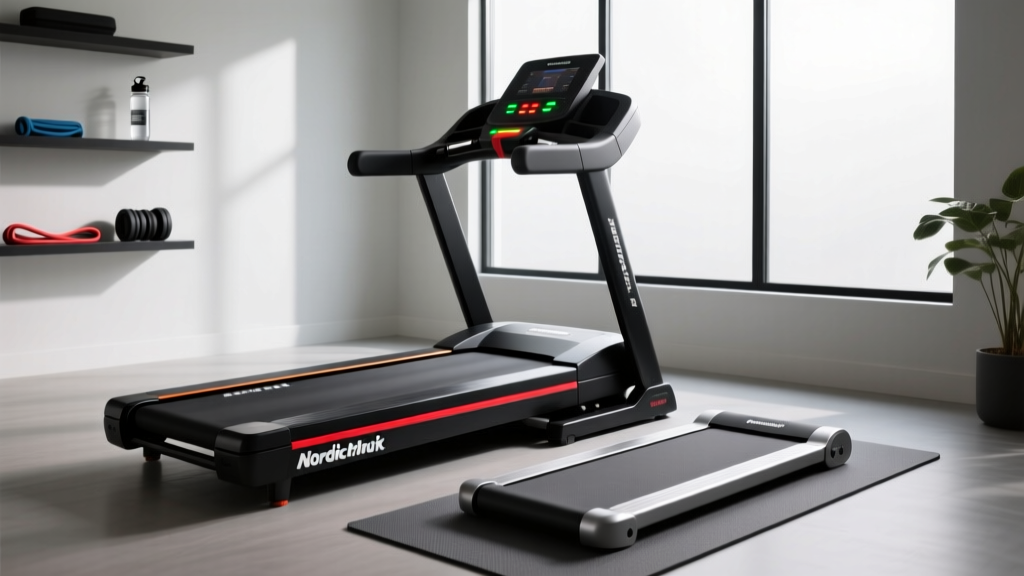
NordicTrack T 9.5 S Treadmill vs Walking Pads: 2026 Review
Compare the NordicTrack T 9.5 S treadmill against premium walking pads. We analyze motor specs, stride biomechanics, and 2026 pricing to help you choose.

The Core Dilemma: Dedicated Cardio vs. Passive NEAT
The home fitness landscape in 2026 has bifurcated into two distinct camps: dedicated, high-intensity cardio stations and passive, lifestyle-integration tools. If you are currently evaluating your options, you have likely found yourself caught in a cross-category debate. On one side sits a traditional, folding full-size machine like the NordicTrack T 9.5 S treadmill. On the other side are ultra-compact, foldable walking pads designed to slide under a standing desk or bed.
This is not just a comparison of sizes; it is a fundamental choice between structured cardiovascular training and Non-Exercise Activity Thermogenesis (NEAT). While a walking pad excels at adding low-impact, continuous movement to your workday, the NordicTrack T 9.5 S is engineered for dedicated running, incline training, and structured iFIT programming. In this comprehensive head-to-head review, we will dissect the motor thermodynamics, belt biomechanics, spatial economics, and hidden software costs of both categories to help you make an evidence-based decision for your home gym.
Head-to-Head Specification Matrix
Before diving into the biomechanics, it is crucial to understand the raw hardware differences. Below is a direct comparison between the NordicTrack T 9.5 S and a leading premium walking pad (representative of the KingSmith WalkingPad R2 / UREVO Strol 2E class).
| Feature | NordicTrack T 9.5 S Treadmill | Premium Walking Pad (R2 Class) |
|---|---|---|
| Motor Type | 3.0 CHP Mach Z Commercial | 2.5 HP Peak (approx. 1.25 CHP) |
| Tread Belt Dimensions | 20' x 55' | 17.3' x 47.2' |
| Speed Range | 0 - 10 MPH | 0.3 - 7.6 MPH |
| Incline Capability | 0% - 12% Auto Incline | 0% (Fixed Flat) |
| Weight Capacity | 300 lbs | 240 - 264 lbs |
| Unit Weight | 140 lbs | 62 lbs |
| Typical 2026 Pricing | $699 + $39/mo iFIT Subscription | $499 (No subscription required) |
Motor Thermodynamics and Belt Physics
The most critical differentiator between a full-size treadmill and a walking pad lies in motor engineering and belt surface area. The NordicTrack T 9.5 S treadmill utilizes a 3.0 Continuous Horsepower (CHP) Mach Z motor. 'Continuous' is the operative word here; it means the motor can sustain a 3.0 HP output indefinitely without overheating, making it perfectly suited for 60-minute tempo runs or heavy interval training. Conversely, walking pads typically advertise 'Peak' horsepower (e.g., 2.5 HP). Peak HP is the maximum output the motor can hit for a few seconds before drawing too much amperage and tripping its thermal shutoff. If you attempt to jog at 6 MPH on a walking pad for 45 minutes, the motor housing will retain heat, drastically reducing the lifespan of the internal electronics.
Furthermore, belt length dictates your natural gait cycle. A 55-inch belt on the NordicTrack allows for a full, uninhibited stride. According to biomechanical standards, an average adult male running at 6 MPH requires a stride length of roughly 45 to 50 inches. The 47-inch belt on a standard walking pad forces a 12% to 15% shorter stride. This unnatural truncation forces the user to alter their foot strike, often leading to a choppy, heel-heavy gait that transfers excess kinetic energy up the kinetic chain into the knees and lower back.
Expert Insight: Never judge a cardio machine solely by its top speed. A walking pad might technically reach 7.6 MPH, but the 47-inch belt length makes sustaining that speed biomechanically unsafe for anyone over 5'6'. The NordicTrack's 55-inch belt is the minimum threshold for safe, continuous running.
Spatial Economics and the Under-Desk Factor
Where the walking pad absolutely dominates is spatial efficiency. The NordicTrack T 9.5 S features an EasyLift folding mechanism, but when folded, it still commands a footprint of roughly 32' x 36' and stands nearly 60 inches tall. It requires a dedicated corner of a room. A premium walking pad, however, features a 180-degree hinge that allows it to fold down to a mere 10-inch profile, sliding effortlessly under a bed or sofa.
This spatial advantage directly enables NEAT (Non-Exercise Activity Thermogenesis). According to foundational research published in the National Institutes of Health regarding NEAT, the energy expended in daily, non-sleeping, non-exercise activities can account for up to 15-30% of a person's total daily energy expenditure. Walking pads are purpose-built to hack this metric. By placing the pad under a standing desk, users can accumulate 10,000 to 15,000 steps a day while answering emails, fundamentally altering their metabolic baseline without requiring a dedicated 'workout' window. The NordicTrack is a destination; the walking pad is an environmental modifier.
The Hidden Software Tax: iFIT vs. Standalone Simplicity
When budgeting for the NordicTrack T 9.5 S, consumers must look beyond the $699 hardware price tag. NordicTrack's business model heavily subsidizes the hardware cost through mandatory software lock-in. To unlock manual speed and incline controls on the console, as well as access the 5-inch LCD screen's interactive global routes and trainer-led classes, you must subscribe to iFIT, which costs $39 per month in 2026. If you opt out of the subscription, the machine functions as a highly restricted, manual-only treadmill with a very limited top speed.
Walking pads operate on a standalone philosophy. They utilize simple infrared remotes or basic Bluetooth apps to track steps and adjust speed. There are no monthly fees, no paywalled incline features, and no mandatory Wi-Fi connections required to start your morning walk.
Deck Cushioning and Joint Biomechanics
Impact attenuation is a vital consideration for long-term joint health. The American Heart Association emphasizes the importance of consistent, moderate-intensity aerobic activity for cardiovascular health, as noted in their physical activity recommendations for adults. However, consistency is only possible if the activity is pain-free.
The NordicTrack T 9.5 S utilizes a FlexSelect deck cushioning system. This system incorporates elastomer shock absorbers beneath the running board, reducing joint impact by up to 30% compared to running on asphalt. You can even adjust the stiffness of the deck to mimic outdoor road running. Walking pads, due to their ultra-slim profiles, lack the physical depth required to house meaningful shock absorption. The deck is typically a rigid MDF board sitting mere millimeters above the floor. While fine for low-speed walking (under 3.5 MPH), jogging on a rigid walking pad deck generates repetitive stress that can exacerbate shin splints and plantar fasciitis over time.
Final Verdict: Choosing Your 2026 Cardio Strategy
The choice between these two machines is not about which is objectively 'better,' but rather which aligns with your primary physiological and spatial goals.
- Buy the NordicTrack T 9.5 S Treadmill if: Your goal is structured cardiovascular conditioning, weight loss through high-calorie-burn interval training, or marathon preparation. You have a dedicated workout space, a budget that accommodates the $39/month iFIT subscription, and you require a 12% incline to simulate outdoor hill training.
- Buy a Premium Walking Pad if: Your goal is to increase daily step counts, combat the sedentary nature of a desk job, and improve NEAT. You live in a small apartment, lack a dedicated gym room, want a zero-subscription device, and have no intention of running at speeds above 5 MPH.
Frequently Asked Questions
Can I run on a walking pad?
While some walking pads advertise top speeds of 7.6 MPH, we strongly advise against running on them. The lack of handrails at high speeds, combined with a short 47-inch belt and rigid deck, creates a high-risk environment for missteps and joint strain. Reserve running for full-size machines like the NordicTrack.
Does the NordicTrack T 9.5 S treadmill work without Wi-Fi?
Yes, but in a highly restricted capacity. Without an active iFIT subscription and Wi-Fi connection, the machine defaults to a basic manual mode. You will lose access to auto-incline adjustments, global routes, and on-demand classes. The 5-inch screen will only display basic telemetry (time, speed, distance, calories).
How much maintenance does a walking pad require compared to a standard treadmill?
Walking pads actually require more frequent belt lubrication. Because the motor is smaller and works harder relative to its size, friction builds up faster. You should apply 100% silicone treadmill lubricant to a walking pad belt every 30 to 40 miles, whereas the NordicTrack T 9.5 S typically requires lubrication only every 150 to 200 miles.
More gear to consider
All reviews
Peloton Treadmill vs NordicTrack: Noise Level Showdown
Rowing Machine vs ProForm Trainer 8.7 Treadmill: 2026 Guide
How Long Should You Run on a Treadmill? Beginner Buying Guide

Treadmill Motor Size & Horsepower Guide: Home Units to the Lode Valiant 2 Rehab XXL Treadmill

Cross Trainer vs Treadmill: Why Rowing Machines Win (2026 Guide)
