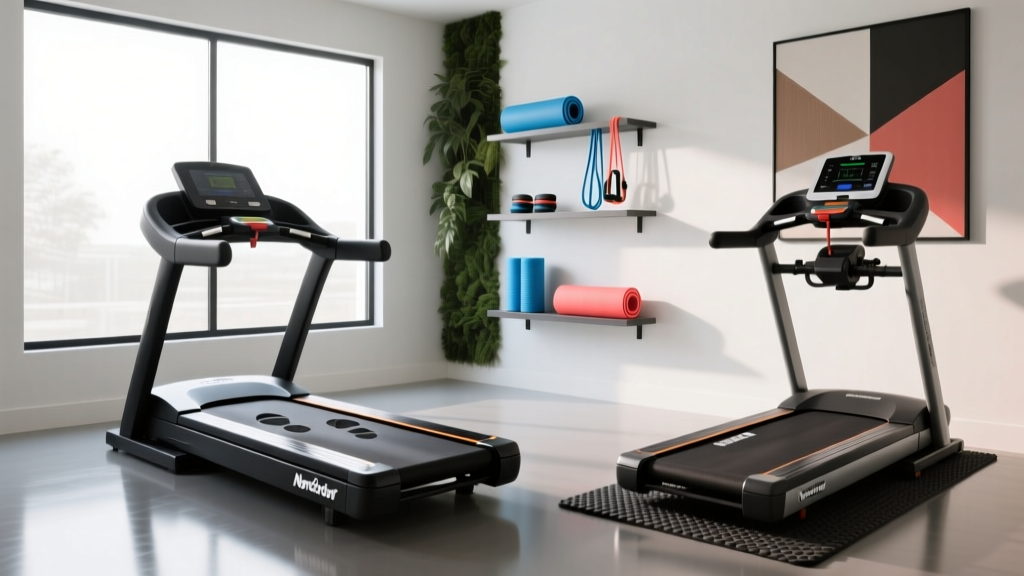
NordicTrack Treadmill Belt Tension vs. Walking Pads: 2026 Review
Comparing 2026 walking pads to full-size decks. We analyze nordictrack treadmill belt tension, motor strain at low speeds, and long-term durability.

The Engineering Divide: Full-Size Decks vs. Folding Pads
The home cardio landscape in 2026 is sharply divided between traditional full-size treadmills and ultra-compact under-desk walking pads. While marketing materials focus heavily on top speed and screen real estate, the true determinant of a machine's lifespan and walking comfort lies beneath the surface: the belt and deck mechanics. Specifically, understanding nordictrack treadmill belt tension and how it contrasts with the fixed-tension continuous loops of walking pads is critical for buyers deciding between a dedicated walking station and a versatile running deck.
Full-size machines like the NordicTrack T Series 10 utilize a 2-ply commercial-grade belt stretched over a medium-density fiberboard (MDF) deck with embedded silicone lubrication. This system requires precise, adjustable tension to balance shock absorption with motor efficiency. Conversely, walking pads like the KingSmith WalkingPad R2 or UREVO Strol 2E use a thin, 1.6mm PVC continuous-loop belt gliding over a low-friction composite or slatted deck. These belts are pre-tensioned at the factory and lack user-adjustable rear rollers, fundamentally changing how the machine handles mechanical stress.
Head-to-Head Specification Matrix
To understand how belt tension impacts overall performance, we must look at the hardware specifications of the leading contenders in both categories.
| Feature | NordicTrack T Series 10 | KingSmith WalkingPad R2 | UREVO Strol 2E |
|---|---|---|---|
| Price (2026 MSRP) | $599 | $499 | $329 |
| Motor Output | 3.25 CHP | 1.25 HP (Peak) | 2.0 HP (Peak) |
| Belt Dimensions | 20' x 55' (2-Ply) | 17' x 47' (1-Ply PVC) | 16' x 41' (1-Ply PVC) |
| Tension Adjustment | User-Adjustable (Rear Bolts) | Fixed / Factory Sealed | Fixed / Factory Sealed |
| Optimal Speed Range | 3.0 - 10.0 MPH | 0.5 - 3.7 MPH | 0.5 - 7.6 MPH |
Motor Cogging and the 'Low-Speed' Problem
One of the most common complaints among users who attempt to use a full-size treadmill strictly for slow, under-desk walking is 'motor cogging'—a stuttering or jerking sensation at speeds below 2.0 MPH. This is directly tied to belt tension and motor gearing.
When evaluating nordictrack treadmill belt tension, a tighter belt increases the static friction the motor must overcome to initiate movement. At high running speeds, momentum carries the belt, and the 3.25 CHP motor easily manages the load. However, at 1.0 MPH, the motor's internal PWM (Pulse Width Modulation) controller struggles to deliver smooth, low-voltage power against a high-tension, heavy 2-ply belt. The result is a micro-stop-and-go sensation that translates to your joints.
Walking pads circumvent this by utilizing ultra-thin belts and low-friction decks, requiring significantly less torque to maintain a slow, continuous crawl. According to biomechanical research published in the Journal of Sports Science & Medicine, maintaining a consistent belt velocity is crucial for replicating natural overground walking kinematics; any micro-stuttering alters stride length and increases knee joint loading.
Step-by-Step: Calibrating NordicTrack Treadmill Belt Tension
If you opt for a full-size deck for your home office, proper maintenance is non-negotiable. An improperly tensioned belt will either slip underfoot (a severe safety hazard) or overheat the motor controller. Here is the exact protocol for checking and adjusting the tension on a NordicTrack T-Series deck:
- The Lift Test: Turn off and unplug the machine. Reach under the center of the belt and lift it away from the deck. The ideal clearance is exactly 2 to 3 inches. If it lifts 4 inches or more, it is too loose. If you cannot lift it at least 2 inches, it is over-tensioned.
- Locate the Rear Roller Bolts: At the back end of the treadmill, locate the left and right idler roller adjustment bolts (usually requiring a 3/8' or 1/2' Allen wrench).
- Quarter-Turn Adjustments: To tighten a slipping belt, turn both the left and right bolts clockwise by exactly one-quarter (1/4) turn. Never adjust one side more than the other, or you will force the belt to track off-center and shred the edge.
- The Spin Test: Plug the machine in, set it to 3.0 MPH, and walk on it. If the belt still hesitates when your foot strikes, repeat the 1/4 turn adjustment.
Walking Pad Maintenance: The Fixed-Tension Reality
Unlike full-size treadmills, walking pads do not offer rear roller adjustment bolts. The continuous loop belt is fused at the seam and tensioned over a fixed front and rear axle. So, what happens when a walking pad belt stretches or begins to slip after 1,000 miles of use?
Failure Mode 1: Belt Seam Splitting
Because walking pad belts are exceptionally thin (often 1.6mm), the fused seam is the weakest structural point. Heavy users (over 220 lbs) frequently experience seam delamination within 12 to 18 months. Because tension cannot be adjusted to compensate for stretching, the only fix is a total belt replacement, which costs between $45 and $80 and requires partial disassembly of the chassis.
Failure Mode 2: Deck Friction Overload
When a walking pad belt feels like it is sticking, users often assume it needs tightening. In reality, the factory-applied silicone coating has worn away, creating massive friction between the PVC belt and the wooden deck. This friction draws excessive amperage, eventually tripping the internal thermal fuse or frying the lower control board. The fix is aggressive, monthly lubrication with liquid silicone, applied directly under the belt seam.
'For non-exercise activity thermogenesis (NEAT) and daily step goals, consistency matters more than intensity. A machine that requires high maintenance or causes joint discomfort at slow speeds will inevitably become a very expensive clothes rack.'
— Adapted from Mayo Clinic guidelines on walking and weight management
Long-Term Durability: Which Machine Survives the Home Office?
When analyzing long-term ownership costs, we must look at how these machines handle the specific demands of a 2026 remote-work lifestyle—typically 3 to 5 hours of continuous, low-speed walking per day.
- Motor Brushes & Heat: Walking pads utilize smaller, often brushed DC motors that are not designed for continuous 4-hour duty cycles. Running a KingSmith R2 for 4 hours straight at 1.5 MPH will cause the motor housing to reach thermal limits, triggering an automatic shutdown. Full-size NordicTrack models use larger, fan-cooled motors that can easily run for 8+ hours without overheating, provided the belt tension is correctly calibrated.
- Deck Warping: Walking pads feature incredibly thin decks to maintain a low profile and foldability. Under the concentrated weight of a user standing still or walking very slowly, these thin MDF or composite decks can warp over time, creating a 'valley' that accelerates belt wear. Full-size treadmills use thick, phenolic-coated decks that resist warping entirely.
- Electronics & Screens: As noted by Consumer Reports in their treadmill buying analysis, integrated screens and complex incline motors are the most frequent points of failure in premium cardio gear. Walking pads win on pure electronic reliability simply because they lack complex incline motors, touchscreens, and advanced Bluetooth receivers, relying instead on basic LED displays and smartphone apps.
Final Verdict: Choosing Your 2026 Cardio Setup
The decision between a full-size treadmill and a dedicated walking pad ultimately hinges on your spatial constraints, user weight, and willingness to perform mechanical maintenance.
If you require a machine that can handle 250+ lbs, accommodate occasional jogging, and offer user-adjustable mechanics to extend the hardware's lifespan, the NordicTrack T Series 10 remains the superior choice. Mastering nordictrack treadmill belt tension and committing to bi-annual silicone lubrication will yield a machine that lasts a decade.
However, if your sole objective is achieving 10,000 daily steps while answering emails, and you lack the floor space for a 70-inch deck, a high-quality walking pad like the UREVO Strol 2E is the pragmatic winner. Just be prepared to treat it as a 2-to-3-year consumable appliance rather than a lifetime fitness investment, and keep a bottle of liquid silicone lubricant on your desk at all times.
More gear to consider
All reviews
Cursor C70 Treadmill Review: 2026 Walking Pad Comparison Guide

Curved vs Motorized Treadmills: Setup & Treadmill Fitness App Guide

Is an Incline Treadmill Better Than a Home Stair Climber?

Walking Pad vs Treadmill Setup: Can It Help Lose Belly Fat?

Curved vs Motorized Treadmills: How to Tighten the Belt on a ProForm