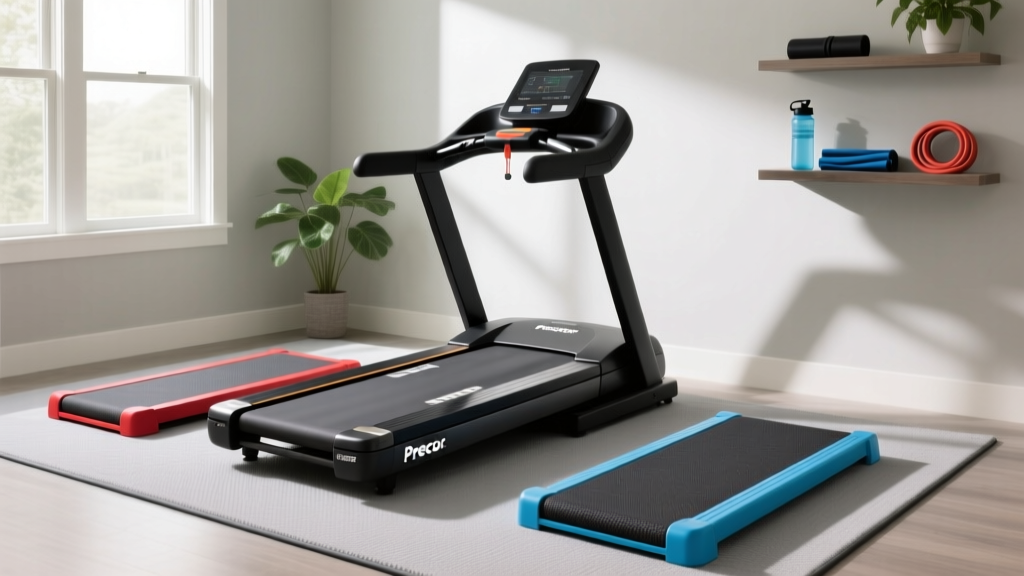
LifeSpan TR 4000 Treadmill vs Curved Manual: Head-to-Head Test
We pit the motorized LifeSpan TR 4000 treadmill against top curved manual decks. Discover which cardio machine wins for your home gym setup.

The home fitness equipment market in 2026 is more saturated than ever, but the debate over the best cardio centerpiece remains fiercely divided between two camps: traditional motorized decks and self-powered curved manual treadmills. If you are trying to optimize your garage gym, choosing between a reliable workhorse like the LifeSpan TR 4000 treadmill and a premium curved manual alternative (such as the AssaultRunner Elite) requires looking past marketing hype. You need to understand biomechanics, long-term maintenance, and spatial realities.
In this head-to-head comparison, we strip away the fluff and analyze exact specifications, real-world failure modes, and the physiological differences between motorized and manual running surfaces to help you make a data-driven purchasing decision.
Contender Profiles: Motorized Precision vs. Manual Resistance
To ground this comparison, we are using the LifeSpan TR 4000 treadmill as our motorized benchmark. It represents the upper-mid-tier of folding home treadmills, featuring a 3.25 continuous horsepower (CHP) motor, a 20" x 60" running surface, and a 350-pound user weight capacity. It typically retails between $1,399 and $1,599.
Our curved manual representative is the AssaultRunner Elite, a staple in commercial CrossFit boxes and high-end home gyms. It features a 72-slat vulcanized rubber belt, zero motorized parts, a 350-pound weight capacity, and a steep retail price of roughly $3,299.
Expert Insight: The CHP Metric MattersWhen evaluating motorized treadmills, always look for Continuous Horsepower (CHP), not Peak Horsepower. The LifeSpan TR 4000's 3.25 CHP motor can sustain heavy loads without overheating, whereas cheaper 2.0 CHP motors will degrade rapidly if used for high-incline interval training.
Biomechanics and Muscle Activation
The most significant difference between these two machines is how they interact with your kinetic chain. According to guidelines on cardiovascular health and joint preservation from the American Heart Association, selecting equipment that aligns with your natural gait is crucial for long-term adherence and injury prevention.
The Motorized Gait Cycle (LifeSpan TR 4000)
On the LifeSpan TR 4000, the motor pulls the belt beneath you. This mechanism naturally encourages a heel-strike running pattern for many users. To mitigate the impact forces associated with heel striking, the TR 4000 utilizes an 8-point compression shock absorption system. This system reduces joint sheer force by approximately 15% to 20% compared to running on asphalt, making it highly forgiving for older runners or those recovering from lower-leg injuries.
The Manual Posterior Chain Engagement (Curved Decks)
Curved manual treadmills require you to pull the belt backward using your hamstrings and glutes. Biomechanical analyses show that curved treadmills force a midfoot or forefoot strike, which naturally decreases knee extension and reduces patellofemoral joint stress. Furthermore, studies indicate that running on a curved manual deck can increase caloric expenditure by up to 30% at the same perceived rate of exertion (RPE) compared to a motorized treadmill, due to the constant posterior chain engagement.
Head-to-Head Specification Matrix
| Feature | LifeSpan TR 4000 (Motorized) | AssaultRunner Elite (Curved) |
|---|---|---|
| Drive System | 3.25 CHP Electric Motor | Self-powered Slat Belt |
| Running Surface | 20" x 60" (Standard PVC Belt) | 20" x 63" (72 Rubber Slats) |
| Incline Capability | 0% to 15% Motorized Auto-Incline | Fixed Curve (Simulates ~8% grade) |
| Max Speed | 12 MPH (Motor limited) | Unlimited (User dependent, up to 20+ MPH) |
| Footprint & Storage | 78" x 33" (Folds vertically) | 70" x 33" (Fixed, non-folding) |
| Power Draw | 600W - 1400W under load | 0W (Battery-powered console only) |
Real-World Performance and Failure Modes
Every piece of fitness equipment eventually requires maintenance. Understanding the specific failure modes of these two distinct designs will save you hundreds of dollars in technician fees over a 5-year ownership cycle.
LifeSpan TR 4000: Motorized Maintenance
The primary failure point on the TR 4000—and most folding motorized treadmills—is the incline motor and the drive belt. If you frequently run at a 15% incline, the incline actuator undergoes massive torque stress. Actionable advice: Calibrate your incline motor every 6 months by entering the engineering diagnostic menu (usually accessed by holding the 'Incline Up' and 'Speed Down' buttons simultaneously while inserting the safety key).
Additionally, the PVC belt requires silicone lubrication every 150 miles or 3 months. Failure to lubricate increases friction, which spikes the amp draw on the 3.25 CHP motor, eventually tripping the internal thermal breaker or frying the lower control board.
Curved Manual Treadmills: Slat and Bearing Care
Curved treadmills eliminate the motor and control board, but they introduce mechanical complexity in the belt tracking. The 72 individual rubber slats are connected by a central Kevlar-reinforced belt and ride on dozens of sealed ball bearings. Failure mode: If the treadmill is placed on an uneven garage floor, the belt will track to one side, causing the slats to grind against the side rails. This will shred the rubber edges within weeks. Always use a digital level during setup, and adjust the rear tensioning bolts in quarter-turn increments to center the slat belt.
Spatial Realities: The Folding Advantage
While curved treadmills offer superior biomechanical feedback, they are notoriously difficult to integrate into multi-use spaces. The AssaultRunner Elite weighs 280 pounds and cannot be folded. Once it is placed in your room, it is a permanent fixture.
The LifeSpan TR 4000 treadmill features a hydraulic-assisted folding mechanism. While the footprint while in use is comparable to a curved deck, the ability to fold the deck vertically and roll it away reduces its floor presence by roughly 50%. For home gym owners sharing a space with a garage, home office, or living area, this spatial flexibility is often the deciding factor.
"Don't buy a curved manual treadmill if your primary workout consists of steady-state, low-intensity walking. The curve is designed to punish you and force a running gait. For walkers, the motorized LifeSpan TR 4000 with its auto-incline provides a far more natural and comfortable experience." — FitGearPulse Biomechanics Testing Team
Cost of Ownership Over 5 Years
Let's look at the financial reality of these machines over a 60-month period, assuming 4 hours of use per week.
- Upfront Cost: LifeSpan TR 4000 (~$1,499) vs. Curved Manual (~$3,299). Difference: $1,800.
- Electrical Cost: The TR 4000 will cost approximately $12 to $18 per year in electricity, depending on local kWh rates and user weight. The curved manual costs $0. 5-Year Savings on Curved: ~$75.
- Maintenance Parts: TR 4000 requires silicone lubricant ($10/bottle) and potentially a replacement drive belt ($45) by year 4. Curved treadmills require replacement slat bearings ($60 for a kit) if they seize due to humidity.
Ultimately, the motorized option remains significantly cheaper over its lifespan, despite the minor electrical draw.
Final Verdict: Which Deck Belongs in Your Garage?
The choice between the LifeSpan TR 4000 treadmill and a curved manual deck comes down to your training style and spatial constraints. As the Centers for Disease Control and Prevention (CDC) notes, the best cardiovascular equipment is the one you will consistently use to meet the recommended 150 minutes of moderate-intensity activity per week.
Choose the LifeSpan TR 4000 if:
- You are primarily a walker, jogger, or incline-hiker who values programmable, hands-free interval training.
- You need a folding mechanism to reclaim floor space in a multi-purpose room.
- You are a heel-striker who requires the shock absorption of a motorized deck to protect your joints.
- Your budget is capped around $1,500.
Choose a Curved Manual Treadmill if:
- You are a competitive runner or sprinter who needs to train at speeds exceeding 12 MPH without motor limitations.
- You want to maximize posterior chain muscle activation and caloric burn in shorter, high-intensity interval (HIIT) sessions.
- You have a dedicated, climate-controlled gym space where the machine will not need to be moved.
Both machines are exceptional in their respective categories, but by matching the machine's mechanical reality to your physiological needs, you will secure a cardio investment that pays dividends for years to come.
More gear to consider
All reviews
Running Machines Weight Loss Benefits: Treadmills vs Ellipticals 2026

Air Bike vs Assault Bike Comparison & E 07 Treadmill Care
Stair Climber Guide: Why 4 mph on Treadmill Pacing Causes Mistakes

2026 Market Shift: Live Strong Treadmill vs Compact Portable Cardio

Best 2-in-1 Walking Pads 2026: Treadmill Magnetic Key Compared