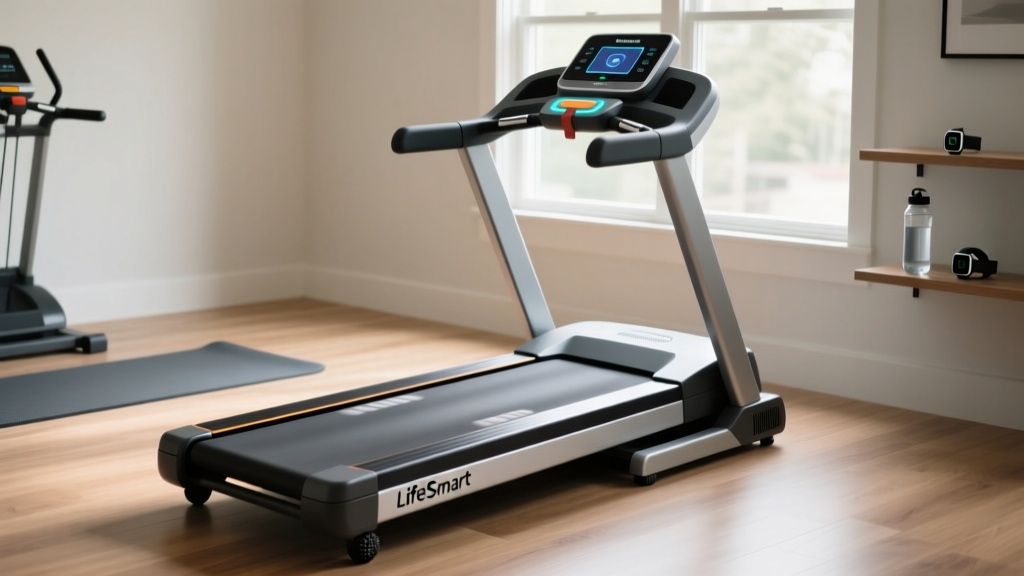
LifeSmart TM4500 PowerTouch Treadmill Review & Cardio Noise Fixes
Read our LifeSmart TM4500 PowerTouch treadmill review focusing on noise troubleshooting, decibel comparisons, and fixes for squeaky cardio machines.

Home gym equipment is an investment in your health, but nothing derails a workout faster than the rhythmic squeaking of a misaligned belt or the heavy thud of a poorly dampened motor. In this comprehensive LifeSmart TM4500 PowerTouch treadmill review, we are taking a highly specialized approach: analyzing the machine through the lens of acoustic output, common mechanical mistakes, and actionable troubleshooting.
As of 2026, the LifeSmart TM4500 remains a staple in the budget-to-mid-tier cardio market, frequently found in warehouse clubs and secondary marketplaces. However, like all motorized cardio equipment, its noise profile can degrade rapidly if maintenance is ignored. Below, we break down the TM4500’s acoustic baseline, compare it against other popular cardio machines, and provide a master troubleshooting guide to silence your home gym.
The Baseline: LifeSmart TM4500 PowerTouch Treadmill Review
The LifeSmart TM4500 PowerTouch is built around a 2.5 Continuous Horsepower (CHP) motor and a 20-inch by 55-inch running deck. While originally retailed around $699 in warehouse clubs, current 2026 inventory and secondary market pricing place the TM4500 between $550 and $800. For this price point, the PowerTouch console and folding mechanism offer solid value, but the acoustic engineering reflects its budget-tier origins.
Motor and Deck Acoustics
Out of the box, the TM4500 operates at approximately 68 to 72 decibels (dB) at a moderate walking pace (3.5 mph), climbing to roughly 76 dB during a 6.0 mph run. The primary noise generators are the motor cooling fan, the poly-v drive belt, and the impact of footfalls on the medium-density fiberboard (MDF) deck. The phenolic coating on the deck reduces initial friction, but without strict lubrication schedules, the coefficient of friction increases, forcing the 2.5 HP motor to draw more amperage and generate excess mechanical whine.
Expert Insight: The TM4500's motor hood is secured with standard Phillips-head screws that are prone to vibrating loose over 100+ miles of use. A loose hood creates a secondary resonance chamber, amplifying the motor's baseline hum by up to 4 dB.Cardio Machine Noise Level Comparison Matrix
To understand where the TM4500 sits in the broader home gym ecosystem, we must look at comparative acoustic data. Understanding the decibel scale is crucial here; because the scale is logarithmic, a 10 dB increase represents a sound that is perceived as twice as loud to the human ear.
| Machine Type | Average dB Range | Primary Noise Source | Vibration Transfer |
|---|---|---|---|
| Motorized Treadmills (e.g., TM4500) | 68 - 80 dB | Motor fan, belt friction, footfall impact | High (Low-frequency thud) |
| Magnetic Ellipticals | 50 - 60 dB | Drive wheel bearings, pedal arm joints | Low |
| Air Rowers (e.g., Concept2) | 65 - 75 dB | Flywheel wind displacement, chain rattle | Moderate |
| Air Bikes (e.g., Assault Bike) | 70 - 85 dB | Fan blades cutting air, belt drive | Low |
As the data illustrates, treadmills and air bikes occupy the highest acoustic tiers, but for entirely different reasons. Air bikes generate high-decibel wind shear, while treadmills like the TM4500 generate structural vibration that transfers through the floor joists, often annoying neighbors or family members in rooms directly below the gym.
3 Common Mistakes That Amplify Home Gym Noise
When conducting home gym audits, we consistently see users making the same critical errors that turn a quiet machine into a neighborhood nuisance. Proper biomechanics and equipment care, as emphasized by the American Council on Exercise, extend beyond the human body to the machines themselves.
Mistake 1: Using Petroleum-Based Lubricants
The most fatal error a TM4500 owner can make is applying WD-40 or petroleum-based oils to the running belt. These chemicals break down the phenolic coating on the MDF deck and degrade the rubber backing of the belt, leading to severe slipping, squealing, and eventual motor burnout.
⚠️ WARNING: Never use aerosol lubricants on your treadmill. Only use 100% silicone liquid or gel specifically formulated for fitness equipment. Apply exactly 1 oz (approx. 30ml) per side, directly to the center of the deck beneath the belt.Mistake 2: Relying on Cheap PVC Foam Mats
Many users place their TM4500 on thin, interlocking PVC foam puzzle mats. While these protect the floor from scratches, they do absolutely nothing to dampen low-frequency impact vibrations. The compressible nature of cheap foam actually allows the treadmill's leveling feet to bottom out during heavy footfalls, transferring the kinetic energy directly into the subfloor.
Mistake 3: Ignoring Belt Tension and Deflection
A belt that is too tight will whine and strain the motor bearings; a belt that is too loose will slip and slap. The correct tension allows you to lift the center of the belt exactly 2 to 3 inches off the deck. Anything outside this tolerance requires immediate adjustment via the rear roller hex bolts.
Step-by-Step Troubleshooting Guide for Squeaks and Rattles
If your LifeSmart TM4500 or similar cardio machine has developed an irritating noise, follow this systematic isolation process to identify and resolve the failure mode.
- The 'Walk and Listen' Isolation Test: Turn the machine on to 2.0 mph. Walk on it, then step off the side rails and let the belt run empty. If the noise stops when you step off, the issue is impact-related (deck, floor coupling, or loose shrouds). If the noise persists while empty, the issue is rotational (motor, drive belt, or rollers).
- Inspect the Poly-V Drive Belt: Unplug the machine and remove the motor hood. Locate the ribbed drive belt connecting the motor pulley to the front roller. Check for frayed edges, missing ribs, or a glazed appearance. A glazed belt will chirp upon startup. Clean it with a damp microfiber cloth or replace it (Part numbers vary, but universal 430J or 480J poly-v belts typically cost under $15 online).
- Check Roller Bearings: With the machine off, spin the front and rear rollers by hand. They should spin freely and silently. If you feel a 'gritty' resistance or hear a grinding sound, the sealed bearings are shot. Roller replacement kits for 2.5-inch diameter tubes generally range from $45 to $70.
- Torque the Frame Bolts: Upright frames vibrate. Use a socket wrench to check all bolts connecting the uprights to the base deck. Insert nylon lock washers or apply a drop of blue Loctite (threadlocker) to prevent future loosening.
"The vast majority of treadmill service calls we analyze are resolved not by replacing expensive electronic boards, but by spending ten minutes with a hex wrench and a bottle of silicone lubricant. Routine mechanical empathy is the secret to equipment longevity."
Expert Callout: When to Replace vs. Repair
Troubleshooting is cost-effective until it isn't. If your TM4500's motor is emitting a distinct burning odor alongside a high-pitched mechanical scream, the internal windings or the main drive board are likely failing. In 2026, a replacement 2.5 HP treadmill motor and compatible PWM (Pulse Width Modulation) controller board will cost between $180 and $260. If the machine is out of warranty and the total repair cost exceeds 50% of the $600 replacement value, it is financially wiser to retire the frame, salvage the console and side rails for parts, and upgrade to a newer commercial-light model with a sealed AC motor, which inherently runs quieter and cooler.
Frequently Asked Questions (FAQ)
How often should I lubricate the LifeSmart TM4500 belt?
For users logging under 10 miles per week, lubricate every 6 months. If you are running 15+ miles a week, or if the ambient temperature in your garage gym exceeds 80°F (which accelerates silicone evaporation), lubricate every 3 months.
Can I use a treadmill on the second floor of my house?
Yes, but you must mitigate structural vibration. Skip the foam mats and purchase a 3/8-inch thick vulcanized rubber mat (often sold as horse stall mats). Place a layer of cork underlayment beneath the rubber mat. This dual-density sandwich absorbs both the high-frequency motor hum and the low-frequency footfall thud before it reaches the floor joists.
Why does my elliptical squeak but my treadmill doesn't?
Ellipticals rely on a complex series of pivot points, crank arms, and rail wheels. Squeaks in ellipticals almost always originate from dry pivot bearings or polyurethane wheels rolling on a dirty aluminum track. Wipe the track with isopropyl alcohol and apply a dry PTFE (Teflon) spray to the wheel axles to eliminate the noise without attracting dust.
More gear to consider
All reviews
Space-Saving Cardio: ProForm Carbon XL Treadmill & Portable Options
NordicTrack Commercial 1750 Treadmill NTL17125: Folding Small Space Review
Compact Professional Treadmills: Small Space Folding Review 2026

Under Desk Treadmill Office Review & Benefits of the Treadmill Exercise

2026 Performance Treadmill Noise Comparison: Quietest Models
