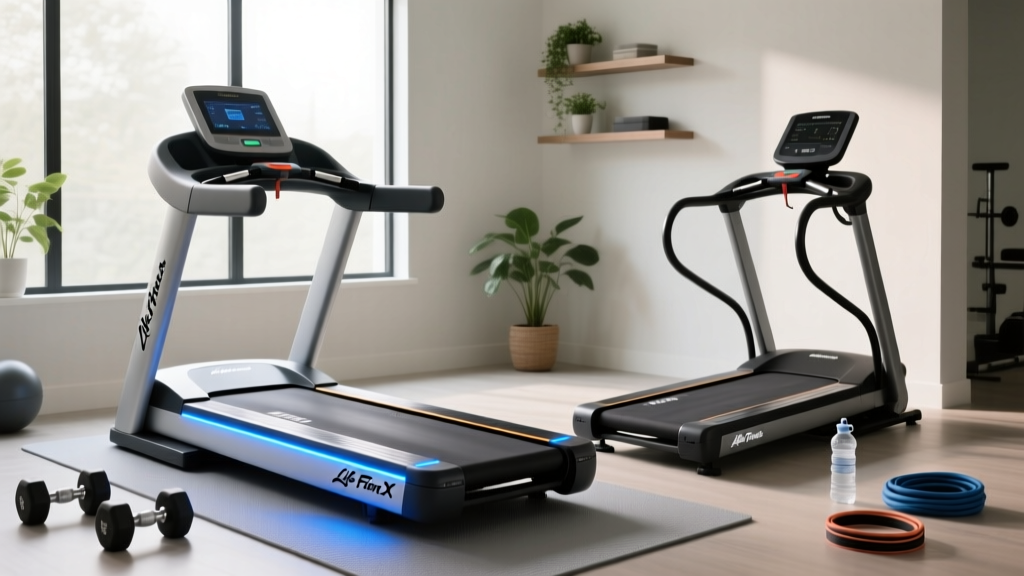
Life Fitness Run CX Treadmill vs Curved Manual: Beginner Guide
A beginner's step-by-step guide comparing the Life Fitness Run CX treadmill with curved manual models to help you build the perfect home gym.

The Great Cardio Debate: Motorized vs. Curved Manual
As of 2026, the premium home fitness market has split into two distinct philosophies: the ultra-smooth, tech-heavy motorized experience and the raw, user-powered biomechanics of curved manual treadmills. For beginners building a home gym, choosing between these two can be overwhelming. Do you invest in a commercial-grade motorized powerhouse like the Life Fitness Run CX treadmill, or do you opt for the self-paced, high-intensity nature of a curved non-motorized deck?
This step-by-step guide will walk you through the mechanical, financial, and physiological differences between these two cardio giants, ensuring you make an informed decision that aligns with your fitness goals, space constraints, and budget.
Beginner Callout: The Core DifferenceA motorized treadmill uses an electric motor to pull the belt beneath your feet, dictating your pace. A curved manual treadmill has no motor; its concave slat-belt design requires you to push the belt backward with your own foot strike, making you the engine.
Step 1: Understand the Core Mechanics
Before comparing specific models, you must understand how the underlying technology dictates your workout.
The Motorized Benchmark: Life Fitness Run CX
The Life Fitness Run CX Club Series is a staple in commercial gyms and luxury home setups. It features a 4.0 HP AC motor, which provides continuous, quiet power even at top speeds of 14 mph. The belt is driven by a roller system, and the machine utilizes the patented FlexDeck shock absorption system, which reduces joint stress by up to 30% compared to outdoor running. Because the motor sets the pace, it is ideal for beginners who need external pacing to maintain steady-state cardio zones.
The Curved Manual Alternative
Curved treadmills, like the popular AssaultRunner Elite or Technogym Skillmill, rely on gravity and friction. The running surface is made of 30 to 32 individual vulcanized rubber slats. To move the belt, you must strike the front curve of the deck, pushing it down and back. According to research highlighted by the American College of Sports Medicine, this self-propelled mechanics forces greater activation of the posterior chain (hamstrings and glutes) and naturally encourages a mid-foot or forefoot strike, reducing heel-strike impact forces.
Step 2: Compare the Benchmarks (Data Matrix)
Let's look at the hard numbers. Below is a direct comparison between the motorized Life Fitness Run CX and a premium curved manual alternative (using the AssaultRunner Elite as the curved benchmark).
| Feature | Life Fitness Run CX (Motorized) | AssaultRunner Elite (Curved Manual) |
|---|---|---|
| Average 2026 Price | $8,499 - $9,200 | $3,299 - $3,500 |
| Power Source | 4.0 HP AC Motor (Requires 20-Amp Outlet) | 100% User-Powered (No outlet needed) |
| Running Surface | 22" x 60" Continuous PVC Belt | 17" x 63" 32-Slat Vulcanized Rubber |
| Max Speed | 14.0 mph (Motor limited) | Unlimited (Dictated by user capability) |
| Machine Weight | ~354 lbs | ~280 lbs |
| Tech & Console | 16" HD Touchscreen, App Integration, TV | Basic LCD (Speed, Watts, Time, Calories) |
Step 3: Evaluate Space, Power, and Installation
Beginners often overlook the logistical requirements of heavy cardio equipment. Your room's infrastructure will heavily influence your choice.
- Electrical Requirements: The Life Fitness Run CX treadmill requires a dedicated 20-amp electrical circuit. Plugging a 4.0 HP motor into a standard 15-amp shared household circuit risks tripping the breaker or damaging the motor control board (MCB). Curved manual treadmills require zero electricity, giving you total freedom to place them in garages, basements, or off-grid spaces.
- Footprint and Clearance: The Run CX measures roughly 83" L x 35" W. You must leave at least 24 inches of clearance on all sides, and crucially, 6 feet of clear space behind the machine to prevent injury in case of a fall. Curved treadmills have a similar length but lack the extended motor hood at the front, slightly altering the spatial geometry.
- Floor Load: Both machines exceed 250 lbs before a user even steps on. If installing on a second-floor wooden subfloor, ensure your joists can handle the dynamic load of a 200 lb runner bouncing at 8 mph.
Step 4: Match the Machine to Your Biomechanics
How you run dictates what you should buy. The American Council on Exercise frequently notes that equipment selection should mirror your primary training modality.
Choose the Motorized Run CX If:
- You Train for Marathons or Long-Distance: Motorized treadmills allow you to set a precise pace (e.g., 8.5 mph) and zone out. The mental fatigue of manually sustaining a pace on a curved treadmill makes it poor for 90-minute steady-state runs.
- You Require Incline Training: The Run CX offers powered incline up to 15%. Most curved manual treadmills are fixed at a single concave angle and cannot simulate hill climbs.
- You Need Joint Forgiveness: The FlexDeck system on the Life Fitness model physically absorbs impact, which is vital for beginners with knee sensitivities or those recovering from lower-leg injuries.
Choose a Curved Manual Treadmill If:
- You Focus on HIIT and Sprints: Curved treadmills have zero acceleration or deceleration lag. You can go from 0 to 15 mph in two strides, and stop instantly by shifting your weight backward. This makes them the undisputed kings of Tabata and sprint interval training.
- You Want to Fix Your Running Form: The curved deck physically prevents over-striding. If you try to heel-strike on the front curve, the belt will not move efficiently. It forces a natural, biomechanically sound mid-foot strike.
- You Want Higher Caloric Expenditure: Studies show that running on a non-motorized curved treadmill requires up to 30% more oxygen and burns significantly more calories per minute than a motorized treadmill at the exact same perceived pace, due to the lack of motor assistance.
Step 5: Calculate Long-Term Ownership Costs
The upfront price tag is only half the equation. Maintenance and failure modes differ wildly between these two categories.
Warning: The Hidden Cost of Motorized TreadmillsThe most common catastrophic failure on high-end motorized treadmills like the Run CX is the Motor Control Board (MCB) or the drive motor itself, usually occurring between years 7 and 10 if the belt is not properly lubricated. An out-of-warranty MCB replacement can cost between $400 and $650, plus labor. Furthermore, the continuous PVC belt requires silicone lubrication every 3 to 6 months to prevent excess friction from frying the electronics.
Curved Treadmill Maintenance: Curved treadmills eliminate the MCB and motor entirely. However, the 32-slat urethane belt requires periodic tightening as the rubber stretches over the first year. The individual slat bearings may also require replacement after 5 to 7 years of heavy use, though this is a modular, relatively inexpensive fix compared to a motorized drive system.
Step 6: The Beginner’s Transition Protocol for Curved Treadmills
If you decide to take the manual route, do not just jump on and sprint. The learning curve is steep. Follow this step-by-step acclimation protocol:
- The Posture Check (Minutes 1-2): Step onto the curve. Do not bend at the waist. Lean forward slightly from your ankles, keeping your core tight and chest up. Hold the side handles lightly for balance, not to support your body weight.
- The Walking Phase (Minutes 3-5): Begin walking. Focus on pushing the belt down and back with the ball of your foot. You will notice that if you drift too far back on the flat part of the curve, the belt stops. You must stay on the front third of the incline to maintain momentum.
- The Braking Drill (Minutes 6-8): Before you run, you must learn to stop. To brake on a curved treadmill, shift your center of mass backward, behind your feet, and take shorter, choppier steps. Never try to stop by grabbing the handrails while your legs are still moving at speed.
- Interval Integration (Minutes 9-15): Alternate between 30 seconds of light jogging on the curve and 30 seconds of walking on the flat back section. This builds the specific hamstring endurance required for manual propulsion.
Frequently Asked Questions
Can beginners safely use the Life Fitness Run CX treadmill at home?
Yes. The Run CX features a 22-inch wide belt, which is significantly wider than standard budget home treadmills (usually 18-20 inches). This extra width provides a massive margin of error for beginners who may drift side-to-side. Additionally, the heavy 354 lb frame prevents the machine from shaking or wobbling at higher speeds, instilling confidence in new runners.
Are curved manual treadmills too difficult for older adults or rehab patients?
Generally, yes. Because the user must overcome the static friction of the heavy slat belt to initiate movement, the initial push requires significant lower-body force. For elderly users or those in early-stage joint rehabilitation, a motorized treadmill with a low starting speed (0.5 mph) and shock absorption is a much safer, more controlled environment. Always consult physical therapy guidelines from authorities like the Life Fitness biomechanics team or your local physiotherapist before starting a new cardio regimen.
Which machine holds its resale value better?
Commercial-grade motorized treadmills like the Life Fitness Run CX tend to hold exceptional resale value, often retaining 40% to 50% of their MSRP after five years if maintenance logs are kept. Curved treadmills also hold value well, but the market is smaller, meaning you may have to wait longer to find a local buyer willing to transport a 280 lb non-folding machine.
More gear to consider
All reviews
Why Does Getting Off a Treadmill Feel Weird? Air vs Assault Bike Layouts

NordicTrack Treadmill Parts Diagram & 2026 Under Desk Office Trends

Rowing Machine Guide: Technique & ProForm Treadmill 540 Comparison

Rowing Technique & Buying Guide vs Lifestyler Expanse 600 Treadmill

Side by Side Treadmill Feature Comparison & Buying Mistakes
