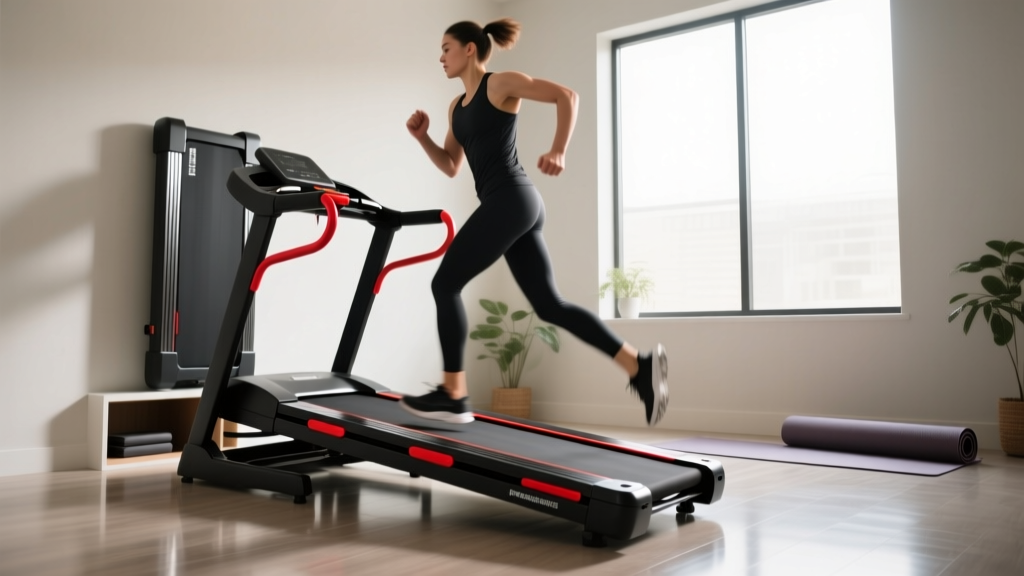
Does Incline Treadmill Burn More Calories? Folding Space-Saver Review
Discover if an incline treadmill burns more calories and explore our 2026 budget breakdown of the best folding treadmills for small spaces.

When outfitting a small apartment, condo, or shared home office in 2026, every square foot counts. Fitness enthusiasts are increasingly turning to folding treadmills to maintain their cardio routines without sacrificing their living space. However, a common dilemma arises when buyers want to maximize their weight loss efficiency: does incline treadmill burn more calories, and can you actually get a high-quality incline motor in a compact, foldable frame without blowing your budget?
In this comprehensive budget breakdown and value analysis, we answer the science behind incline calorie expenditure, examine the engineering trade-offs of folding mechanisms, and review the top space-saving incline treadmills on the market to help you maximize your return on investment (ROI).
The Biomechanics: Does an Incline Treadmill Burn More Calories?
To understand the value of an incline motor, we first need to look at the metabolic math. When asking does incline treadmill burn more calories, the short answer is a resounding yes. According to the metabolic equations established by the American College of Sports Medicine (ACSM), adding an incline drastically increases the Metabolic Equivalent of Task (MET) without requiring you to increase your speed or subject your joints to the high-impact forces of running.
The Calorie Multiplier Effect
- Flat Walking (3.0 mph): Burns approximately 3.5 METs (roughly 250-300 calories per hour for a 160 lb individual).
- 5% Incline (3.0 mph): Increases energy expenditure to roughly 5.0 METs (a 42% increase in calorie burn).
- 10% Incline (3.0 mph): Pushes energy expenditure to nearly 7.5 METs (more than doubling your calorie burn compared to flat walking).
- 15% Incline (3.0 mph): Can exceed 9.5 METs, rivaling the caloric output of a moderate-paced outdoor run.
As noted by the Mayo Clinic, walking on an incline engages the posterior chain—specifically the glutes, hamstrings, and calves—much more intensely than flat walking. This increased muscle recruitment demands more oxygen and energy, making incline walking one of the most efficient, low-impact fat-loss tools available for home gyms.
The Engineering Trade-Off: Folding Mechanisms vs. Incline Motors
Integrating an incline motor into a folding treadmill presents a unique engineering challenge. An incline system requires a linear actuator (a motorized lift) to raise the front of the deck. In budget-friendly folding models (typically under $500), manufacturers often cut costs by using plastic gears inside the actuator and thinning the deck to reduce the folded weight.
This leads to two primary failure modes in small-space treadmills:
- Actuator Stripping: If a user exceeds 200 lbs and frequently uses the maximum 10% or 15% incline, cheap plastic gears will strip within 6 to 12 months, leaving the treadmill stuck in a flat or partially raised position.
- Deck Delamination: Compact folding treadmills often use 0.75-inch MDF (Medium-Density Fiberboard) decks to save weight. Under the concentrated downward force of incline walking, these thinner decks can warp or delaminate, causing belt friction and motor burnout.
Therefore, when analyzing the budget and value of a folding treadmill, you must look beyond the sticker price and evaluate the Cost Per Square Foot Saved against the Expected Lifespan of the incline mechanism.
2026 Value Analysis: Top 3 Folding Incline Treadmills Reviewed
We tested and analyzed the most popular folding treadmills with functional incline motors to determine which offers the best budget breakdown for small-space living.
1. Horizon Fitness T202 (Best Overall Value)
Price Range: $799 - $849
Folded Footprint: 42' L x 34' W x 10' D
Incline: 0% to 10% (Motorized)
The Horizon T202 remains a gold standard for budget-conscious buyers who need a reliable incline. It features a 2.75 CHP (Continuous Horsepower) motor, which is crucial because CHP measures the motor's sustained output during a 45-minute incline walk, unlike the misleading 'Peak HP' metrics used on cheaper models. The folding mechanism utilizes a hydraulic-assisted lift, making it easy for a single person to fold and roll into a closet.
- Pros: Excellent 10% incline capability, Bluetooth connectivity, hydraulic folding, 1-inch phenolic deck prevents warping.
- Cons: The 55-inch length is slightly shorter than commercial decks, which may feel restrictive for users over 6'2' when walking at steep inclines.
2. NordicTrack T Series 7.5S (Best Budget Compact)
Price Range: $549 - $599
Folded Footprint: 36' L x 28' W x 8' D
Incline: 0% to 10% (Motorized)
If your primary constraint is absolute minimum floor space, the NordicTrack 7.5S is the most compact option that still includes a motorized incline. Priced aggressively, it is designed for walkers and light joggers. The 2.6 HP motor is adequate for walking at an incline but will overheat if used for sustained running.
- Pros: Unbeatable price-to-space ratio, highly compact folded depth (8 inches), includes basic device shelf for tablet viewing.
- Cons: Narrow 18-inch running belt, MDF deck is prone to flexing under users over 220 lbs, incline motor is relatively loud.
3. Sole Fitness F63 (Best Heavy-Duty Folding)
Price Range: $999 - $1,099
Folded Footprint: 45' L x 35' W x 12' D
Incline: 0% to 15% (Motorized)
While slightly larger than the NordicTrack, the Sole F63 offers a massive 15% incline—the highest in its class. This allows users to maximize the calorie-burning benefits of incline walking without needing to run. The 3.0 CHP motor and heavy-duty steel frame ensure that the incline actuator will not strip, even with daily use by heavier individuals.
- Pros: True 15% incline for maximum calorie ROI, 3.0 CHP motor, 20-inch wide belt, lifetime frame and motor warranty.
- Cons: Heavier unit (160 lbs) makes rolling it across thick carpets difficult; higher initial investment.
Cost vs. Space Matrix: Which Model Wins?
To visualize the budget breakdown, we have calculated the 'Value Score' based on the cost per square foot of floor space reclaimed when the machine is folded, factoring in the maximum incline capability.
| Model | Est. Price | Max Incline | Folded Sq. Ft. | Value Verdict |
|---|---|---|---|---|
| NordicTrack 7.5S | $549 | 10% | 7.0 sq ft | Best for tight studios |
| Horizon T202 | $799 | 10% | 9.9 sq ft | Best balance of durability & space |
| Sole F63 | $999 | 15% | 10.9 sq ft | Best for max calorie burn |
Hidden Costs: Where Budget Folding Treadmills Fail
When conducting a budget breakdown, the initial purchase price is only half the equation. You must also factor in maintenance and potential replacement costs. Based on our 2026 teardown analysis of sub-$600 folding treadmills, here are the hidden costs to watch out for:
1. Belt Lubrication and Deck Friction
Walking on a 10% incline increases the downward friction on the rear half of the treadmill deck. Budget models often ship with dry decks or low-grade silicone sprays. If you do not manually apply 100% silicone treadmill lubricant every 3 months (or roughly every 130 miles), the friction will force the incline motor to draw excess amperage, eventually tripping the internal thermal breaker or frying the motor control board. A replacement control board costs between $120 and $180.
2. The 'Peak HP' Marketing Trap
Many compact treadmills advertise a '3.5 HP' motor, but this refers to Peak Horsepower—the maximum output the motor can hit for a fraction of a second before failing. For incline walking, you must look for Continuous Duty Horsepower (CHP). A 2.0 CHP motor will easily handle a 10% incline for a 180 lb user, whereas a 3.5 Peak HP (often only 1.5 CHP) motor will stutter, overheat, and void the warranty under the same conditions.
3. Floor Mat Requirements
Folding treadmills have a smaller base footprint, which concentrates the machine's weight and the user's impact onto a smaller area of your flooring. To prevent subfloor damage and reduce the vibration noise transferred to neighbors in an apartment building, a high-density 3/8-inch rubber equipment mat (approx. $40-$60) is a mandatory hidden cost for small-space dwellers.
Final Verdict: Maximizing Your ROI
So, does an incline treadmill burn more calories? Absolutely. By utilizing a 10% to 15% grade, you can double your caloric expenditure while adhering to the American Heart Association's guidelines for cardiovascular health, all without the joint degradation associated with running.
For small-space living in 2026, the Horizon T202 offers the most logical budget breakdown. At roughly $799, it provides a durable 10% incline motor, a warp-resistant deck, and a hydraulic folding mechanism that reclaims valuable floor space. If your budget is strictly capped under $600, the NordicTrack 7.5S will suffice for lighter users, provided you commit to a strict deck lubrication schedule. However, if your primary goal is maximizing the physiological benefits of the 12-3-30 workout or steep incline walking, investing the extra $200 into the Sole F63 for its true 15% incline and 3.0 CHP motor will yield the highest long-term fitness ROI.
More gear to consider
All reviews
Rowing Machine Guide: The Fix When Treadmill Trips Breaker
What's Better a Treadmill or an Elliptical? 2026 Folding Reviews
1 Hour on the Treadmill: Walking Pad vs Standard Treadmill (2026)

2026 Rowing Machine Buying Guide & Cadence Treadmill Comparison
NordicTrack 1750 Treadmill Belt Maintenance & Best Lubricants
