Home Stair Climbers 2026: Matching a 9 Min Pace on Treadmill
Discover the best home stair climbers in 2026. We compare top models and show how to match the cardio output of a 9 min pace on treadmill.

For cardiovascular purists, maintaining a 9 min pace on treadmill (approximately 6.6 miles per hour) is a gold-standard benchmark. It sits perfectly in the vigorous aerobic zone, demanding a VO2 max output that torches calories and builds endurance without crossing into unsustainable anaerobic sprinting. However, the repetitive ground-reaction forces of running—often reaching 2.5 times your body weight per stride—frequently lead to tibial stress syndrome, plantar fasciitis, or runner's knee.
In 2026, the home fitness market has pivoted heavily toward low-impact, high-yield alternatives. The modern home stair climber has evolved from clunky hydraulic mini-steppers into sophisticated, biomechanically tuned cardiovascular engines. But can stepping vertically truly replicate the metabolic and muscular demands of a 6.6 mph run? In this head-to-head guide, we dissect the physiology of the 9-minute mile and compare the top three home stair climbers capable of matching—or exceeding—that exact workload.
The Metabolic Benchmark: What a 9 Min Pace on Treadmill Demands
To accurately compare equipment, we must first quantify the target. According to the Compendium of Physical Activities, running at 6.5 to 6.8 mph carries a Metabolic Equivalent of Task (MET) value of roughly 10.5 to 11.0. For a 165-pound (75 kg) individual, sustaining a 9 min pace on treadmill for 30 minutes burns approximately 400 to 430 calories.
📊 The 9-Minute Pace Data Profile:- Speed: 6.66 mph (10.7 km/h)
- Cadence: ~155-160 steps per minute
- Joint Impact: High (2.5x body weight per foot strike)
- Primary Movers: Calves, hamstrings, quadriceps, hip flexors
- Target MET: 10.5 - 11.0
To match this on a stair climber, the user must generate a MET output of 10.5 without the assistance of forward momentum. Because stair climbing eliminates the 'flight phase' of running, the muscular time-under-tension is significantly higher, shifting the burden heavily onto the gluteus maximus and quadriceps.
Head-to-Head: Top 3 Home Stair Climbers to Replicate Treadmill Intensity
Not all steppers are created equal. A standard budget mini-stepper will struggle to provide the resistance required to push your heart rate into the 10.5 MET zone without causing premature localized muscle failure (the 'burn' in your quads) before your cardiovascular system peaks. Here is how the top-tier home models stack up for serious endurance athletes.
1. The Premium Hybrid: Bowflex Max Trainer M9
MSRP: $2,299 | Footprint: 49' L x 30.5' W | Max Weight: 300 lbs
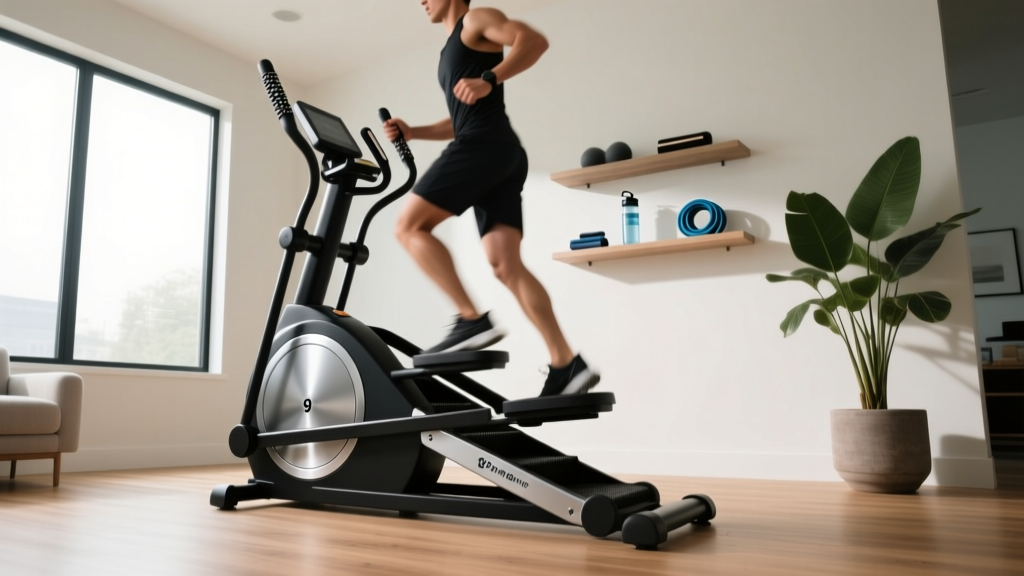
The Bowflex M9 is technically a hybrid elliptical-stair climber, utilizing a proprietary dual-rail system that forces a steep, vertical stepping motion rather than a flat gliding stride. To match a 9 min pace on treadmill, users typically operate the M9 at resistance levels 12-14, utilizing the moving handlebars to engage the latissimus dorsi and biceps. This upper-body recruitment is the metabolic 'cheat code' to matching treadmill calorie burn: by distributing the workload across the upper and lower body, you can sustain a 30-minute vigorous session without your legs giving out prematurely.
2. The Luxury Standard: StairMaster FreeClimber
MSRP: $5,499 | Footprint: 53' L x 31' W | Max Weight: 350 lbs
If budget and space allow, the StairMaster FreeClimber remains the undisputed king of vertical cardio. Unlike older chain-driven models, the 2026 FreeClimber uses independent pedal movement and a whisper-quiet alternator resistance system. To replicate the 10.5 MET demand of a 6.6 mph run, users should set the machine to Level 9 or 10, maintaining a cadence of 70-80 steps per minute. The 6-inch step height perfectly mimics standard architectural stairs, providing unparalleled glute activation that a flat treadmill belt simply cannot achieve without a 10%+ incline.
3. The Space-Saver: Sunny Health & Fitness SF-S900205W Mini Stepper
MSRP: $89.99 | Footprint: 16' L x 13' W | Max Weight: 220 lbs
Can a budget hydraulic stepper match a vigorous run? Yes, but with caveats. The SF-S900205W relies on dual hydraulic cylinders. Because the stride length is fixed and short (roughly 3.5 inches of vertical travel), matching the cardiovascular output of a 9 min pace on treadmill requires an exceptionally high cadence and the inclusion of the attached resistance bands. You will need to perform continuous overhead presses or bicep curls while stepping at 100+ steps per minute to elevate your heart rate into the equivalent zone. It is highly effective for HIIT intervals, but difficult to sustain for a steady-state 45-minute run equivalent.
Specification & Performance Matrix
| Feature | Bowflex Max M9 | StairMaster FreeClimber | Sunny SF-S900205W |
|---|---|---|---|
| Resistance Type | Magnetic / Eddy Current | Alternator / Generator | Hydraulic Cylinders |
| Stride/Step Height | Variable (up to 9') | Fixed (6') | Fixed (3.5') |
| MET Matching Strategy | High Res + Upper Body | High Cadence (Level 9-10) | Max Cadence + Bands |
| Best For | HIIT & Full Body Burn | Steady-State Endurance | Budget / Small Spaces |
Protocol Translation: Treadmill vs. Stair Climber Workouts
Transitioning from the treadmill to the stair climber requires a mental and physical shift. On a treadmill, the belt pulls your foot back, utilizing the stretch-shortening cycle of your Achilles tendon to recycle energy. On a stair climber, you must lift your entire body mass against gravity with every single repetition. Here is a step-by-step framework to translate your favorite treadmill run to the climber.
- The Warm-Up (Minutes 0-5): Start at Level 3-4. Do not grip the handrails tightly. Mayo Clinic guidelines emphasize that leaning on the rails reduces caloric expenditure by up to 20% and compromises lumbar posture. Keep a 'ghost grip' for balance only.
- The Steady-State Climb (Minutes 5-25): Increase resistance to Level 8 (StairMaster) or Level 12 (Bowflex). Your target cadence should be 70-85 steps per minute. This is the direct metabolic equivalent to holding a 9 min pace on treadmill. Your heart rate should sit in Zone 3 or low Zone 4 (75-85% of max HR).
- The Finisher (Minutes 25-30): To replicate the end-of-run kick, drop the resistance to Level 5 but increase your cadence to 100+ steps per minute. Focus on shallow, rapid steps to flush lactic acid and spike the heart rate one final time.
Biomechanics and Joint Preservation
Why make the switch if you already own a high-end treadmill? The answer lies in ground reaction forces (GRF). According to data published by Harvard Health Publishing, vigorous stair stepping burns a comparable amount of calories to running at a 10-minute mile pace, but with a fraction of the joint degradation.
'When you run at a 9-minute pace, your knee joint absorbs an impact force equivalent to roughly 2.5 to 3 times your body weight. On a stair climber, because your foot never leaves the pedal and there is no downward strike, the impact force is virtually zero. You are trading impact for muscular endurance, which is vastly superior for longevity and joint preservation.' — Biomechanics & Sports Physiotherapy Consensus
Furthermore, the stair climber forces continuous hip extension. A 9 min pace on treadmill relies heavily on the hamstrings and calves for propulsion, whereas the stair climber demands massive output from the gluteus maximus. For athletes looking to build posterior chain strength while maintaining elite cardiovascular conditioning, the climber is the superior tool.
Frequently Asked Questions
Will a stair climber make my legs bulky?
No. Matching a 9 min pace on treadmill requires sustained, low-resistance, high-repetition stepping. This builds Type I (slow-twitch) endurance muscle fibers, resulting in lean, toned legs rather than the hypertrophy (bulk) associated with heavy, low-rep weightlifting.
How do I prevent lower back pain on the climber?
Lower back pain usually stems from 'hanging' on the handrails, which shifts the pelvis into an anterior tilt and compresses the lumbar spine. Stand completely upright, engage your core, and swing your arms naturally or use the moving handles on hybrid models like the Bowflex M9.
Is the calorie counter on the machine accurate?
Machine calorie counters are notoriously optimistic, often overestimating burn by 15-20%. To get a true reading of your 10.5 MET workout, use a chest-strap heart rate monitor synced to your smartwatch, which calculates expenditure based on your actual cardiac output rather than a generic algorithm.
More gear to consider
All reviews
What's Better, StairMaster or Incline Treadmill? Motor & Setup Guide
Escaping the Hedonistic Treadmill: Motor Size & HP Guide
Rucking on a Treadmill: Best Folding Models for Small Spaces & Maintenance Guide

NordicTrack C900i Treadmill Pivot: Air Bike vs Assault Bike Comparison

Treadmill Motor HP Guide: How Long to Get 10k Steps on Treadmill
